Jeffrey Kaplan attempts the impossible: compressing a semester-long philosophy course into twenty-two minutes without losing the intellectual teeth of the arguments. The piece is not a mere summary; it is a high-speed demolition of our moral intuitions, forcing the listener to confront whether our daily choices are actually ethical or just convenient. Kaplan's most striking move is treating utilitarianism not as an abstract academic exercise, but as a radical lens that brands the average affluent person as "morally bad" for buying coffee instead of saving a life.
The Arithmetic of Pleasure
Kaplan begins by introducing Jeremy Bentham's utilitarianism, a theory that reduces morality to a simple calculation. "Utilitarianism says roughly we are morally required to do whatever produces the greatest total of pleasure minus pain," Kaplan explains. He highlights Bentham's controversial assertion that "prejudice apart the game of pushpin is of equal value with the arts of music and poetry if the game of pushpin furnish more pleasure it is more valuable than either." This flattening of human experience is the theory's strength and its fatal flaw. Kaplan notes that Bentham believed "it doesn't matter how fancy the pleasure is... all pleasure counts the same." The author effectively uses this to show how the theory strips away cultural hierarchy, but he quickly pivots to why this arithmetic fails to capture the human condition.
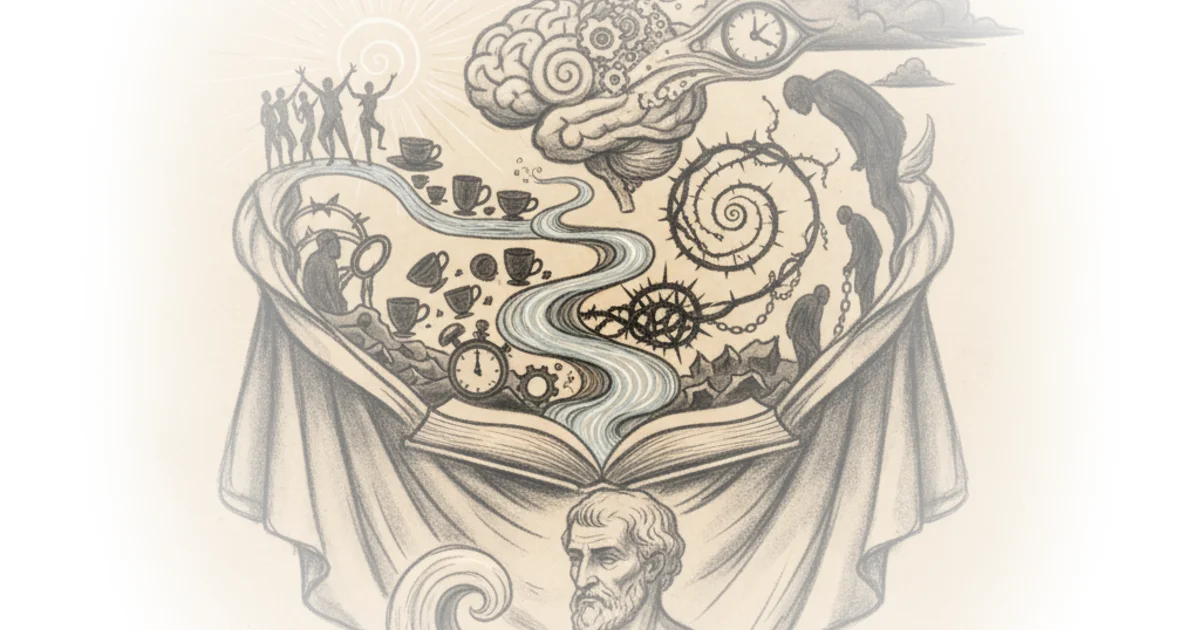
To dismantle the idea that pleasure is the only metric that matters, Kaplan introduces Robert Nozick's "experience machine" thought experiment. He describes a scenario where super-duper neuropsychologists could stimulate your brain to feel like you are writing a great novel or making a friend, all while you float in a tank. "Nozick thinks that most people would not agree to be plugged into a machine like this for their entire life," Kaplan writes. The implication is profound: if we reject the machine, we admit that "there must be something that matters to us... other than pleasure." Kaplan argues that we value "controlling your life," "actual friendship," and "actually doing things" over the mere illusion of those experiences. This is a crucial pivot; it suggests that morality cannot be reduced to a feeling, but must involve reality and agency.
The idea that the main things that matter morally to human beings are pleasure and pain is a mistake that utilitarianism is built on.
The Radical Demands of Charity
The commentary shifts to the most provocative section: Peter Singer's 1972 paper, "Famine, Affluence, and Morality." Kaplan does not soften Singer's blow. "Everyone that you've ever met is a morally bad person," Kaplan states, summarizing Singer's claim that we are obliged to give away our luxuries to save lives. He uses Singer's famous "shallow pond" analogy to drive the point home: if you see a child drowning and refuse to save them because you don't want to ruin your shoes, you are a monster. Kaplan writes, "Saving the child in the shallow pond is not some extra nice thing... saving the child in the shallow pond is the bare minimum morally speaking." He then applies this to the modern world, arguing that buying coffee or a new car is morally identical to letting a child starve because of distance. "Singer thinks that your situation in which you can give to famine relief is morally identical with the situation in which a person walks past the shallow pond," Kaplan asserts. This is a devastating argument that removes the comfort of "charity" and replaces it with the obligation of justice.
Critics might note that this level of moral demand is psychologically unsustainable and could lead to burnout rather than action. However, Kaplan presents Singer's logic as airtight, noting that proximity and the presence of other bystanders do not absolve the individual of responsibility. "The fact that there are other people who could help but who don't just doesn't seem relevant," Kaplan explains, dismantling the common excuse of diffusion of responsibility.
The Sheriff's Dilemma
Before moving to Kant, Kaplan returns to the weaknesses of utilitarianism with a chilling counter-example from H.J. McCloskey. He describes a scenario where a sheriff must frame an innocent person to stop a riot that would kill hundreds. "According to utilitarianism what is the sheriff supposed to do? It's pretty simple... you just add up all the pleasure and pain," Kaplan says. The math suggests framing the innocent man is the right thing to do. "McCloskey thinks that this isn't right like it's just obvious that it's wrong for the sheriff to frame an innocent person," Kaplan notes. This exposes the theory's inability to protect individual rights against the "arithmetic of morality." Kaplan uses this to show that a system based solely on outcomes can justify horrific injustices if the numbers add up.
Kaplan also touches on Bentham's surprising defense of gay rights in an unpublished essay, noting that "upon the principle of utility I can find none" to justify punishing consensual acts. This historical footnote adds depth, showing that utilitarianism can be a force for liberation even when it fails in other areas. However, the tension remains: if the theory can justify framing the innocent, can we truly trust it as a moral compass?
Bottom Line
Jeffrey Kaplan's condensed course succeeds by refusing to let the listener off the hook with easy answers. The strongest part of the argument is the relentless application of the "shallow pond" logic to modern consumerism, forcing a confrontation with the cost of our comfort. Its biggest vulnerability is the potential for moral paralysis; if every luxury purchase is a sin, the system may collapse under the weight of its own demands. The reader should watch for how Kant's deontology attempts to solve the "sheriff's dilemma" that utilitarianism cannot, offering a rule-based alternative to the arithmetic of pain and pleasure.