Dave Borlace delivers a sobering reality check: the sheer velocity of global urbanization threatens to derail climate goals before we even begin, yet the same density offers our only viable path to decarbonization. The piece distinguishes itself by moving beyond abstract emissions targets to examine the gritty mechanics of retrofitting existing cities and building new ones from the ground up, arguing that the next fifty years of human civilization hinge on our ability to engineer urban environments that are not just habitable, but regenerative.
The Urban Tipping Point
Borlace opens with a staggering statistic from the United Nations that reframes the climate crisis as an urban planning emergency. "According to the United Nations there'll be about 70 million new people moving into cities every single year between now and the mid part of this century," he notes, highlighting that this migration alone could generate nearly 230 billion extra tons of carbon dioxide if current consumption patterns persist. This framing is crucial because it shifts the narrative from individual lifestyle choices to systemic infrastructure failure. The author argues that without a radical transformation, the goal of limiting warming to 1.5 degrees Celsius becomes mathematically impossible.
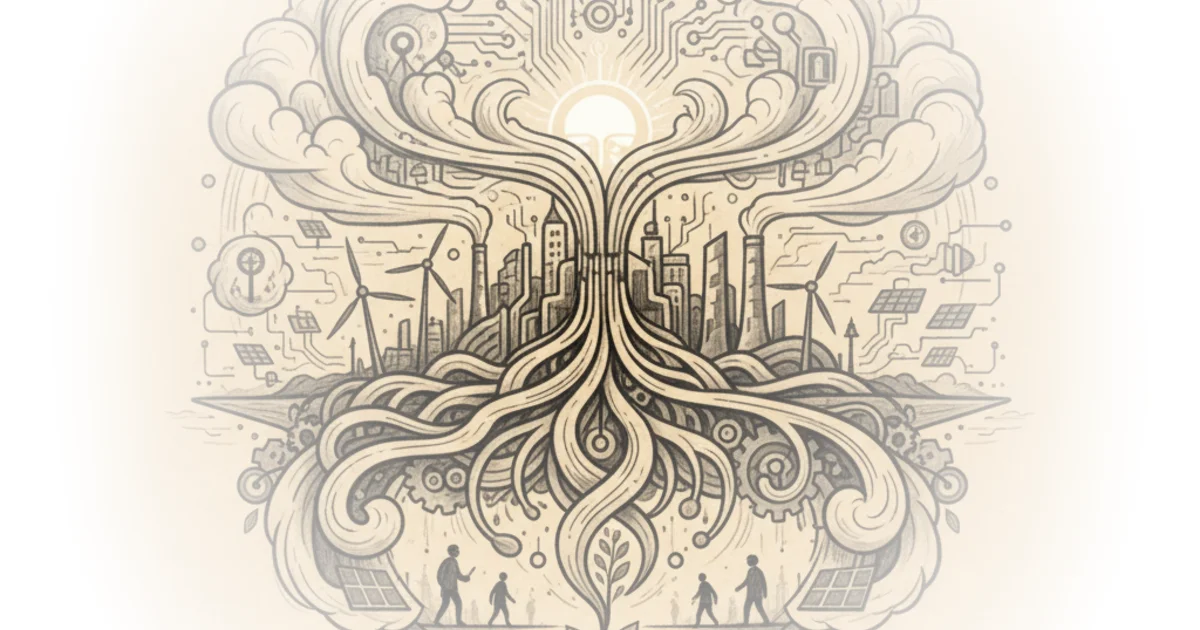
The commentary effectively warns that cities are not just victims of climate change but potential accelerants if left unmanaged. Borlace writes, "Cities are also places in which the risks associated with warming such as heat stress, terrestrial and coastal flooding, new disease vectors, air pollution and water scarcity will coalesce." This observation lands with particular force because it connects disparate climate threats into a single, compounding urban risk profile. The argument suggests that adaptation cannot be an afterthought; it must be the foundational design principle of the 21st-century city.
Critics might note that the sheer scale of the required transformation—retrofitting 5% of all existing buildings in OECD countries annually—seems politically and economically improbable without a global emergency mobilization. However, Borlace counters this by pointing to the cost-effectiveness of low-urban environments, which offer job creation and gender equality alongside carbon reduction.
If we can't achieve that, we can wave bye-bye to any hope at all of keeping the global temperature rises to within 2 degrees Celsius.
Reimagining the Built Environment
The piece pivots to specific architectural and material solutions, moving from the problem to the toolkit. Borlace highlights the work of visionary architects like Richard Hassell and Stefan Lehman, who are proving that buildings can be net energy producers rather than consumers. The argument here is that technology exists today; the barrier is implementation speed and political will. Borlace emphasizes that "buildings are responsible for 32 percent of all global energy consumption," which means they hold the key to massive emission reductions.
He draws a compelling distinction between the carbon-intensive legacy of concrete and the potential of engineered timber. "If you use timber to construct buildings on a city scale then you're locking up huge quantities of carbon within the body of the building material itself," Borlace explains. This reframes construction materials from passive structural elements to active carbon sinks. The inclusion of vertical farming in Singapore as a case study further illustrates how urban density can solve food and water scarcity simultaneously, with one facility producing "10 times as much produce as the same traditional farm footprint."
However, the argument glosses over the significant logistical hurdles of sourcing sustainable timber at a global scale without triggering deforestation elsewhere. While the technology is sound, the supply chain constraints are a real-world friction point that requires more than just good design.
The Industrial and Governance Challenge
Borlace does not shy away from the political economy of decarbonization, particularly the tension between corporate competitiveness and climate necessity. The author points out that industries like steel and petrochemicals are "watching each other like hawks," waiting for a competitor to move first to avoid being undercut on price. This dynamic creates a collective action problem where no single nation or company wants to bear the cost of transition alone.
The commentary offers a fascinating cultural lens on this challenge by contrasting Western and Chinese approaches to environmental management, citing Austin Williams' comparison of Noah and Yu the Great. "Noah builds a boat to survive the rains... conversely, Yu... builds flood defences, reroute rivers, dredge channels, [and] tamed those forces," Borlace writes. This metaphorical framework suggests that China's rapid rise in renewable technology and smart city development stems from a cultural philosophy of active mastery over nature rather than passive survival.
Yet, the piece also acknowledges the dark side of this rapid development, noting that "corruption and commercial expediency have historically tended to mean such codes get circumnavigated or ignored altogether." This is a vital counterpoint that prevents the narrative from becoming a simple cheerleading piece for state-led development. The argument remains balanced by admitting that without strict governance, even the best engineering plans can fail.
Industry will need to very quickly embrace these mitigation and adaptation behaviors... but nobody wants to jump first because they're all still ruled by the overlord of quarterly earnings reports.
Bottom Line
Borlace's strongest contribution is the synthesis of urban density, architectural innovation, and industrial policy into a single, urgent roadmap for survival. The piece's greatest vulnerability lies in its reliance on the assumption that the "vision, belief and courage" required to bypass quarterly profit motives will materialize in time. The reader should watch for how global governance frameworks evolve to force the hand of industries that are currently stuck in a waiting game.
The race is on to establish how we can transform our cities into digitally smart, climate resilient, adaptive and sustainable environments, and if we can't achieve that, we can wave bye-bye to any hope at all of keeping the global temperature rises to within 2 degrees Celsius.