A Timeline Built to Speak for Itself
Emily Kopp, editor-in-chief of Racket News, presents a meticulously sourced timeline tracing the United States and Israel's path from economic pressure to full-scale military operations against Iran. The piece spans roughly thirteen months, from February 2025 through late February 2026, and its editorial posture is deliberately restrained. Kopp states the publication's intent plainly at the outset.
Prescribing what to think about the U.S.-Israel mission would violate our own. But you should have all the facts.
That restraint is the article's defining feature. The timeline format strips away the interpretive scaffolding that most outlets layer on top of events, letting the sequence of decisions, escalations, and reversals accumulate their own weight. What emerges is a picture of compounding momentum -- sanctions tightening, diplomacy faltering, military assets massing -- where the window for de-escalation narrowed with each passing month.
Maximum Pressure and Its Consequences
The timeline opens with President Donald Trump signing a National Security Presidential Memorandum in February 2025 aimed at choking Iran's oil exports to zero. The framing is broad: not merely nuclear disarmament, but the neutralization of what Washington characterized as a terrorist network, asymmetric weapons development, and intercontinental ballistic missile ambitions.
Iran's response was to negotiate, breaking with its historical pattern of avoiding direct diplomatic engagement. Five rounds of indirect talks through an Omani mediator followed in spring 2025. Then came the International Atomic Energy Agency resolution declaring Iran non-compliant with the Nuclear Non-Proliferation Treaty for the first time in two decades.
Iran's retort was pointed and exposed a longstanding tension in the nonproliferation regime.
The same countries remain silent on the Zionist regime's exclusion from the NPT and its development of weapons of mass destruction, including nuclear weapons. Moreover, they have taken no action against the regime's threats to attack the peaceful nuclear facilities of NPT member states.
Israel has never joined the Nuclear Non-Proliferation Treaty and maintains strategic ambiguity about its own widely acknowledged nuclear arsenal. The timeline notes this fact without editorial comment, but the juxtaposition is sharp. A rules-based order that applies selectively is a difficult instrument to wield with moral authority.
The Twelve-Day War
On June 13, 2025, Israel launched strikes on Iranian nuclear sites, military targets, and nuclear scientists. Tehran fired back with ballistic missiles. The war lasted twelve days. On June 21, the United States joined directly, hitting enrichment facilities at Fordo, Natanz, and Isfahan in what the Pentagon called Operation Midnight Hammer.
Trump's post-strike messaging was absolute.
Iran's key nuclear enrichment facilities have been completely and totally obliterated.
The reality was more complicated. Seymour Hersh reported that Iran's enriched uranium stockpile at Fordow may have survived intact, sealed underground because the entrances were bombed rather than the material itself destroyed. Hersh traced the inspiration for this approach to an unlikely source: Heinrich Schliemann, the amateur archaeologist who destroyed the ruins of Troy by digging a trench through them.
The solution that became policy -- blockading any entrance to the nuclear site -- arose because one member of the secret group remembered what he had learned, perhaps in college, about Schliemann's Trench in Turkey. Iran's stockpile of enriched uranium may be intact, but it will be impossible to reach for many years, if ever.
The administration pushed back hard on any suggestion that the sites had not been destroyed, publishing multiple statements under a headline that invoked the phrase "Fake News." But the Defense Intelligence Agency's own after-action report reportedly concluded otherwise. The gap between the official narrative and the intelligence assessment is one of the timeline's most consequential details.
One counterpoint worth noting: even critics of Operation Midnight Hammer acknowledged that the destruction of enrichment and conversion facilities at Isfahan meant Iran could no longer convert its stockpile into a usable weapon, regardless of whether the enriched uranium itself survived. The strategic outcome may have been achieved even if the public messaging overstated the physical destruction.
Economic Warfare and the Protests
By late 2025, Iran's economy was in freefall. Treasury Secretary Scott Bessent described the strategy with unusual candor during congressional testimony.
What we have done at Treasury is created a dollar shortage in the country. One of the largest banks in Iran went under, the Iranian currency went into freefall, inflation exploded, and hence, we have seen the Iranian people out on the street.
Protests erupted in December 2025 after the rial crashed. They spread rapidly. The Iranian government's response was catastrophic violence. Two senior officials from Iran's Ministry of Health told Time magazine that as many as 30,000 people may have been killed on January 8 and 9, 2026 alone. Amnesty International described a coordinated nationwide escalation in the use of lethal force against mostly peaceful protesters.
The timeline captures the rhetorical escalation on both sides. Ayatollah Ali Khamenei labeled protesters "rioters." Senator Lindsey Graham addressed Khamenei directly on television. Trump urged Iranians to "take over your institutions."
By January 21, Iran's prosecutor general declared the unrest finished.
This isn't a threat, but a reality I feel I need to convey explicitly. The violence on our streets has subsided and normal life has returned nationwide.
Normal life had not returned. It had been crushed.
Diplomacy's Final Hours
What makes the timeline's final section most striking is the proximity of negotiation and military action. Three rounds of talks took place in February 2026. Omani Foreign Minister Badr al-Busaidi, mediating between the parties, announced what appeared to be a genuine breakthrough on February 27.
If the ultimate objective is to ensure forever that Iran cannot have a nuclear bomb, I think we have cracked that problem. Iran's stockpiles will be downblended to the lowest level possible and converted into fuel, and that fuel will be irreversible.
That same day, the U.S. Embassy in Israel told personnel who wished to leave to "do so today." Secretary of State Marco Rubio briefed the Gang of Eight on impending strikes. The next morning, Operation Epic Fury began.
The diplomatic track and the military track had been running in parallel. Whether the negotiations were conducted in good faith by either side, or served primarily as political cover for a decision already made, is one of the questions the timeline raises but does not answer. It is fair to note, however, that Iran's foreign minister characterized the operation as arriving "in the midst of a diplomatic process," while Israeli Prime Minister Benjamin Netanyahu claimed the negotiations were a delay tactic.
The Question of "America First"
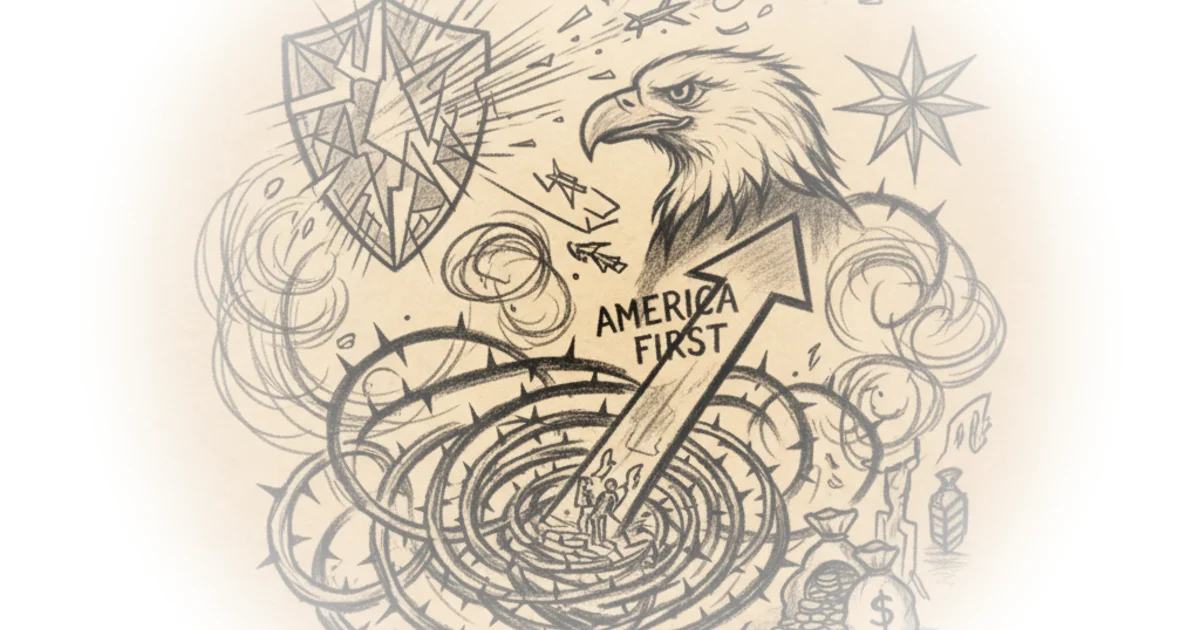
Kopp frames the entire timeline with a question about the meaning of "America First." During the 2024 campaign, Trump, JD Vance, and Tulsi Gabbard positioned the phrase as opposition to foreign intervention. The timeline documents where that principle ended up: two major military operations against Iran within nine months, the largest American force deployment to the Middle East since the 2003 invasion of Iraq, and a stated objective that included regime change.
The tension was visible in real time. Tucker Carlson and Representative Marjorie Taylor Greene objected to intervention in Iran. Trump himself expressed frustration with Israel's conduct during the June ceasefire, saying both countries "don't know what the fuck they're doing." The 2025 National Security Strategy, published months after Operation Midnight Hammer, outlined a "predisposition to non-interventionism" with a "high bar for what constitutes a justified intervention."
The THAAD interceptor deployment during the Twelve-Day War quietly underscored the costs. The United States expended 20 to 50 percent of its total inventory of Terminal High Altitude Area Defense interceptors, raising immediate questions about readiness for future conflicts elsewhere.
Bottom Line
Racket's timeline is valuable precisely because of what it does not do. It does not argue for or against the operations. It does not characterize the Iranian regime as sympathetic or the American-Israeli alliance as righteous. It lays out dates, statements, and consequences in sequence and trusts readers to follow the logic of escalation.
The result is a document that will be useful long after the op-eds and cable news segments have faded. The facts it assembles -- an IAEA resolution followed by immediate strikes, economic warfare explicitly designed to produce civil unrest, a diplomatic breakthrough announced hours before a bombing campaign -- are the kind of details that tend to get smoothed over in retrospective accounts. Kopp and her team have preserved them in order, with sources attached.
For anyone trying to understand how the United States went from "maximum pressure" to regime change in thirteen months, this is the primary source to start with.