Derek Muller makes a claim that's easy to miss on first read but becomes staggering when you sit with it: the numbers that "turn up in the heart of our best physical theory of the universe" — imaginary numbers — were invented not because physics demanded them, but because mathematicians hit an impossible wall while solving cubic equations. The connection is unexpected and Muller builds it carefully.
Ancient Mathematicians vs. Negative Numbers
The article opens with a fascinating observation: ancient mathematicians solved quadratic equations for thousands of years but never acknowledged negative solutions. "They were dealing with things in the real world — lengths and areas and volumes," Muller writes. "What would it mean to have a square with sides of length negative 27? That just doesn't make any sense." This is the core of his argument — mathematics was tethered to reality, and that tether prevented mathematicians from accepting what their equations were telling them.
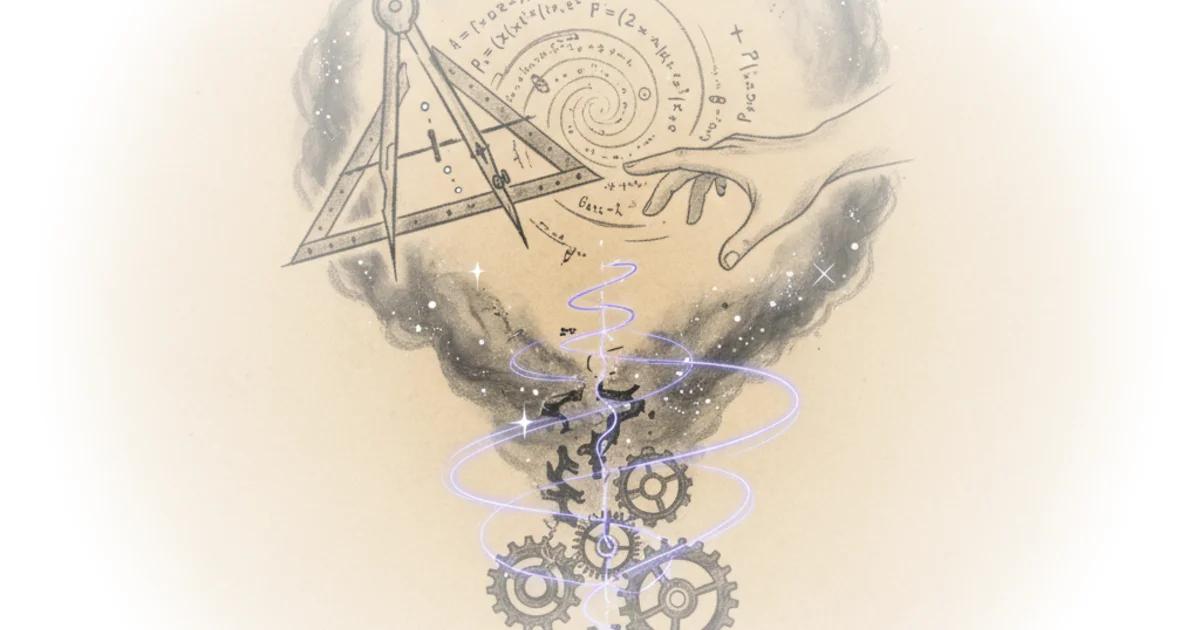
The piece effectively uses visual geometry to show how ancient mathematicians actually thought about equations. "Ancient mathematicians would think of the x² term like a literal square with sides of length x," Muller explains, describing how they visualized problems by literally drawing shapes — cutting rectangles and completing squares — rather than manipulating symbols. This geometric approach feels foreign to modern readers who've only seen algebra as letters on a page.
Mathematicians were so averse to negative numbers that there was no single quadratic equation — instead there were six different versions, arranged so that coefficients were always positive.
The Mathematical Duel
The story shifts to the 1500s with one of the most vivid historical scenes in the piece: a math duel. Del Ferro, a mathematics professor at the University of Bologna, "finds a method to reliably solve depressed cubics" and keeps it secret for nearly two decades. "Being a mathematician in the 1500s is hard — your job is constantly under threat from other mathematicians who can show up at any time and challenge you for your position," Muller writes. The loser suffers public humiliation.
When Fiore challenges Tartaglia, the math-dual format creates real drama. "Fiore can't solve a single problem — Tartaglia solves all 30 of fiore's depressed cubics in just two hours." It's a satisfying narrative turn that makes mathematical history feel like a competition match.
The Birth of Imaginary Numbers
Muller builds toward his central claim: imaginary numbers weren't invented to model reality — they emerged because geometry broke. When Cardano applies the general cubic solution algorithm, he encounters equations that work perfectly but lead to geometric paradoxes. "While the 3D cube slicing and rearrangement works just fine," Muller writes, "the final quadratic completing the square step leads to a geometric paradox." Specifically, Cardano finds "part of a square that must have an area of 30 but also sides of length 5." The contradiction — adding negative area — is where imaginary numbers enter mathematics.
This is the piece's most compelling argument. Muller writes: "You have to abandon the geometric proof that generated it in the first place — negative areas, which make no sense in reality, must exist as an intermediate step on the way to the solution." The insight is that mathematics needed to detach from physical reality before it could find truth.
Bombelli's Leap
The resolution comes through Raphael Bombelli, who picks up where Cardano left off. "Bombelli assumes the two terms in cardano's solution can be represented as some combination of an ordinary number and this new type of number," Muller writes. The result feels like magic: "these square roots cancel out leaving the correct answer four." It's a powerful word — "miraculous" — that captures how surprising the solution appears even to its discoverer.
Counterpoints
Critics might note that Muller frames this as a triumph of mathematics over reality, but he underplays what these imaginary numbers actually do in physics. The connection to quantum mechanics and the Standard Model is mentioned in the opening but never explored with the same depth as the historical narrative. Also, the piece occasionally treats visual geometry as inherently superior to symbolic algebra — a modern bias that ancient mathematicians might have disputed.
Bottom Line
Muller's strongest move is showing how the solution to centuries of mathematical frustration came not from better calculations but from abandoning the requirement that math make physical sense. The historical arc — from Pacioli declaring impossibility, through secret methods and mathematical duels, to Cardano's geometric breakdown — makes the emergence of imaginary numbers feel like a detective story rather than a textbook explanation. The vulnerability is in the title promise: "How Imaginary Numbers Were Invented" suggests we'll learn about the numbers themselves, but we spend almost all our time on how they were discovered through solving cubics. The connection to physics is mentioned early and then dropped.