Most economic forecasts treat artificial intelligence as a universal productivity booster, but Economics Explained makes a chillingly specific claim: the technology isn't just automating tasks; it is actively dismantling the primary growth engine of the developing world. The author's most distinctive insight is that the very industries nations like the Philippines and Bangladesh built their middle classes upon—outsourced service work—are now the first dominoes to fall, potentially reversing decades of global convergence. This is not a distant sci-fi scenario; the data suggests the gap between rich and poor nations is about to widen violently, not shrink.
The Collapse of the Outsourcing Model
The piece begins by dismantling the comforting historical narrative that technology always creates more jobs than it destroys. Economics Explained writes, "The other side argues that yeah, sure, when we replaced our muscles with machinery in the past, it let us leverage our minds, which are clearly what humans have invested most of our evolutionary traits into, but if machines replace that, what else do we have left to offer?" This rhetorical pivot is effective because it forces the reader to confront a fundamental shift: for the first time, capital is targeting the human brain, not just the human hand.
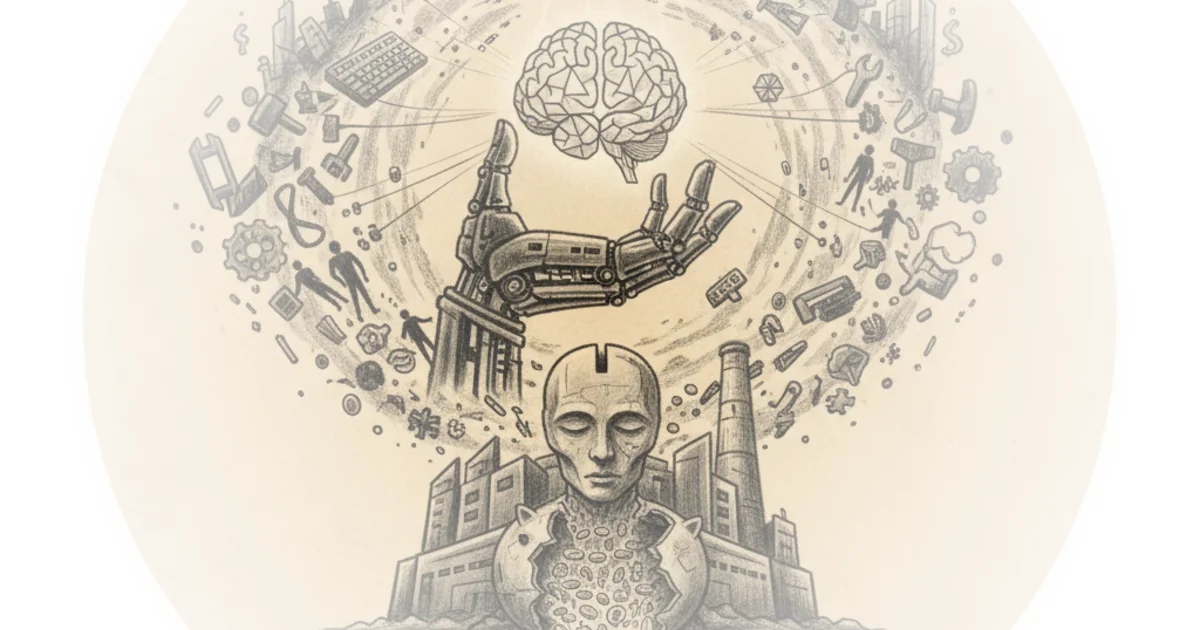
The author identifies the Philippines and Bangladesh as the canaries in the coal mine. These economies spent thirty years constructing entire industries around call centers, data entry, and transcription, assuming language skills and context were safe havens. That assumption has crumbled. Economics Explained notes, "In the Philippines, the IMF estimates that a staggering 89% of outsourced service jobs are at high risk of being automated by AI. That's over a million people whose jobs could disappear in just a few years." The speed of this disruption is the most alarming factor; it is not a slow erosion but a rapid obsolescence of the specific skill sets these nations cultivated.
A single slot in a server rack could soon replace an entire core center in Manila or Dhaka.
The argument here is that the economic logic of outsourcing has flipped. Previously, companies moved work to developing nations to save on labor costs. Now, AI allows companies to keep the work domestic or automate it entirely, removing the need for human intermediaries. Economics Explained observes, "If AI can deliver the same quality of work at a better speed for significantly less money, there's simply no compelling economic reason to continue outsourcing." This is a devastating blow to the development strategy of emerging markets, which relied on this specific type of labor arbitrage to climb the global ladder. Critics might note that new, unforeseen industries often emerge to replace old ones, but the author rightly points out that the timeline for adaptation is likely too short to prevent immediate social collapse in these regions.
The Great Divergence: Who Owns the Capital?
The commentary then shifts to the global distribution of wealth, arguing that AI acts as a force multiplier for those who already possess capital while rendering labor obsolete for everyone else. The author distinguishes between two types of economic impact: "complimentary capital," which makes workers more productive, and "substitutive capital," which replaces them entirely. Economics Explained writes, "For more routine process-driven work, AI increasingly acts as what economists call substitutive capital. Replacing human labor altogether instead of enhancing it." This distinction is crucial; it explains why the benefits of AI are not being shared evenly.
The concentration of this power is stark. The author highlights that the vast majority of breakthroughs come from a handful of firms in the US and China, creating a feedback loop of wealth accumulation. Economics Explained states, "PWC estimated that AI could add $15.7 trillion to global GDP by 2030, but 70% of that wealth is projected to go to just two countries, the USA and China because they own AI." This framing effectively illustrates that the future of global inequality is not just about national policy, but about who controls the foundational infrastructure of the new economy.
Furthermore, the hardware required to run these systems is equally concentrated. Economics Explained notes, "More than 90% of that hardware comes from the US, Taiwan, China, South Korea, and Japan." This means that even wealthy nations outside this core group are becoming dependent on licensing tools they did not build. The result is a world where the gap between the "haves" and the "have-nots" widens not just in income, but in technological sovereignty.
The Human Cost of Disruption
Finally, the piece grounds these macroeconomic trends in the visceral reality of past industrial shifts. The author draws a parallel to the deindustrialization of the American Midwest and the UK, where entire communities were left behind when factories closed. Economics Explined writes, "The Midwest bore the brunt of this economic transformation. Cities like Detroit, Cleveland, and Youngstown were once packed with well-paying jobs in steel, cars, and textiles. But then came robotic welders, computer run assembly lines, and cheaper labor overseas." The parallel is chilling: just as manufacturing jobs vanished without returning, the author suggests that the service jobs of the developing world may face the same fate.
The consequences of such a shift are not merely statistical. Economics Explained warns, "A lot of these towns saw life expectancy drop, opioid addiction rise, and schools struggled to keep up." By invoking these historical scars, the author makes the abstract threat of AI feel immediate and personal. The argument is that the short-term pain of technological disruption can be so severe that it permanently alters the social fabric of a region, regardless of long-term theoretical gains. A counterargument worth considering is that government intervention and retraining programs could mitigate these effects, but the author's tone suggests that the market forces driving this change are moving faster than any policy response can manage.
In short, the countries least equipped to absorb disruption are the ones getting hit first and hardest.
Bottom Line
Economics Explained's strongest contribution is the specific identification of the outsourcing sector as the primary casualty of the AI revolution, a detail often lost in broader discussions about white-collar automation. The argument's biggest vulnerability lies in its deterministic view of the future, potentially underestimating the resilience of human labor in adapting to new, non-routine roles. However, the warning is clear: without deliberate intervention, the AI era promises to be the greatest accelerant of global inequality in modern history.