The Trillion-Dollar Shakeout
Two trillion dollars vanished from financial markets in recent weeks. Matt Stoller tracks where the money went and why it matters for anyone who uses software, touches cryptocurrency, or pays bills at hospitals and banks.
Crypto's Narrative Collapse
Bitcoin and related cryptocurrencies lost $1.7 trillion in market value since October. The drop accelerated last week. Matt Stoller writes, "Crypto falls periodically. What matters is that this time there is a lack of confidence in the crypto narrative."
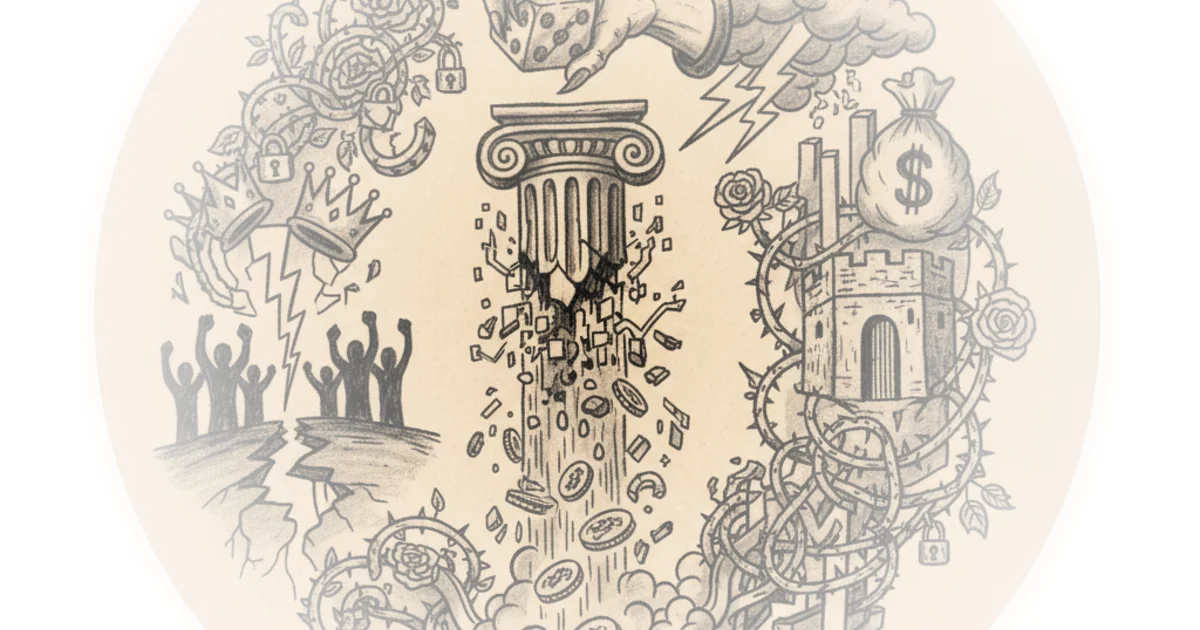
The story investors believed was simple: blockchain represented groundbreaking technology suppressed by hostile politics. Once legal and mainstream, cryptocurrencies would skyrocket as use cases emerged. Regulatory friendliness arrived. Congress passed legislation to legalize stablecoins. Trading became easier.
As Matt Stoller puts it, "it turns out there are no real use cases for crypto except for money laundering and fraud, and little real interest beyond 'number go up' speculation."
The technology proved less interesting than AI. Legalized gambling and prediction markets absorbed the speculative froth. Even Coinbase pivoted toward becoming a less regulated dollar-based bank. Matt Stoller writes, "everyone knows that crypto is a legal way to gamble that is more boring than other ways to legally gamble."
Critics might note that cryptocurrency still enables cross-border transactions without traditional banking infrastructure, and some developers continue building genuine applications beyond speculation. The narrative may have collapsed faster than the underlying technology's actual utility.
"everyone knows that crypto is a legal way to gamble that is more boring than other ways to legally gamble."
Software-Mageddon
The second collapse matters more. Software companies — Adobe, Zoom, Salesforce, Workday, ServiceNow, LegalZoom, Thomson Reuters, Microsoft — lost $1 trillion in market value within a week. The S&P Software & Services index crashed. Private equity firms like Thoma Bravo and Vista Equity Partners, which Stoller once called the "bridge trolls" of corporate software, face exposure.
The fear: AI tools could automate away their business models.
Matt Stoller writes, "Pretty much every one of these platforms is just a database hooked up to a user interface."
System of Record Extraction
The most profitable software firms serve as "system of record" providers — the nervous system of organizations. SAP, Salesforce, Microsoft, Oracle dominate broadly. Workday, Kronos, Rippling handle specific functions. Sector-specific platforms embed deeper: Mindbody for yoga studios, CDK Global for auto dealers, Yardi for real estate, Epic Systems for hospitals, Tyler Technologies for municipal functions ranging from permit processing to jail booking.
As Matt Stoller puts it, "Software systems must work well enough to cover most situations, but don't have to excel at anything except sales."
The bankers' meeting in 2016 revealed the reality. Community bankers came to lobby against consumer protection laws. Stoller asked about their core software providers — FIS, Fiserv, Jack Henry — an oligopoly controlling bank operations. The room lit up. Every banker complained.
"It's expensive." "Terrible." "I hate it."
Matt Stoller writes, "Enshittification is a word for a reason, and it's not just applicable to the big platforms."
Switching providers took eighteen months and huge operational investment. Bankers signed non-disclosure agreements around price and terms. They hired consultants just to negotiate. In 2024, CDK Global got hacked, preventing Americans from buying cars across the country.
The AI Disruption Question
Once system-of-record platforms achieve market dominance and high switching costs, the economics favor extraction. Matt Stoller writes, "Once they've achieved market dominance and high switching costs, the economics heavily favor growing wallet share, first by relentless feature expansion but, as that falters, often by bundling, lock-in, and ecosystem control."
Generative AI may break this. Stoller built a free app showing how federal legislation changes underlying law — a task requiring manual cross-referencing that commercial software handles poorly. Companies like GroWrk saved $50,000 annually by eliminating Asana and similar tools, building custom solutions internally.
As Matt Stoller puts it, "Now you can build these tools internally," he said. "That's a good thing."
Real engineering departments can use AI-assisted coding to create reliable software. Companies may supplement or replace purchased programs with custom builds. AI doesn't need to be perfect — just good enough for internal projects requiring 90% accuracy, not the 100% demanded by health records or bank transfers.
Critics might note that enterprise software incumbents have survived multiple disruption waves before. AI coding tools still hallucinate, introduce security vulnerabilities, and lack the "one throat to choke" support structure that CIOs rely on. The selloff may reflect panic more than structural change.
What Antitrust Made Possible
The best antitrust cases succeeded by allowing competition via new platforms. The IBM 360 antitrust suit in 1969 created competition across hardware, software, networking, and printing — spawning multi-trillion dollar industries. Microsoft's antitrust case enabled the 2000s web boom. Healthcare data portability requirements in the Cures Act allow new companies to interoperate with dominant platforms without displacing them entirely.
Matt Stoller writes, "It doesn't need to displace the platform; you could sell an emergency room management module without kicking Epic out of the whole hospital."
Bottom Line
The crypto collapse reveals a technology without use cases beyond speculation and fraud. The software collapse reveals something different: extraction machines vulnerable to AI-enabled competition. System-of-record monopolies extracted value by locking customers in, not by excelling. AI coding tools may not replace enterprise software entirely, but they enable organizations to build what they need internally. That competitive pressure — not total displacement — could force incumbents to improve quality and pricing. The trillion-dollar shakeout may be the market recognizing that extraction has limits.