The Unlearning of Andre 3000
There is a particular kind of courage required to walk away from mastery. Andre Benjamin spent decades as one of hip-hop's most celebrated voices, half of OutKast, a figure whose verses and choruses entire arenas could sing back to him. And then he picked up a wooden flute and wandered into the unknown. In this wide-ranging conversation with Rick Rubin, Andre 3000 traces the path from a breathwork class in Venice to a Grammy-winning instrumental album, and what emerges is less a story of reinvention than one of return -- a musician circling back to the raw, unmediated feeling that first drew him to music as a child.
The Amateur as Radical
Andre's relationship with his own lack of formal training is the quiet engine of the entire conversation. He does not apologize for it. He valorizes it. Where a conservatory-trained musician might hear limitation, Andre hears freedom from the tyranny of knowing what comes next. He describes his approach to live performance with disarming honesty:
I got better at not knowing what I'm doing. I got more confidence and having confidence that I don't know what I'm doing.
This is not false modesty. During shows, he keeps thirty flutes spread on a blanket, auditioning them in real time against whatever his bandmates are playing. He cannot name keys. He does not read music. He plays by feel and ear and -- his word -- "physicality," watching his own fingers the way a guitarist might, trusting that physical intuition will find something worth hearing.
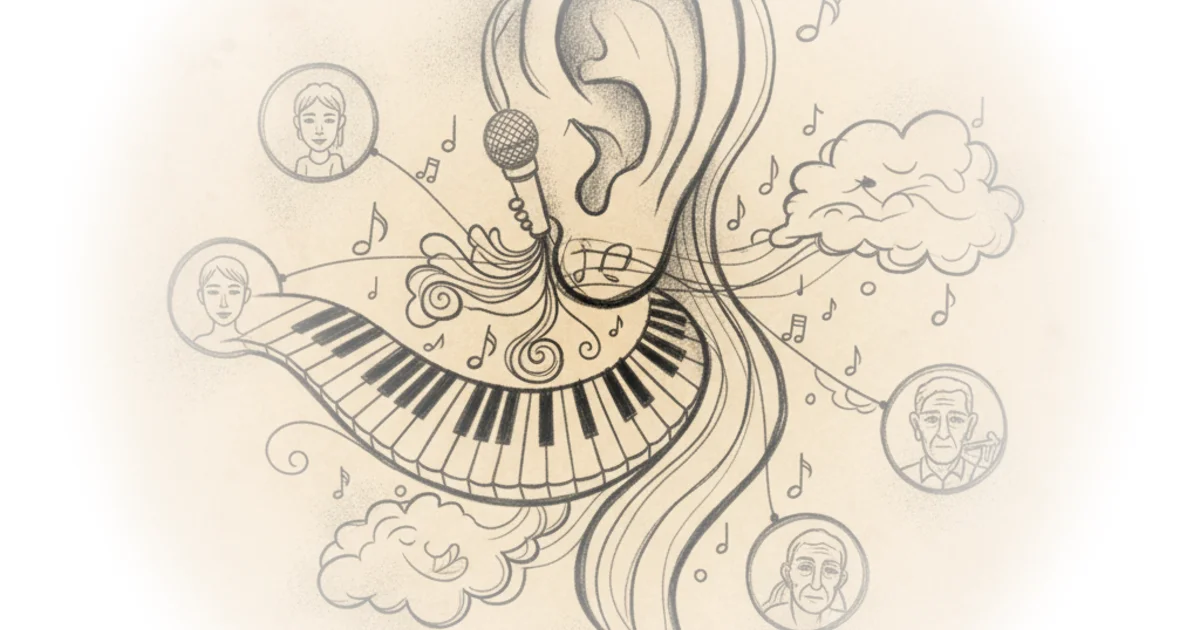
The comparison he draws is telling: not jazz, not classical, but impressionism. "If you were looking at figurative art and it's where you see an actual thing, a body or whatever, it's almost like I'm doing an abstract version of it," he explains. "Like just an impression of something." The notes may land right or wrong, but the feeling will be real. There is a philosophical wager embedded in this approach -- that sincerity of intention can substitute for technical precision, and that audiences can tell the difference.
Breadcrumbs and Altered States
The origin story Andre tells is steeped in a kind of spiritual serendipity that skeptics will find convenient and believers will find confirming. A real estate agent suggests a small house in Venice on a whim. A breathwork class leads to a sound healing session. A woman named Cassia plays a wooden flute while Andre lies on his back in an altered state, and something breaks open. Rubin makes the connection explicit: holotropic breathing is essentially a psychedelic experience, and Andre first encountered the flute while in that liminal space. Had he skipped the session or left early, none of what followed -- the flute from GMO Martinez, the meeting with Carlos Nino at Erewhon, the New Blue Sun album -- would have happened.
Andre then layers on the ayahuasca experience in Hawaii, where his body began "toning" involuntarily, producing sounds he insists were not his own. He describes the experience with a candor that risks sounding unhinged:
Your body is an instrument and you're kind of getting played. And so I know I was not making these notes cuz I didn't even -- I was not in my mind frame to even think of notes.
The human part of him, he admits, immediately wished he had his phone to record it. That tension -- between mystical surrender and the instinct to capture and share -- runs through the entire conversation. It is also the tension at the heart of the New Blue Sun project: how do you release something that was born in formlessness without calcifying it into product?
The Saxophone Problem
One of the most revealing moments comes when Andre discusses a deliberate exclusion. The band recorded strong material featuring saxophone, but Andre ultimately cut the instrument from the project entirely. His reasoning is precise: the saxophone carries too much cultural freight.
As soon as I hear a saxophone, it pulls me to jazz. And so we made the decision to -- because we recorded some great songs with saxophone on them for some of the sessions for this album, but I didn't necessarily wanted to sit in the jazz mode.
This is not an anti-jazz position. Andre loves jazz. But he understood that a single timbral association could collapse the entire project into a familiar category, and familiarity was exactly what he was trying to escape. The decision reveals a sophisticated understanding of how listeners process sound -- not note by note, but through accumulated cultural associations. A saxophone does not just produce frequencies; it produces expectations. By removing it, Andre forced listeners to meet the music on its own terms.
Critics might argue this is overthinking it, that great music transcends its instrumentation. But Andre's instinct was validated by the results: New Blue Sun won the Grammy for Best Alternative Music Album, a category that would have been far less plausible had the record sounded like a jazz album with a celebrity guest.
The Uncleaned Flute
There is a wonderful digression about Andre's first flute and the coating of moisture that built up inside it over years of playing without cleaning. The instrument, he says, developed "a soul" -- it sounded like "a mature woman that had lived." When he finally had it cleaned, the character vanished, and he was left holding a stranger.
It's your stuff, too. It's like it's personal.
This anecdote functions as a miniature philosophy of art. The imperfections that accumulate through use are not flaws; they are autobiography. The instrument becomes an extension of the player not through technical mastery but through the literal residue of shared experience. It is a deeply physical, even biological, understanding of the relationship between artist and tool -- one that stands in sharp contrast to the digital perfection Andre identifies in contemporary music, where everything is "quantized and autotuned and perfected."
The Weight of Expectation
Andre is fifty now, and he carries the particular burden of an artist who achieved massive commercial success young and then changed direction. He acknowledges the backlash to New Blue Sun with remarkable equanimity: people waited seventeen years for a new album and got experimental flute music instead of rapping. His response is simple -- he never asked anyone to wait.
But the expectation problem cuts deeper than public reception. Andre admits he no longer thinks of himself as a rapper, though he still rhymes things instinctively and writes them down. He describes this as a kind of phantom limb:
I wish I was more of a rapper right now. It's another life. Yeah, it is.
Rubin pushes him on whether any other artist has successfully made such a radical creative pivot, and neither man can produce a convincing example. Andre offers Boots Riley's move from music to filmmaking, but that is a medium change, not the same thing. What Andre has done -- abandoning a genre he helped define to pursue untrained improvisation on instruments he is still learning -- may genuinely be without precedent at his level of fame.
Church, Breath, and the Roots of Feeling
The deepest current in this conversation runs through Andre's childhood in the Black church, where his grandfather preached and his mother kept him in choir and Bible study three times a week. The gospel music he plays for Rubin -- Reverend C.J. Johnson's raw, clapping, foot-stomping sermons -- sounds nothing like New Blue Sun and everything like it. The freeness is the same. The absence of artifice is the same. The prioritization of feeling over form is the same.
Rubin observes that Andre experienced, from a young age, music that was not showbiz -- not performance for an audience but genuine spiritual communion. Andre does not disagree. The through-line from his grandfather's church to holotropic breathing to ayahuasca to free-form flute improvisation is remarkably consistent: each is a practice of surrender, of getting out of one's own way to let something larger move through.
Whether that "something larger" is God, the subconscious, or simply the emergent properties of collective improvisation is a question Andre wisely declines to answer definitively. He left organized religion behind. But the structure of his creative practice -- the ritual, the intention-setting, the submission to forces beyond conscious control -- remains unmistakably devotional.
Bottom Line
Andre 3000's conversation with Rubin is at its most compelling when it resists the narrative of triumphant reinvention. This is not a story about a rapper who boldly became a flutist. It is a story about a person who followed curiosity without guaranteeing the destination, who valued the "amateur gear" of first encounters over the polish of expertise, and who discovered that the thing he was looking for had been present all along -- in his grandfather's church, in Tracy Chapman's storytelling, in the breath that connects a human body to a hollow tube of wood. The risk of this posture is preciousness, and Andre occasionally skirts it. But the evidence -- 120 shows of unrepeatable free-form music, a Grammy, jazz musicians coming backstage to say they wished they had been this free -- suggests the wager paid off. The most radical thing Andre 3000 did was not pick up a flute. It was put down the need to know what he was doing.