Brian Beutler makes a chillingly pragmatic argument that the only force capable of restraining the current administration's most destabilizing impulses is not Congress, nor the courts, but the cold, hard calculus of global bond traders. He suggests that the very mechanism Republicans once weaponized to paralyze the Obama administration—the specter of "bond vigilantes"—may now be the only thing preventing a total economic collapse under the current executive branch.
The Market as a Brake
Beutler challenges the popular narrative that the administration operates on a "Madman Theory," where unpredictability is a calculated strategy to force concessions. Instead, he posits that the executive is driven by a narcissistic fear of failure that is uniquely sensitive to financial signals. "The bond market turns out to be the signal that most reliably alerts him that he's chosen a course that will end in disaster rather than triumph," Beutler writes. This reframing is crucial; it shifts the focus from political grandstanding to a tangible vulnerability. If the administration's bluster is merely a bluff, the bond market is the one entity that can call it.
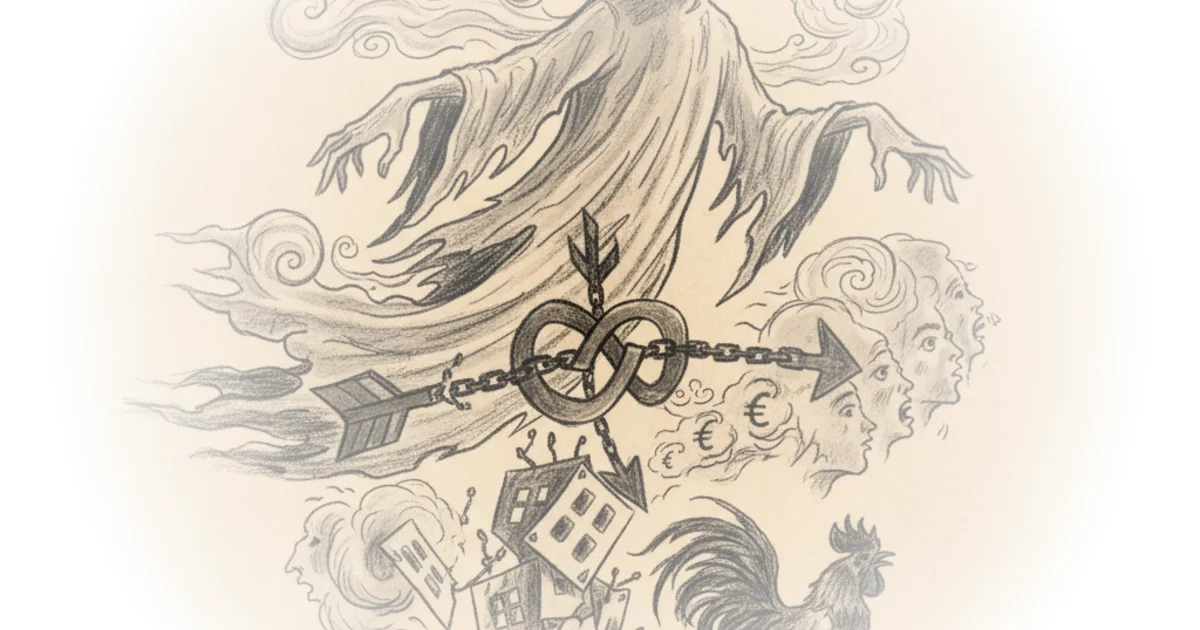
The author describes a dangerous feedback loop where the administration tests boundaries, markets react, and the executive retreats, only to push further next time. "It's not rinse, repeat. It's rinse, rinse, rinse, drown," he argues, warning that each cycle requires more extreme actions to achieve the same market reaction. This dynamic creates a ratchet effect where the administration is forced to escalate its threats—from tariffs to territorial disputes—until the financial damage becomes irreversible. Critics might note that relying on market panic as a check on power is a precarious strategy, as it assumes the market will always react quickly enough to prevent catastrophic policy implementation.
"Being an extortionate shitheel of a president can cause severe, perhaps permanent economic damage to the United States."
The Hypocrisy of Bond Vigilantism
Beutler draws a sharp parallel between the current situation and the political tactics used against the Obama administration. He reminds readers that the threat of bond market rebellion was once a fictional tool used by Republicans to force austerity, despite no actual risk of a credit crisis. "The specter of bond-market vigilantism was entirely fictional," he notes, highlighting how the same fear was manufactured to paralyze a Democratic president. Now, the roles have reversed, but the mechanism remains the same. The administration's actions are causing genuine market volatility, transforming a political weapon into a real economic threat.
He argues that Democrats have failed to recognize this liability, paralyzed by a fear of the word "impeachment." Beutler contends that this hesitation is misplaced when the stakes involve the solvency of the nation. "Impeachment has become a kitchen-table issue," he asserts, suggesting that the logic of removing the president shifts from legal norms to economic survival. This is a bold claim, one that challenges the traditional boundaries of political discourse. However, it forces a necessary conversation: if the executive's behavior threatens the global economy, is the preservation of the office more important than the stability of the nation?
The Path to Collapse
The piece culminates in a grim prediction: the administration may eventually trigger a bond market rebellion that cannot be undone. Beutler describes a scenario where institutional investors, including foreign pension funds, begin to disinvest from U.S. treasuries, effectively cutting off the government's ability to finance its operations. "If enough of them disinvested themselves of U.S. treasuries, it would cut the legs out from under the U.S. economy, and Trump would be mired in a huge, potentially fatal political crisis," he writes. This is not a minor recession; it is a potential insolvency event.
He suggests that the only alternative to this economic fire is a political one, urging Democrats to embrace the narrative of economic ruin to galvanize action. "Better an economic fire than the other kind," he concludes, implying that a depression might be the necessary catalyst to discredit the current political movement before it engulfs the globe in violence. This is a stark, almost apocalyptic framing, but it underscores the severity of the situation. The author is not predicting a minor correction; he is warning of a systemic failure that could reshape the global order.
"Better that Trump and MAGA and fascism fully discredit themselves before they engulf the globe in slaughter."
Bottom Line
Beutler's strongest move is reframing the administration's greatest weakness not as a political scandal, but as a financial one, turning the bond market into the ultimate check on power. His biggest vulnerability is the assumption that the market will act as a rational brake rather than a catalyst for chaos, a gamble that could leave the global economy in ruins. Readers should watch for signs of coordinated selling by sovereign debt holders, as this could be the first signal that the "TACO" cycle has finally broken.