Chris Chappell delivers a raw, on-the-ground account that transforms a standard protest report into a study of tactical escalation and shifting power dynamics. Unlike distant analysis, this piece captures the precise moment a movement redefined its strategy by physically surrounding the police headquarters, turning a potential stalemate into a high-stakes confrontation.
The Tactical Shift
Chappell begins by grounding the reader in the immediate chaos outside the Hong Kong Police Headquarters, noting that the crowd's presence was not a pre-planned march but a rapid, organic surge. "Within ten minutes this entire area was flooded with protestors," Chappell observes, highlighting how the movement's energy shifted from a smaller gathering at the Legislative Council to a massive blockade. This sudden mobilization underscores a critical point: the protesters are no longer waiting for government concessions but are actively dictating the terms of engagement. The author notes that the police had issued a statement refusing to clear the area, yet the crowd's actions rendered that announcement moot by physically cutting off emergency services and strategic exits.
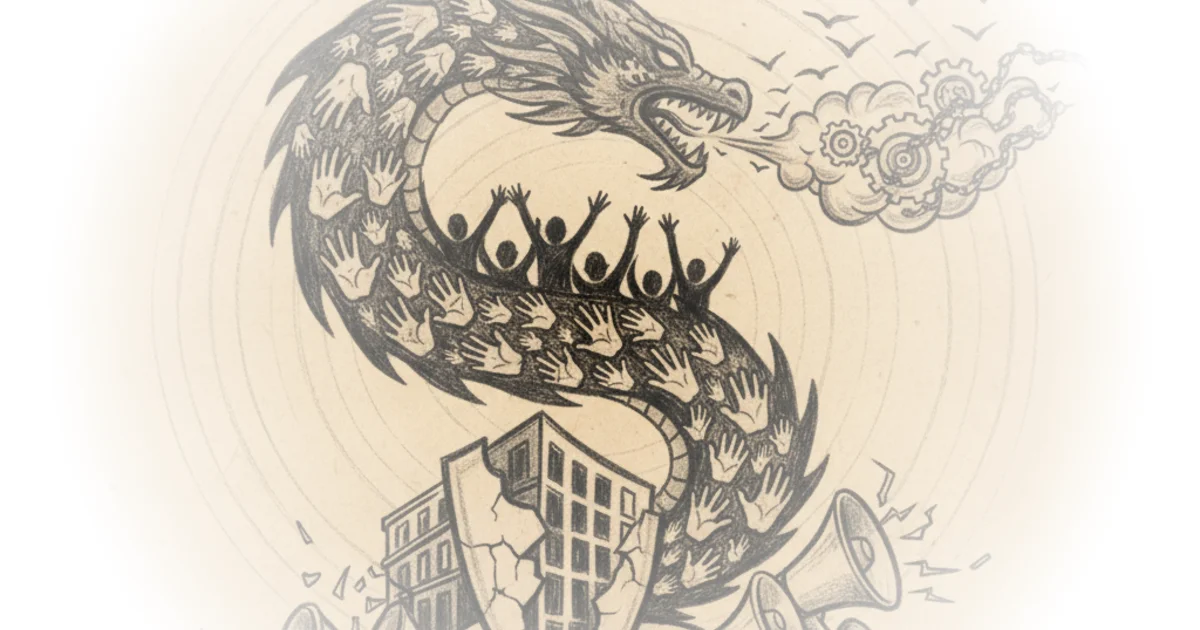
The commentary effectively frames the police response not as a standard law enforcement operation, but as a reactive posture to a crowd that has seized the initiative. Chappell points out the irony of the situation, where police negotiators are forced to admit the crowd is blocking roads, while protesters have "grabbed barricades and like put them up over strategic exits for the police so they wouldn't be able to come out." This tactical ingenuity suggests a level of organization that contradicts the administration's narrative of a disorganized mob. Critics might argue that blocking emergency services is a dangerous escalation that could turn public opinion against the movement, but Chappell's reporting emphasizes the crowd's internal discipline, noting that when someone was injured, "everyone cleared a path and let the first aid people through."
"This morning I thank you Matt Matt has been a champion I'm gonna try not to do an upskirt it's beginning to rain a little bit but fortunately umbrellas are kind of a symbol for this movement so that's not going to be too much of a issue."
The Erosion of Trust
A central theme in Chappell's coverage is the profound shift in public perception regarding the police force. The author contrasts the historical reputation of the Hong Kong police as "one of the nicest police forces in the world" with the current reality of aggressive tactics. Chappell writes, "since the Occupy central / umbrella movement in 2014 that's kind of become less and less so and police have become using more and more force." This erosion of trust is not merely anecdotal; it is rooted in specific incidents of perceived brutality, such as the video of a man "handing out water getting mobbed by police" who "basically like started beating him."
The piece argues that the administration's heavy-handed response on June 12, involving "150 K like tear gas canisters," has backfired by validating the protesters' claims of excessive force. Chappell notes that while the police attempt to spin the narrative by highlighting isolated acts of violence from protesters, the scale of the crackdown was a "mass attack on the people." This framing is powerful because it shifts the blame from individual agitators to institutional policy. However, a counterargument worth considering is that the administration likely views these measures as necessary to maintain order in a territory facing significant civil unrest, a perspective that Chappell dismisses rather than engages with deeply.
The author also highlights the psychological warfare being waged, noting that police are "definitely filming this trying to get people's faces" while protesters wear masks in response. "Big concern of a lot of people here that you know police are gonna see their faces and then later that the year now the crackdown," Chappell explains. This mutual surveillance creates a tense atmosphere where the threat of future retribution looms large, further entrenching the divide between the citizens and the state.
The Role of Media and Uncertainty
Chappell dedicates significant attention to the role of foreign media, suggesting that their presence acts as a deterrent to police violence. "When especially foreign media are paying attention the police tend to be less violent," the author posits, arguing that the heavy media presence on June 12 was a "huge mistake" for the police to ignore. This observation adds a layer of strategic analysis to the coverage, suggesting that the movement's success is partly dependent on international visibility.
Yet, the piece is perhaps most compelling in its admission of uncertainty. Chappell repeatedly emphasizes that "nobody has any idea what's going to happen," noting that even the protesters themselves are unsure of the next steps. "We came here you know an hour plus ago because there are a few people lining up... and they're like oh oh we don't know we're kind of going to see where this goes," Chappell recounts. This lack of a central command structure is presented not as a weakness, but as a source of resilience, making the movement difficult to predict or suppress. The author concludes that the upcoming July 1st anniversary of the handover could be a pivotal moment, but for now, the situation remains fluid and unpredictable.
"These protesters are really really effectively keeping us from coming home... I'm just amazed by how difficult it is to predict what's gonna happen next everyone has different ideas and nobody's correct."
Bottom Line
Chappell's coverage succeeds by capturing the visceral energy of a movement that has outmaneuvered the authorities through sheer numbers and tactical adaptability. The strongest element is the detailed account of how the protest evolved from a planned demonstration into a spontaneous siege, effectively neutralizing the police's ability to control the narrative. The piece's primary vulnerability is its reliance on the assumption that international media presence will continue to restrain state violence, a variable that may not hold if the administration decides to escalate regardless of global scrutiny.