In a rare conversation between two titans of media, Barry Diller argues that while the technology of distribution has exploded, the soul of storytelling has remained stubbornly unchanged—and that this very stability is what makes modern media feel so hollow. Diller, the architect of the miniseries and former chairman of Paramount, offers a firsthand account of how a 24-year-old executive once rewrote the rules of television by simply asking, "Why not try and tell a story in how long it takes to tell that story?" His insight is not just a nostalgia trip for the golden age of broadcast; it is a sharp critique of the current content glut, where even worthy work "doesn't resonate anymore" because the cultural attention span has fractured into oblivion.
The Death of the Cultural Moment
Diller's central thesis is that the shift from three networks to thousands of digital channels has not altered the fundamental nature of mass communication, but it has destroyed its ability to linger. He observes that while we now have "thousands and thousands of quote channels," the result is a paradox where abundance leads to insignificance. "It hasn't changed the essence of what I just said," Diller notes, pointing out that the real tragedy is "how fast it disappears" and how little of it actually stays in the culture. He contrasts the fleeting nature of modern hits with the seismic impact of Roots, a miniseries that "captured more than half the United States and stayed in the culture for months and months and months."
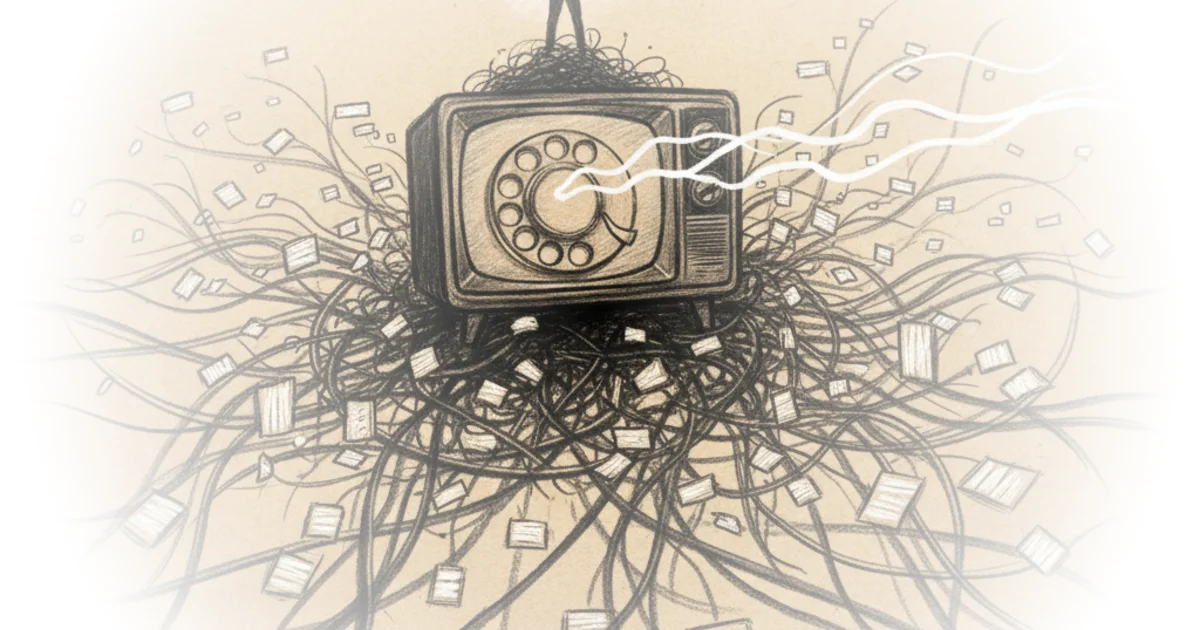
This observation lands with particular weight because it comes from the man who invented the format that made Roots possible. Diller argues that the "gathering around the family around the television set" was not just a viewing habit but a cultural engine that has since broken down. He laments that "worthy stuff that's great in any form of worthiness or not just simple great just doesn't resonate anymore," suggesting that the sheer volume of content has diluted the power of any single story to change the world. Critics might note that this view romanticizes a past era where gatekeepers decided what was "worthy," potentially ignoring the diverse voices that were silenced by the old three-network model. However, Diller's point is not about who got to speak, but about the collective impact of what was heard.
"I am so for my friends and just empathy for others when I see a film that I know people worked on for close to a year and it's gone in two days."
The Invention of the "Novel for Television"
The most compelling part of Diller's narrative is his account of how he stumbled upon the miniseries format not through grand strategy, but through frustration with the constraints of the "movie of the week." In the late 1960s, Diller realized that compressing a "really good thick juicy fiction book" into a 90-minute film was an act of violence against the source material. "Why do they make a 2-hour movie of this stuff?" he asked himself. "It's almost impossible." Recognizing that television had "unlimited time," he proposed a radical idea: to create a "novel for television" that could unfold over multiple nights.
This move required a level of audacity that seems impossible in today's risk-averse corporate environment. Diller recalls that when he first pitched the idea, he was met with skepticism, yet he was allowed to proceed because "nobody kind of wants to get near you," which inadvertently protected him from bureaucracy. "There was no one there to stop you," he explains, describing ABC at the time as a place where a young executive could "kind of just take" responsibility. This isolation allowed him to build a manufacturing process that churned out 75 movies a year, a feat no major film studio could match. The success of this model proved that the form factor could be as flexible as the story demanded.
As Diller puts it, "We didn't have a word called miniseries. We had the word we invented which is called the novel for television." This rebranding was crucial; it shifted the perception of television from a medium of filler to a platform for epic storytelling. The result was a cultural phenomenon where a single story could dominate the national conversation for weeks, a feat that is increasingly rare in the algorithmic age.
The Outsider's Journey to Hollywood
Diller's transition from television to the film industry in the early 1970s serves as a cautionary tale about the rigidity of established institutions. At the time, the movie business was a closed club that viewed television executives with disdain. "They used to pee on the people from television," Diller recalls, highlighting the deep snobbery that separated the two worlds. When he was offered the chairmanship of Paramount at age 32, it was a shock to the system, and his reception was far from warm. "Not kindly," he admits, describing the industry's resistance to an outsider who dared to apply television's manufacturing logic to film.
His early years at Paramount were defined by failure as he tried to navigate a business dominated by agent-driven packages rather than idea-driven development. Diller describes his first few years as a period of learning through failure, epitomized by the flop The Dog That Saved Hollywood, which "sunk without a trace." Yet, this struggle was essential to his growth. "The only process I know is kind of fail first before I can figure it out and make my way," he says. This willingness to fail in public, and to learn from the mistakes, stands in stark contrast to the current media landscape, where the pressure to be instantly successful often leads to risk-averse, formulaic content.
"There was nobody at that time from television who was allowed into the theatrical motion picture business."
Critics might argue that Diller's success was an anomaly made possible by the unique, less bureaucratic environment of 1970s ABC, and that such opportunities are no longer available in today's consolidated media landscape. While true, Diller's story underscores a timeless truth: innovation often comes from the margins, from those who are not yet accepted by the establishment but are free to experiment because they are ignored.
Bottom Line
Barry Diller's reflection is a powerful reminder that while the delivery mechanisms of media have evolved from rotary dials to infinite streams, the human need for stories that linger remains unchanged. His argument that the fragmentation of the audience has eroded the cultural resonance of even the best work is a sobering truth for anyone navigating the modern content economy. The piece's greatest strength lies in its firsthand account of how a single executive's willingness to break the rules created a new art form, a lesson in courage that feels increasingly urgent in an era of algorithmic conformity.