Brian Merchant exposes a disturbing reality in the tech sector: the line between genuine innovation and cynical performance art has vanished. In an era where billions flow to companies with no products, the most effective strategy for securing capital is no longer building a solution, but manufacturing a controversy. This piece is essential listening because it moves beyond the hype of artificial intelligence to reveal the hollow mechanics of a bubble fueled by narrative rather than utility.
The Art of the Troll
Merchant opens by dissecting the aggressive marketing of Artisan, an enterprise AI firm that launched a campaign with the slogan "STOP HIRING HUMANS." The backlash was immediate, yet the company's response was to shrug it off as a joke. "It's really just a viral marketing tactic," the 23 year-old CEO Jaspar Carmichael-Jack wrote on a reddit AMA, "we don't actually want anyone to stop hiring humans." Merchant argues that this cynicism is not an anomaly but a feature of the current market. "When you have a market as impossibly frothy as AI, it doesn't matter if you have an AI-powered SaaS business with a decent UI. So does everyone else. If you want investors and the press to take note, you have to manufacture yourself a narrative, and one of the easiest ways to do so is, naturally, to troll."
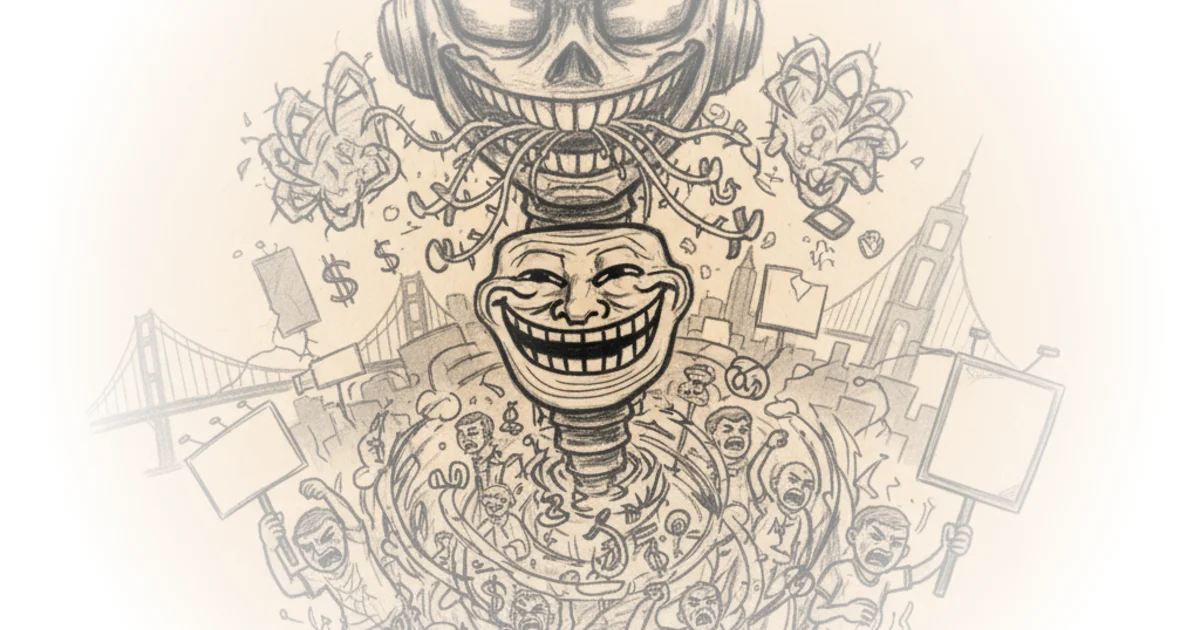
The author suggests that the administration's desire to keep the "juiced times rolling" has created an environment where absurdity is rewarded. We are witnessing a moment where "$12 billion companies are formed entirely on the basis of one of the founders having formerly worked at OpenAI and literally nothing else." This observation strikes a nerve because it highlights a fundamental disconnect between valuation and tangible output. Critics might argue that early-stage investing is inherently speculative and that hiring based on pedigree is standard venture capital practice. However, the scale of the funding here—handed over without a product or a clear plan—suggests a market that has lost its tether to reality.
Trolling is now all but indistinguishable from AI profiteering. It may be one and the same.
The Currency of Absurdity
The commentary deepens as Merchant examines the funding of Thinking Machines, led by former OpenAI CTO Mira Murati. Despite having no product and refusing to discuss plans with backers, the company secured $2 billion. An investor described the pitch as "the most absurd pitch meeting," noting that Murati insisted on secrecy while asking for billions. Merchant points out the irony of their eventual product, Tinker, which is "an AI model that automates the creation of more AI models." This recursive loop is presented not as innovation, but as a symptom of a market chasing its own tail.
Similarly, the piece scrutinizes the rise of Friend, a startup selling a wearable device that invites public harassment. The CEO, Avi Schiffman, admitted to the strategy, stating, "I know people in New York hate AI... So I bought more ads than anyone has ever done with a lot of white space so that they would socially comment on the topic." Merchant interprets this as a calculated gamble: "Nothing is sacred anymore, and everything is ironic," as he told the Atlantic. "AKA 'idk I'm trolling but it's working because you're writing about me.'"
The argument here is that the public's anger is being monetized. By positioning themselves as the villains, these companies generate the very attention they need to survive. This framing is effective because it reframes public outrage not as a failure of the product, but as a successful marketing metric. The vandalism of the ads, which included messages like "Don't be a phoney, be a Luddite," is catalogued not as a rejection of the technology, but as content for the company's narrative.
The Prophet of the End Times
Perhaps the most striking example Merchant provides is Leopold Aschenbrenner, a young entrepreneur who leveraged a leaked manifesto about AI apocalypse to raise $1.5 billion. Merchant notes that Aschenbrenner's resume includes a stint at the fraudulent FTX exchange and a firing from OpenAI for leaking confidential information. Yet, he is now treated as a "prophet of the AI age." The author questions the sincerity of this doomsaying, suggesting that "People who sincerely believe an apocalypse is coming do not tend to start hedge funds."
The core of Merchant's argument is that the fear of AI is being weaponized to sell AI. "This technology could kill us all, but use it to automate your email job while you can." This contradiction is the engine of the current boom. The author draws a parallel to a time when a founder who couldn't answer basic questions would be rejected, noting that "during a particularly absurd bubble around a technology with uniquely science fictional aspirations, however, investors might say, great, here is $2 billion."
The signature moment in the entire AI boom thus far, to me, took place in the early days of OpenAI, when Sam Altman was asked about how AI products would make money. He told a crowd of industry folks, with a straight face, the plan was simply to build AGI and then ask it.
This anecdote serves as the capstone to the argument: the entire enterprise is built on a foundation of faith rather than fact. The willingness of investors to fund "unexperienced and smarmy guys in their early twenties" who are willing to "aggressively announce themselves as scapegoats for the future" is the ultimate red flag.
Bottom Line
Brian Merchant's analysis is a powerful indictment of a financial ecosystem that has prioritized storytelling over substance. The strongest part of the argument is the identification of trolling as a viable business model, where public outrage is converted into venture capital. The biggest vulnerability, however, is the assumption that this bubble will inevitably burst; history shows that irrational markets can remain irrational far longer than logic dictates. Readers should watch for the moment when the narrative no longer sustains the valuation, as the gap between the hype and the actual utility of these tools widens daily.