"The system sucks." That blunt, exhausted admission from a federal prosecutor in open court is the hook Chris Geidner uses to expose a deeper rot in the executive branch's immigration enforcement strategy. This isn't just a story about legal technicalities; it is a forensic look at how a unilateral policy shift has overwhelmed the judiciary, endangered civil liberties, and nearly broken the federal government's own legal team.
The Architecture of Non-Compliance
Geidner begins by dismantling the notion that the current chaos is accidental. He argues that the Department of Homeland Security and the Justice Department have engaged in a calculated, unilateral rewriting of immigration law. The administration decided in mid-2025 that anyone in the country without legal admission status must be held in mandatory detention, stripping away the historical discretion to release individuals pending hearings.
"DHS and the Justice Department announced internally on July 8, 2025, that the executive branch unilaterally decided — 'revisited its legal position' — about how a key aspect of immigration enforcement works."
This move is not merely aggressive; Geidner points out, it is legally fragile. He highlights that virtually every judge who has reviewed this new interpretation has rejected it. The sheer volume of judicial pushback is staggering.
"By a recent count, the central issue in this case... has been challenged in at least 362 cases in federal district courts. The challengers have prevailed... in 350 of those cases decided by over 160 different judges."
The author uses this data to illustrate a critical breakdown: the executive branch is operating in a legal vacuum, ignoring the overwhelming consensus of the judiciary. This echoes the historical tension seen in the Southern District of New York, where courts have long served as a check against executive overreach, a role that has become even more vital as the administration attempts to bypass established statutory interpretation.
"Requiring the detention of noncitizens like Mr. Barco would be inconsistent with how immigration law in this country long has worked, not to mention the rule of law and basic notions of due process."
Critics of the administration might argue that the surge in enforcement is a necessary response to border pressures, but Geidner's evidence suggests the problem is not the volume of arrests, but the legal foundation upon which they rest. The administration is fighting a war against the law itself, and the courts are winning every skirmish.
The Human Cost of a Broken Machine
The narrative shifts from legal theory to human tragedy as Geidner details the consequences of "Operation Metro Surge." The policy has led to thousands of arrests and a flood of habeas corpus petitions, overwhelming a system that was already strained. The human toll is not abstract; it is measured in families torn apart and, tragically, in lives lost.
"As Operation Metro Surge has worn on — most notably following federal immigration agents killing Renee Good and Alex Pretti, as well as the Trump administration's responses to those killings and another shooting — and as the public opposition has spread, the office has taken many losses."
The author does not shy away from the violence. He notes that the aggressive tactics have resulted in the deaths of civilians, a stark reminder that policy decisions made in Washington have lethal consequences on the ground. The legal team tasked with defending these actions is crumbling under the weight of the administration's own contradictions.
"The myriad frustrations of the staffers at the Minnesota US Attorney's Office has fueled a new wave of departures from an office that was already hemorrhaging personnel."
This section is particularly powerful because it centers the experience of the lawyers themselves. They are not villains; they are overwhelmed functionaries trying to navigate a system that has been deliberately broken. The administration sent agents to enforce a policy that the courts have repeatedly declared illegal, and now the prosecutors are left to clean up the mess.
"I wish you would just hold me in contempt of court so I can get 24 hours of sleep."
This quote from Julie Le, a Special Assistant U.S. Attorney, captures the absurdity of the situation. She is not asking to break the law; she is asking for the court to force her own agency to comply with it so she can stop working in a state of perpetual crisis.
"The system sucks, this job sucks, I am trying with every breath I have to get you what I need."
The author argues that Le's outburst is not a sign of incompetence, but a symptom of a policy that is fundamentally unsustainable. The administration's refusal to acknowledge the court's rulings has created a feedback loop of non-compliance that only intensifies when judges threaten contempt.
The Judicial Response
Geidner details how federal judges are moving from patience to fury. Chief Judge Patrick Schiltz, a George W. Bush appointee, issued a scathing rebuke after ICE failed to respond to court orders. The judge's frustration is palpable, and his actions are escalating.
"The Court's patience is at an end. Accordingly, the Court will order Todd Lyons, the Acting Director of ICE, to appear personally before the Court and show cause why he should not be held in contempt of Court."
The author notes that Schiltz attached an appendix listing 96 court orders violated by ICE in a single month. This is not a minor administrative error; it is a systemic collapse.
"ICE has likely violated more court orders in January 2026 than some federal agencies have violated in their entire existence."
This statistic is chilling. It suggests that the executive branch is no longer just ignoring the law; it is actively dismantling the mechanism of judicial review. The Fourth Amendment, which protects against unreasonable searches and seizures, has been effectively sidelined by internal memos that claim a new interpretation of "entry" into the country.
"The administration decided that anyone in the country who was never legally admitted to the country is subject to a section of law that requires mandatory detention, as opposed to a different section of law that allows release and requires bond hearings."
Critics might argue that the courts are being too slow to address the administration's security concerns, but Geidner's reporting shows that the courts are actually moving faster than the executive branch can comply. The delay is not in the judiciary; it is in the will of the administration to follow the law.
Bottom Line
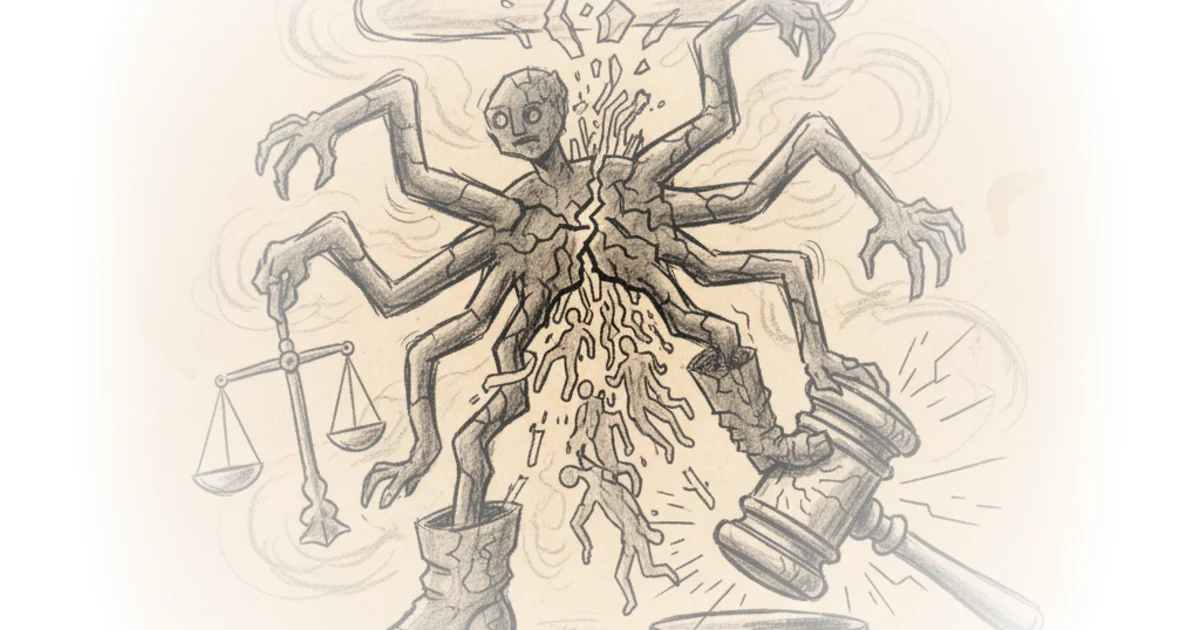
Chris Geidner's piece is a masterclass in connecting the dots between a specific legal maneuver and a broader institutional collapse. The strongest part of the argument is the evidence that the administration is knowingly violating court orders, turning the legal system into a game of whack-a-mole. The biggest vulnerability, however, is the lack of a clear path forward; without a change in policy from the top, the courts will eventually have to choose between enforcing contempt or watching the rule of law evaporate. Readers should watch for whether the administration will finally comply or if the judiciary will be forced to take more drastic measures to restore order.