Kings and Generals reframes the Imjin War not as a distant historical footnote, but as a stark case study in how a unified military machine can exploit the paralysis of a corrupt, fractured state. The coverage is notable for its granular deconstruction of the invasion's logistics, stripping away the romanticized image of the samurai to reveal a war machine powered by peasant conscripts and Portuguese firearms.
The Unifier's Dilemma
The narrative begins by establishing the unique geopolitical pressure cooker that forced the hand of the Japanese leadership. Kings and Generals writes, "peace proved to be yet another challenge for the new Overlord toyotomi hioshi for his country was now home to hundreds of thousands of warriors with no war left to fight." This sets the stage for a conflict driven not by religious zeal or simple expansionism, but by the internal necessity of a newly unified state to redirect its violent energy outward. The author argues that the invasion was a calculated political maneuver: "aware of this fact he made plans to turn his vassels outwards in the late 1580s hungrily eyeing Korea as the initial Target and the Chinese Ming Empire after that."
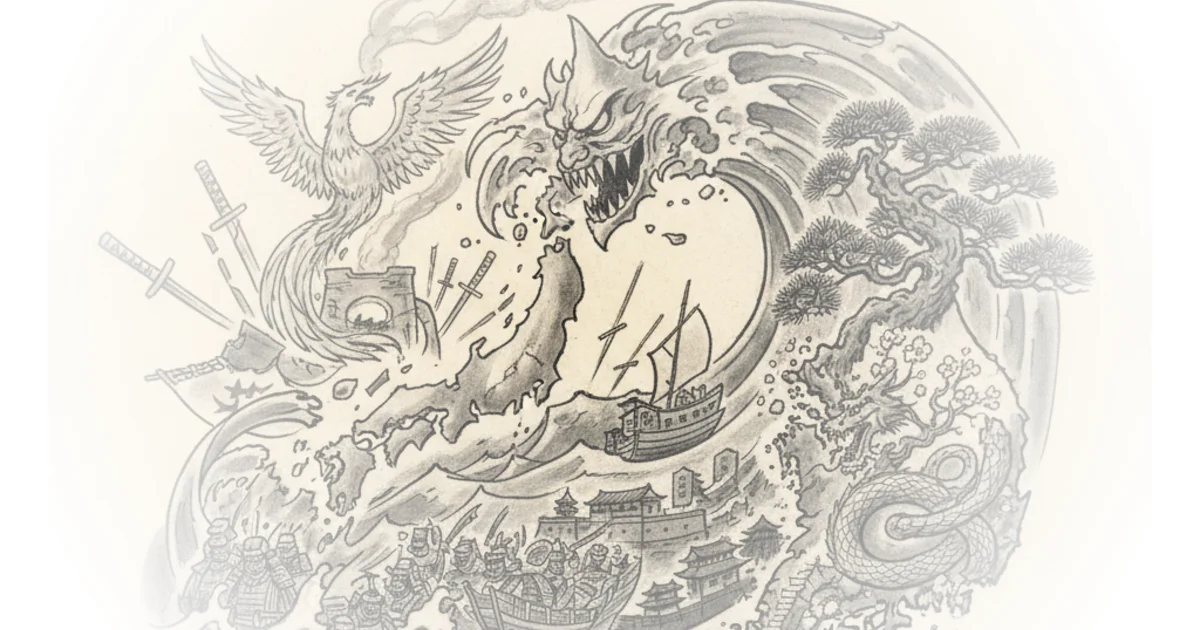
The piece effectively highlights the domino theory employed by the Japanese command, where Korea was merely a logistical stepping stone. As Kings and Generals puts it, "when the Koreans were conquered they were to supply Manpower and material for the push into China." This framing is crucial; it suggests the war was a multi-generational strategy rather than a raid. However, the execution relied heavily on the diplomatic incompetence of intermediaries. The source details how the So clan, tasked with delivering the initial demand, botched the mission through arrogance. The envoy "insulting his Korean hosts by degrading the size of their Spears compared to the Japanese and mocking their lifestyle," a blunder that turned a potential tribute negotiation into a casus belli.
Critics might note that while the diplomatic failure is emphasized, the underlying structural drive for expansion was likely inevitable regardless of the envoy's rudeness. The unification of Japan created a surplus of military power that demanded an outlet, whether the Korean court was polite or not.
The Asymmetry of Readiness
The most striking section of the commentary is the dismantling of the "noble samurai" myth. Kings and Generals writes, "rather than a noble force of katana wielding Samurai the majority of hideyoshi's invading troops were instead humble ashigaru peasant foot soldiers armed with swords Spears and Bows." This correction is vital for understanding the tactical reality of the conflict. The source further notes that "perhaps onethird of this Army was armed with arabus an early form of firearm introduced to Japan by the Portuguese," highlighting a technological edge that the Korean defenders lacked.
In contrast, the Korean defense is portrayed as a tragedy of institutional decay. The author notes that "corruption in Korea was rampant leaving military units neglected untrained and lazy as a whole." This internal rot was compounded by political infighting in Seoul, where the "Westerner faction gradually came to realize the very real Peril Japan posed but any attempt to prepare for the invasion was actively opposed by the easterner group." The result was a catastrophic lack of coordination. When the invasion began, "the incompetent Korean Naval commanders scuttled their sizable provincial fleets and destroyed their weaponry and Provisions retreating North as quickly as they could."
The Josan kingdom was not ready for the storm that was coming.
This quote encapsulates the central thesis: the war was lost before the first ship landed because the defensive infrastructure had been hollowed out by years of neglect and factional strife. The source emphasizes that despite having superior shipbuilding and cannon technology, the Korean navy failed to intercept the initial landing force due to a "catastrophic lack of decisiveness and initiative."
The Battle of Chungju and the Limits of Tactics
The narrative culminates in the Battle of Chungju, a engagement that serves as a grim illustration of tactical superiority meeting strategic desperation. The source describes General Sin Rip's decision to fight on open ground as a deliberate trap: "placing troops in this kind of situation was a long-established Chinese military tactic which had led to remarkable victories in the past." However, the reality of the battlefield rendered the tactic useless against the Japanese firepower.
Kings and Generals writes, "The Peasant soldiers began to route under the pressure but the brave General would not Retreat so easily he led his crack Cavalry in a headlong charge towards the enemy line." The outcome was inevitable: "the arabus reigned withering musket fire down on his Horsemen breaking the charge before any contact was made." The description of Sin Rip's death—"threw himself into a natural spring adorned in full armor committing suicide by Drowning"—underscores the total collapse of the Korean defensive line.
The source effectively uses this battle to illustrate the broader failure of the Korean command structure. The panic in Seoul that followed led to the flight of the court, a decision made "despite the pleas of the populace." This highlights a disconnect between the leadership and the people they were sworn to protect, a theme that runs through the entire coverage. While the Japanese commanders were driven by a race for glory, with rivals like Kishi Yukinaga and Katō Kiyomasa pushing ahead to "monopolize the glory of seizing the capital," the Korean response was defined by paralysis and retreat.
Bottom Line
Kings and Generals delivers a compelling analysis of how internal political fractures and diplomatic hubris can render even a technologically advanced nation vulnerable to a unified, ruthless adversary. The strongest part of the argument is the detailed breakdown of the Japanese army's composition, which corrects historical misconceptions and explains their tactical dominance. The biggest vulnerability, however, is the relative lack of depth regarding the long-term resilience of the Korean-Ming alliance, which ultimately reversed these early gains. Readers should watch for how the source handles the subsequent years of the war, where the initial Japanese momentum inevitably meets the limits of its supply lines and the growing resistance of a mobilized populace.