This piece cuts through the diplomatic noise to reveal a stark truth: the alliance between Beijing and Moscow is fracturing not over ideology, but over the price of a gallon of gas. Joseph Webster argues that while the world watches the headlines of the Shanghai Cooperation Organization, the real story is the economic divergence turning the "Moscow-Beijing axis" into a fragile, transactional arrangement.
The Cracks in the Axis
Webster opens by dismantling the assumption of a monolithic anti-Western bloc. He points out that "daylight has emerged between the positions of Beijing and Moscow" driven by a simple, brutal reality: China needs cheap energy to fuel its factories, while Russia needs expensive energy to fund its war machine. This is not a subtle disagreement; it is a fundamental clash of economic survival.
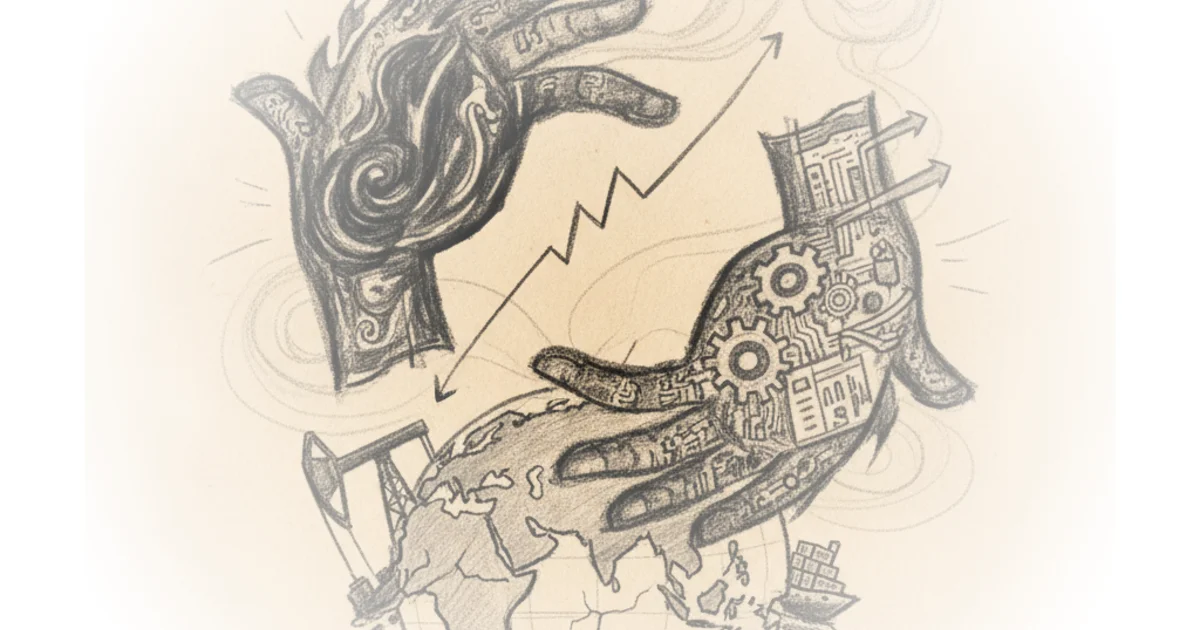
The author grounds this in the current crisis in Ukraine, noting that "Ukraine's increasingly successful drone strike campaign has placed Moscow on its back foot." As Russian refineries burn and diesel prices spike, the Kremlin faces a domestic reckoning. Webster cites analysis by Janis Kluge showing that "Russian gas and diesel prices are rising sharply," creating a feedback loop where military spending consumes two-thirds of the budget while the average citizen feels the pinch at the pump.
"Pain at the pump is further straining the Russian economy and war effort."
This framing is crucial because it shifts the narrative from Russian invincibility to Russian vulnerability. Webster suggests that the West should leverage this by "starving Russia's gas pumps," a strategy that targets the regime's domestic stability rather than just its battlefield capabilities. However, critics might argue that high energy prices could also drive Moscow to double down on aggression rather than seek peace, a risk that remains unquantified in the analysis.
Diverging Agendas in the Middle East
The commentary then pivots to the Middle East, where these economic divergences play out on the diplomatic stage. Webster details how Chinese Foreign Minister Wang Yi and Russian Foreign Minister Sergey Lavrov met with their Iranian counterpart, Abbas Araghchi, yet spoke with different tones. Wang Yi urged a return to negotiations, stating that "the door to negotiations, once opened, should not be closed," reflecting Beijing's desire for stability to protect its trade routes.
In contrast, Moscow's rhetoric is more ambiguous. Webster observes that while Moscow understands it cannot openly argue for war, it has an interest in underscoring the "precarious prospects for a peaceful settlement." This aligns with Russia's need for high oil prices. The author notes that Russia is reportedly providing Iran with satellite imagery and shipping military cargo, actions that serve Moscow's goal of prolonging the conflict to keep energy markets tight.
"Moscow has an economic interest in the conflict continuing and even escalating."
This distinction is vital for policymakers. While the West often treats the two powers as a single entity, Webster shows they are pulling in opposite directions. He warns that the West should be aware of its constraints in attempting a "reverse Kissinger" strategy to split the axis, noting that even if Putin were to leave the scene, "the West and Russia will continue to have an adversarial relationship for the foreseeable future."
The Illusion of the Tollbooth
A significant portion of Webster's analysis challenges the prevailing wisdom on Iran's economic leverage. He tackles the popular theory that Iran could generate massive revenue by taxing ships in the Strait of Hormuz. Webster writes that early estimates claiming Tehran could earn "$100 billion annually" were a result of "anchoring bias" and "wildly overstate the toll's extortion potential by an order of magnitude."
Instead, he relies on Oxford Economics data to suggest a more modest reality: a tollbooth might net Iran and Oman "$6.8 billion a year." While still significant, Webster argues this pales in comparison to the revenue from simply lifting sanctions on oil exports. "Restarting crude oil exports at de-discounted prices and higher volumes would actually account for more incremental economic growth," he asserts.
"Tehran may prioritize the crude oil revenue stream in negotiations over a tollbooth."
This is a powerful correction to the "tollbooth" narrative. It suggests that Iran's primary goal is not to become a toll collector, but to regain access to the global market. Webster also highlights the danger of focusing too much on exports while ignoring imports. He draws a parallel to Russia, noting that "Russia's imports of dual-use, defense-industrial, and civilian goods from the PRC enabled it to prosecute the war." For Iran, access to imports is critical to curbing inflation, which he estimates is running at over 70% per year.
The Human and Strategic Cost
The piece concludes by urging the West to consider the broader implications for global democracies. Webster reminds readers that "the U.S.-Israel-Iran war is imposing significant costs on democracies across East Asia and Europe," which rely on these energy flows to sustain their economies and, increasingly, their artificial intelligence supply chains.
He argues that unfreezing Tehran's assets is a more potent lever than many realize. "A dollar of deployable cash now is worth more to Tehran than its face value," he writes, emphasizing the regime's acute liquidity crisis. However, he also warns that if the West abandons sanctions, U.S. allies may have little interest in sustaining them, creating a fragmented global response.
"The interests of the East Asian and European democracies must be respected."
This final point serves as a sobering reminder that the conflict in the Middle East is not an isolated event. It is a stress test for the global order, where energy security, supply chain resilience, and diplomatic cohesion are all on the line. The human cost of this geopolitical chess game is often invisible in high-level strategy, yet the disruption of energy flows threatens to deepen poverty and instability for millions.
Bottom Line
Webster's strongest contribution is his ability to strip away the ideological veneer of the Russia-China-Iran axis to reveal the cold, hard economic calculations driving their behavior. His biggest vulnerability lies in the assumption that economic pain will necessarily translate into political concessions, a dynamic that has often failed to materialize in authoritarian regimes. Readers should watch closely for how the West balances the need to pressure Tehran with the imperative of keeping global energy markets stable for its own allies.