This piece cuts through the noise of climate rhetoric to deliver a stark, data-driven correlation that many policymakers prefer to ignore: the political color of a state's leadership is now the single strongest predictor of its electricity bills. Energy Bad Boys doesn't just suggest a trend; they map a direct line from legislative mandates to the price on your monthly statement, arguing that affordability has become a casualty of ideology. For a busy professional trying to understand why their overhead is soaring while competitors in other regions thrive, this analysis offers a rare, unvarnished look at the cost of "green" policy choices.
The Political Price Tag
The core of the argument rests on a simple, almost shocking statistical reality. Energy Bad Boys reports, "twelve out of the top fifteen states with the highest electricity prices in the country are blue states, and only one is red." The piece leans heavily on federal data to show that electricity prices have surged 27% from January 2021 through January 2025, with the burden falling disproportionately on regions that voted for Democratic nominees in the last two elections. The editors note that "86% of states with electricity prices above the national average in the continental U.S. are reliably blue," while the cheapest power is found almost exclusively in states with Republican governance.
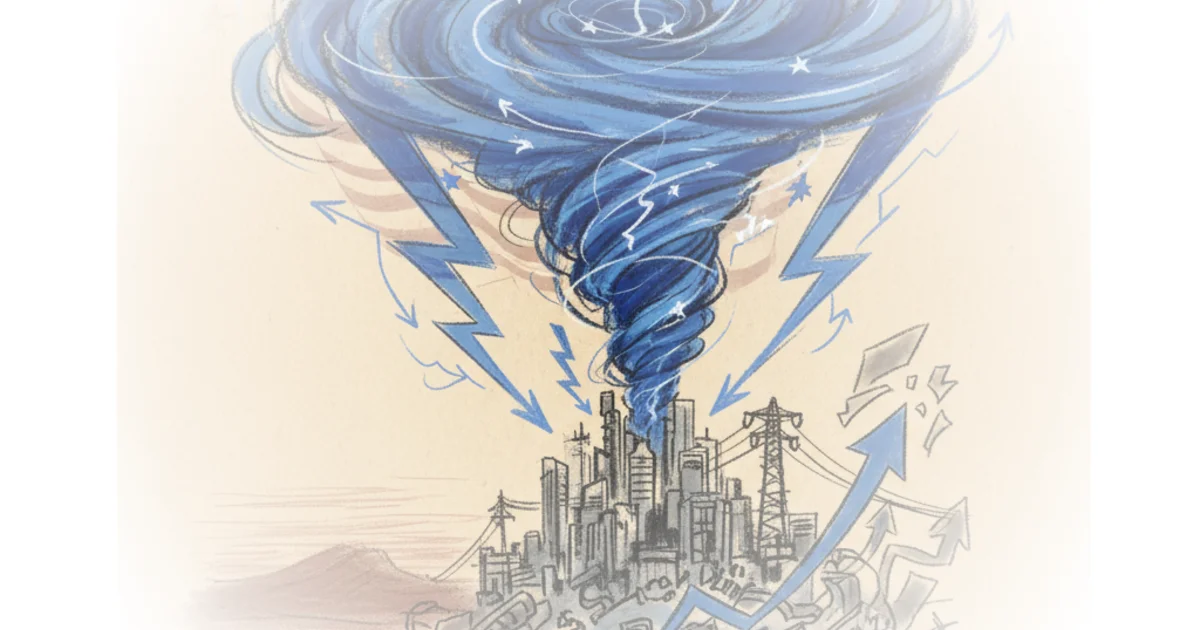
This framing is effective because it bypasses the usual debate over carbon emissions to focus squarely on the consumer's wallet. The article argues that these price hikes are not accidental market fluctuations but the result of deliberate state-level decisions. "Electricity prices are especially high in traditionally liberal areas of the country," the piece asserts, linking high costs directly to the authority states hold under the Federal Power Act to dictate their own generation portfolios. By highlighting that states can mandate renewable portfolio standards or clean energy standards, the authors suggest that the market is being artificially constrained by political preference rather than economic fundamentals.
"Expensive Electricity is a Choice: How States Shape Electricity Policy."
Critics might argue that this correlation ignores the timing of the transition; many "blue" states are simply further along in decarbonizing their grids, meaning their costs reflect the upfront investment in a new infrastructure era rather than a permanent failure of policy. However, the piece counters this by pointing to the immediate strain on ratepayers, noting that "73% of U.S. residents were concerned about their electricity and gas bills rising this year."
The Cost of Mandates
The commentary dives deep into specific case studies to illustrate how policy translates to price. In New York, the editors highlight the Climate Leadership and Community Protection Act (CLCPA), which mandates 70% renewable energy by 2030 and 100% by 2040. The piece argues that these goals are being pursued even as the state's reliable capacity shrinks, citing the premature closure of the Indian Point nuclear power plant. This is a crucial historical context; the loss of that massive baseload generator forced the grid to rely more heavily on intermittent sources and expensive imports, a dynamic the article claims is driving prices up by 62% compared to Florida.
The analysis suggests that New York's leadership is trapped by their own regulations. "The convergence of shrinking supply and rising demand inevitably leads to upward price pressures for consumers," the piece quotes from a Progressive Policy Institute study, adding that these costs are "compounded by the immense capital investment required to transform the grid." The editors point out that even the Governor has had to delay certain carbon cap-and-tax mandates because they were deemed "infeasible" due to the "extraordinary and damaging costs upon New Yorkers." This admission of policy overreach is the article's strongest evidence that the current trajectory is unsustainable.
California receives similar scrutiny. The piece notes that rates there are "double the national average," driven by a decades-long string of mandates starting with SB 1078 in 2002 and culminating in the 2018 SB 100, which set a 100% carbon-free target. The editors argue that California is prioritizing social policy over energy security, noting that the state is now "second in the country in electricity imports" because it has "intentionally increase[d] electricity rates" to fund these goals. The article claims that "California's sky-high electricity rates are not the result of scarcity... but rather are the direct consequence of policies that deliberately sidelined reliable, conventional fuels."
The Outliers: Affordability as Policy
In stark contrast, the piece profiles Florida, Louisiana, and Kentucky as models of affordability achieved through a different regulatory philosophy. Florida, despite its hurricane risks and massive residential demand, keeps rates 2% below the national average. The editors attribute this to a simple strategy: "Florida has been successful by avoiding the aggressive climate mandates adopted by most high-cost blue states." By generating 75% of its power from natural gas, the state has insulated its ratepayers from the volatility of renewable integration.
Louisiana and Kentucky offer similar lessons. Louisiana leverages its status as a top natural gas producer to keep costs low, with the piece noting that "low natural gas prices in the United States lead to low electricity prices in Louisiana." Kentucky, meanwhile, relies heavily on coal and natural gas, resulting in rates that are "21% lower than the national average." The editors argue that these states prove that "prioritizing affordability and reliability over mandates" is a viable path forward. The piece concludes that in these regions, "utilities select generation resources based on economic fundamentals rather than political preferences."
"Aggressive renewable energy mandates and climate policies entail steep costs borne directly by ratepayers."
A counterargument worth considering is that the long-term economic risks of fossil fuel dependence—such as stranded assets or future carbon taxes—are not reflected in today's lower rates. The article dismisses these concerns by focusing on the immediate financial pain of current mandates, but it offers little discussion on how these "red" states might adapt if federal regulations or global market shifts force a transition later.
Bottom Line
The strongest part of this argument is its refusal to treat high electricity prices as an inevitable side effect of climate progress; instead, it frames them as a direct, predictable outcome of specific legislative choices. The piece's biggest vulnerability is its narrow focus on current ratepayers, potentially underweighting the long-term necessity of decarbonization or the external costs of pollution. Readers should watch for how state legislatures respond to these rising bills—whether they double down on mandates or, as seen in New York, begin to backtrack under the weight of economic reality.