Dave Amos delivers a startling diagnosis for a problem we all recognize but rarely name: the drive-through has evolved from a convenient amenity into a public nuisance that chokes our streets and erodes our social fabric. While most coverage focuses on the frustration of waiting in line, Amos argues that the very architecture of modern fast food is actively dismantling the "third places" where communities gather, replacing them with dystopian, car-centric monoliths.
The Architecture of Gridlock
Amos begins by documenting the sheer scale of the traffic crisis, noting that popular chains are so successful they are effectively turning public streets into private parking lots. He cites specific examples, such as a Santa Barbara location that "regularly blocks the rightmost lane for about 90 minutes every weekday," forcing the city to consider declaring the restaurant a public nuisance. The problem is so acute that a shopping center in Bowmont, Texas, is actually suing a Chick-fil-A for the traffic jams caused by its drive-throughs.
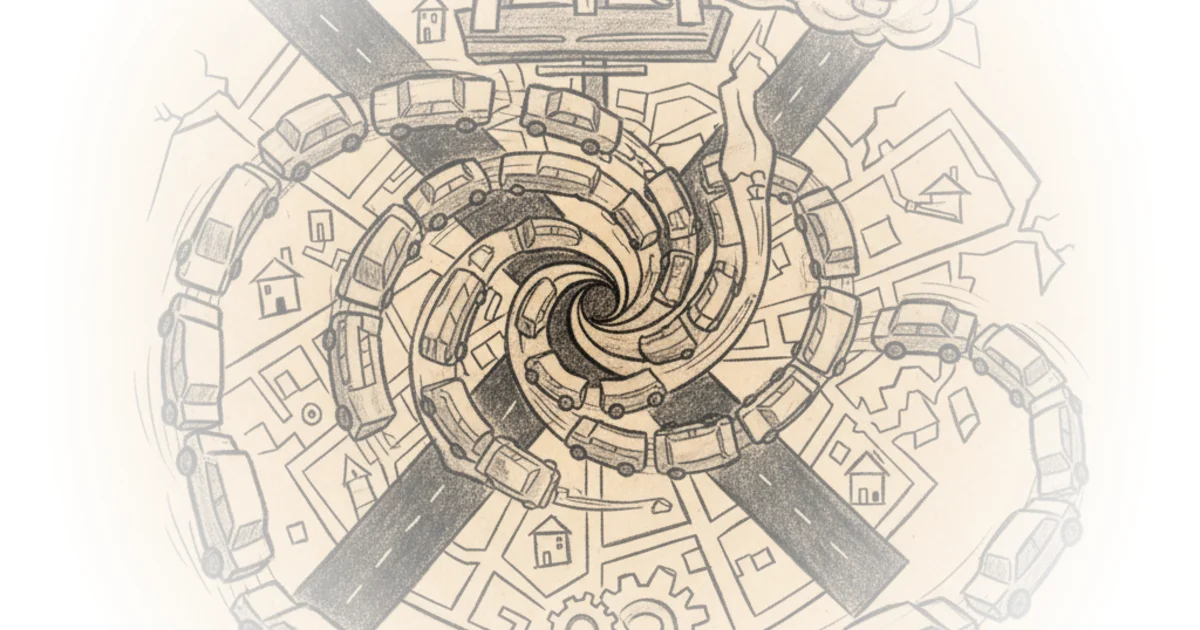
The author observes that the industry's response to this congestion is not to reduce demand, but to double down on car infrastructure. When chains hit revenue thresholds, they engage in a "scrape and rebuild," demolishing existing structures to add more lanes or, in extreme cases, eliminating indoor dining entirely. Amos points out the absurdity of this trajectory: "Chick-fil-A is going even further too they launched a new four-lane drive-through concept with no indoor dining and a kitchen that sits above the drive-through Lanes." He describes a unique meal transport system where a conveyor belt moves orders from a kitchen twice the size of a normal one to servers below, a setup the company claims can deliver a meal every six seconds.
This engineering marvel, however, comes at a steep cost. Amos argues that while these innovations might solve the queuing problem for the individual driver, they are "eliminating third spaces or places for people to hang out." The shift toward drive-thru-only models is not just a traffic issue; it is a fundamental change in how we use public space. Critics might note that for low-income workers or parents with young children, the drive-through remains an essential convenience that indoor dining cannot replace. Yet, Amos suggests that the convenience of the car is being prioritized over the health of the community's social ecosystem.
Fast food locations with multiple drive-through Lanes generated more emissions than those with just one, and closing a drive-through can reduce nox emissions by 60 to 70%.
The Erosion of Community
The commentary shifts from traffic engineering to social science, highlighting the hidden cost of the drive-through boom: the loss of human connection. Amos reminds readers that fast food restaurants have historically served as vital "third places"—social surroundings separate from the two usual social environments of home and the workplace. He cites gerontological studies showing that seniors often rely on these spaces, noting that in Honolulu, one restaurant hosted 100 to 150 seniors daily, making up 80% of all patrons.
"Since 2010 almost all categories of third places including houses of worship grocery stores and Civic buildings have been losing locations," Amos writes. He connects this decline to a broader crisis in American social health, arguing that "regular quality socialization is positively correlated with individual health." By replacing these gathering spots with sterile, car-only facilities, the industry is accelerating the isolation of vulnerable populations.
The environmental impact is equally stark. Amos notes that idling vehicles block sidewalks and interfere with transit schedules, generating a pound of carbon for every Big Mac while waiting. The argument here is compelling because it reframes the drive-through not as a neutral convenience, but as an active pollutant that degrades air quality and blocks pedestrian access. The sheer volume of these establishments means that eliminating them would yield "a significant measurable Improvement for local air quality."
The Case for the Ban
So, what is the solution? Amos turns to policy, highlighting a growing movement among local governments to ban the construction of new drive-throughs. He points to Minneapolis, which prohibited new facilities in 2019, and Baldwin Park, California, which recently enacted a ban despite being the home of the first modern drive-thru. The most compelling evidence comes from Amos's own experience in San Luis Obispo, a city that banned drive-throughs in 1982.
"The word on the street is that the band has prevented in andout from ever opening a location in the city and the residents have to drive 20 minutes to get their double doubles," Amos admits, but he immediately counters the nostalgia for convenience: "honestly I don't miss drive-through Lanes all that much." He explains that without the "drive-through moat" surrounding the building, fast food locations can be integrated into the sidewalk network, making them walkable and allowing for shared parking in strip malls.
This approach forces a behavioral shift. "If you want your food you have to pull up park and go inside," Amos writes, noting that mobile ordering has made this process faster than waiting in a line anyway. The ban effectively ends the "madness" of chains designing increasingly complex car-centric concepts, forcing them to integrate into the existing urban fabric. A counterargument worth considering is whether such bans disproportionately hurt rural or car-dependent communities where public transit is non-existent. However, Amos's focus remains on urban and suburban centers where the infrastructure for walking and shared parking already exists.
Instead of local governments battling fast food chains to Shell out for traffic improvements or fast food restaurants designing dystopian restaurant Concepts we could just end the madness and have people actually go into the building and order food.
Bottom Line
Amos's strongest argument is the reframing of the drive-through from a symbol of efficiency to a driver of social and environmental decay, backed by concrete examples of cities successfully reversing the trend. The piece's biggest vulnerability lies in its potential to alienate those who rely on drive-throughs out of necessity rather than choice, a nuance that requires more robust policy solutions than a simple ban. Ultimately, the reader should watch for the spread of these bans to major metropolitan areas, which could force a fundamental redesign of the American fast-food landscape.