James Meadway delivers a stinging critique of the economic establishment's inability to grasp why inflation has behaved so unpredictably, arguing that the real culprit isn't policy error or temporary shocks, but the arrival of a chaotic new era defined by climate collapse and geopolitical fracture. He posits that the standard models economists rely on are not just slightly off; they are fundamentally broken because they treat environmental disasters as rare anomalies rather than the new normal. For busy leaders trying to navigate a volatile global economy, this piece suggests that the next decade won't be about fine-tuning interest rates, but about managing a system where the weather and the map are constantly changing.
The Failure of the "Transitory" Narrative
Meadway begins by dismantling the prevailing consensus that recent inflation was merely a temporary glitch caused by the pandemic and the war in Ukraine. He notes that while the Federal Reserve and other central banks have celebrated a decline in price rises, the underlying conditions that caused the spike remain unresolved. He writes, "Crucially, neither side look today to be correct. Inflation has remained higher, for longer, than expected by Team Transitory; but, on the other side, unemployment has remained pretty low across the developed world."
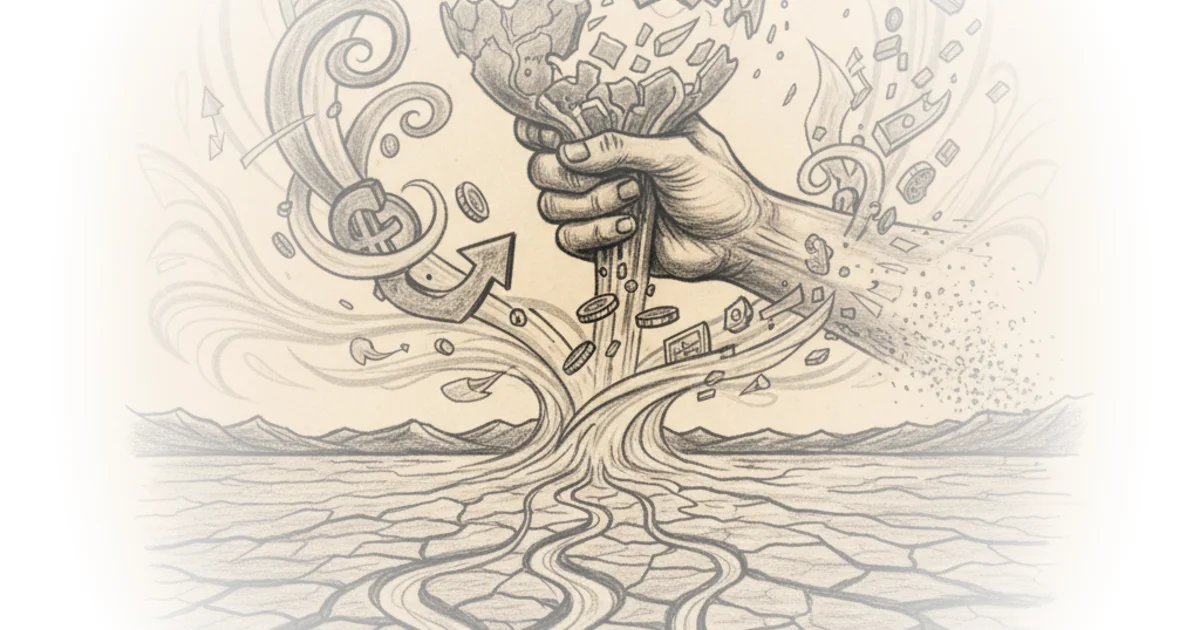
This observation is vital because it exposes the fragility of the "Team Transitory" argument, which assumed supply chains would snap back to normal and that the economy would self-correct. Meadway points out that this view relied on a belief in the efficiency of competitive markets that simply doesn't exist in a world of concentrated power and physical limits. He argues that sectors with the highest price increases were those dominated by a few producers, not a free market swooping in to fix bottlenecks. As he puts it, "You couldn't (for example) harvest a second Ukraine to replace disrupted supplies in 2022, because there isn't one."
The author's framing here is particularly effective because it moves the debate away from abstract monetary theory and toward physical reality. Critics might argue that inflation is still cooling and that the worst is over, but Meadway counters that this ignores the structural shifts that will prevent a return to the stability of the past. He suggests that treating these events as one-off shocks is a dangerous delusion.
The storm will never pass.
When Models Meet the Anthropocene
The core of Meadway's argument is that the economic models used by central banks are ill-equipped to handle the "polycrisis" of the 21st century. He describes a situation where environmental degradation and geopolitical instability are no longer external factors but are becoming the primary drivers of economic behavior. He cites the simultaneous failures of the Panama Canal due to drought and the Suez Canal due to conflict as a perfect encapsulation of this new reality. He writes, "In a world subject to repeated, consistent shocks, deriving from the same source, what use is a model that can only say they are 'external' deviations from the economy's growth path?"
This is a profound shift in perspective. Instead of viewing climate change as a future risk to be priced in, Meadway argues it is a present, active force that is breaking the transmission mechanisms of the global economy. He notes that the Phillips Curve, a staple of economic theory linking unemployment and inflation, has become "unstable" and useless for policy-making. He quotes a Federal Reserve survey paper to support his claim that relying on "inflation expectations" to explain current dynamics is "unnecessary and unsound."
The strength of this section lies in its willingness to call out the intellectual stagnation of the profession. Meadway accuses mainstream economists of engaging in "paradigm maintenance," where they add "epicycles to epicycles" to defend a core theory that no longer fits the facts. He draws on the philosopher of science Imre Lakatos to describe this as a "degenerating scientific research programme," where theorists are running faster just to stay in place.
A New Economic Reality
Meadway concludes by warning that the era of stable environmental conditions, which allowed economists to ignore the link between nature and the economy for a century, is over. He references historical attempts to link sunspots to business cycles, noting that while those were ridiculed, the current reality of climate-driven inflation is far more serious. He writes, "The presence of environmental effects isn't unknown to economics... but it was good enough for most purposes, at least in terms of the degrees of accuracy macroeconomic models are supposed to operate with. This is increasingly not going to apply."
The author's tone is one of urgent realism. He suggests that the next phase of economic history will be defined by "global instability, resulting from the environmental instability." This means that the tools used to manage the post-2008 crisis, such as tweaking aggregate production functions or borrowing from behavioral economics, will be insufficient. The challenge is not just to update the models, but to recognize that the economy is now embedded in a volatile biosphere that does not care about GDP targets.
Critics might note that Meadway's dismissal of all current macroeconomic tools could leave policymakers without any immediate guidance. However, his point is that clinging to broken tools is more dangerous than admitting ignorance. He quotes John Maynard Keynes to drive the point home: "Economists set themselves too easy, too useless a task if in tempestuous seasons they can only tell us that when the storm is long past the ocean is flat again."
Bottom Line
James Meadway's strongest argument is his insistence that the "polycrisis" of climate and conflict has rendered the standard economic playbook obsolete, forcing a reckoning with a world where supply shocks are permanent features rather than temporary glitches. The piece's biggest vulnerability is its lack of a concrete alternative framework, leaving readers with a diagnosis of the problem but no clear map for the solution. For leaders relying on these models, the takeaway is stark: the storm is here, and the ocean is not flattening out anytime soon.