Sebastian Raschka delivers a rare, granular autopsy of a model release that arrived quietly over a holiday weekend, yet carries the weight of a paradigm shift. While the industry fixates on proprietary black boxes, Raschka argues that the real story lies in how an open-weight contender is redefining efficiency through architectural gymnastics rather than brute force. This is not just a benchmark update; it is a blueprint for how to compete when compute resources are scarce and the hardware landscape is volatile.
The Architecture of Efficiency
Raschka immediately dismantles the narrative that the DeepSeek team went dormant after their initial success. He notes that while there was a quiet period, the team was "navigating the switch from NVIDIA to Huawei chips," a critical detail that underscores the geopolitical fragility of modern AI development. This context is vital for any observer trying to understand the supply chain realities behind the code.
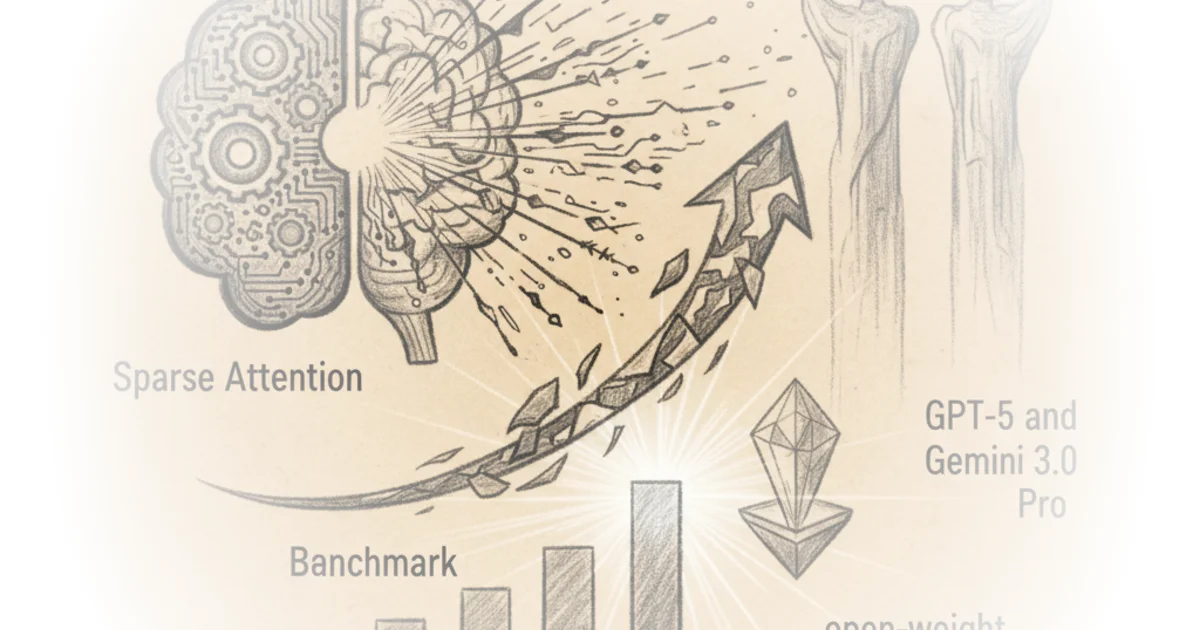
The core of the piece focuses on the transition from DeepSeek V3 to the new V3.2. Raschka highlights the persistence of Multi-Head Latent Attention (MLA), a memory-saving strategy that compresses data before storage. He explains that "MLA... offers a memory-saving strategy that pairs particularly well with KV caching," allowing the model to store compressed tensors and project them back only when needed. This is a sophisticated engineering choice that prioritizes inference speed and memory footprint over raw parameter count.
"The idea in MLA is that it compresses the key and value tensors into a lower-dimensional space before storing them in the KV cache."
This approach is particularly striking because it mirrors techniques used in fine-tuning, yet here it is baked into the fundamental architecture. Raschka suggests this is not a new invention but a refinement of a strategy introduced in V2, proving that iterative optimization can sometimes outpace radical reinvention. Critics might argue that relying on such complex compression adds latency during the up-projection phase, but Raschka's analysis suggests the trade-off is favorable for long-context scenarios.
The Reasoning Pivot
Perhaps the most provocative argument in the piece is Raschka's observation about the shifting philosophy of reasoning models. He contrasts the dedicated reasoning approach of DeepSeek R1 with the new hybrid nature of V3.2. He posits that the earlier R1 model was essentially a "testbed or prototype model" designed to prove that Reinforcement Learning with Verifiable Rewards (RLVR) could work.
The shift to a hybrid model, where users can toggle between general chat and reasoning modes, signals a maturation of the technology. Raschka writes, "The V3.2 release may be more about developing the best overall model for different use cases." This move away from siloed models suggests the industry is moving toward more versatile, cost-effective solutions that don't require users to maintain multiple versions of a model for different tasks.
"DeepSeek V3 is a base model, and DeepSeek R1 is a dedicated reasoning model... The V3.2 release may be more about developing the best overall model for different use cases."
This framing challenges the prevailing hype cycle that treats every new model as a distinct, singular purpose tool. Instead, Raschka sees a consolidation of capabilities. He notes that while the team developed V3.1 and V3.2 with reasoning capabilities, they "might still be working on a dedicated R2 model," implying that the hybrid approach is a strategic bridge rather than a final destination.
The Sparse Attention Breakthrough
The technical climax of Raschka's commentary is his deep dive into the DeepSeek Sparse Attention (DSA) mechanism introduced in the V3.2-Exp variant. This is where the piece moves from observation to technical revelation. Unlike standard attention mechanisms that look at all previous tokens, or sliding windows that look at a fixed block, DSA uses a "lightning indexer" to selectively attend to specific past tokens.
Raschka explains that this mechanism is not random but learned, using a "fine-grained sparse attention mechanism powered by a lightning indexer" to decide which tokens matter. This allows the model to ignore irrelevant context, drastically reducing computational load during long sequences. He details how the indexer computes relevance scores based on compressed token representations, effectively creating a dynamic, intelligent filter for information.
"With DSA, a fine-grained sparse attention mechanism powered by a lightning indexer, DeepSeek-V3.2-Exp achieves significant efficiency improvements in both training and inference, especially in long-context scenarios."
This is a significant departure from the "sliding window" approach used by other recent models. While sliding windows are predictable, Raschka points out that DSA's selection is "more random" in appearance but actually driven by learned relevance. This distinction is crucial: it means the model is learning what to remember, not just how much to remember. A counterargument worth considering is whether this dynamic selection introduces instability in reasoning tasks where context continuity is paramount, but Raschka's evidence suggests the efficiency gains outweigh these risks for most applications.
"The sparsity rather comes from the separate token selector. The separate token selector keeps only a small number of high-scoring tokens... and constructs a sparse attention mask that masks out the other tokens."
Bottom Line
Raschka's analysis succeeds in reframing the DeepSeek V3.2 release not as a mere incremental update, but as a strategic masterclass in resource-constrained innovation. The strongest part of his argument is the identification of sparse attention as the new frontier for efficiency, moving the industry beyond the brute-force scaling of the past. However, the piece's biggest vulnerability is its reliance on the assumption that these architectural gains will translate seamlessly to real-world, high-stakes applications without hidden latency costs. For the busy professional, the takeaway is clear: the future of AI isn't just about bigger models, but smarter, leaner architectures that can operate effectively even when the hardware landscape shifts beneath them.