Pitch
There's a rhetorical trick that's become standard in internet debates: force your opponent to define exactly what they're discussing—God, justice, insurrection—and then watch them scramble for an answer. The crowd cheers as exceptions pile up. But what if this isn't a failure of definition? What if it's two people playing entirely different language games? Stephen West argues that Ludwig Wittgenstein's final work offers a powerful explanation for why these conversations seem to go nowhere—and why they might be unavoidable.
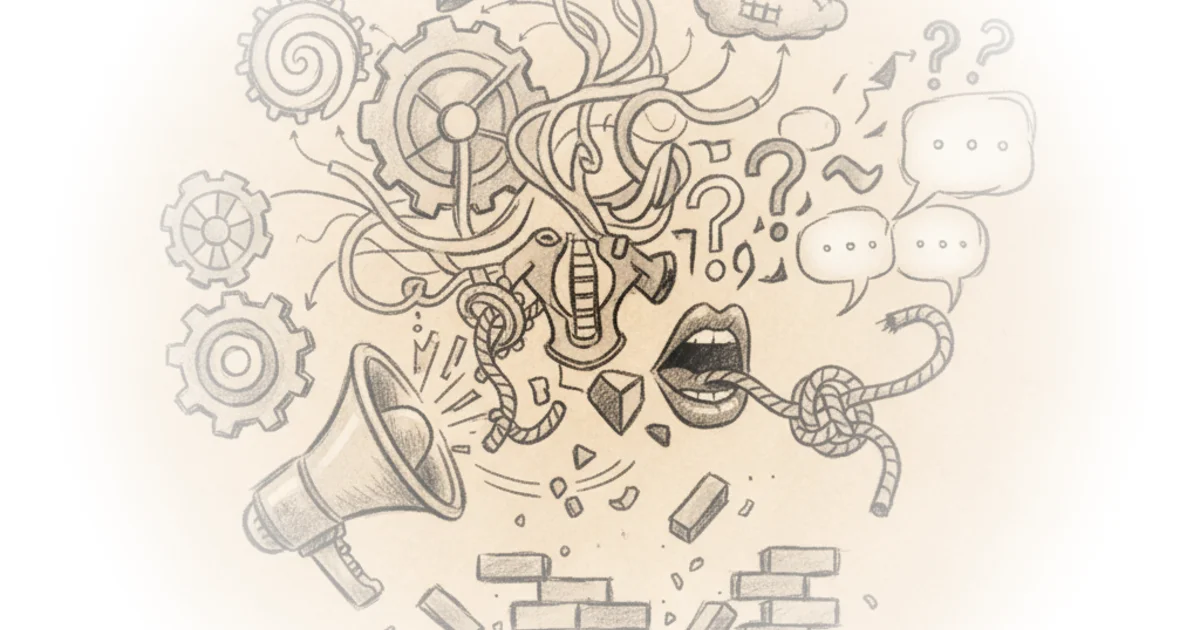
The Capture of Language
Wittgenstein's Philosophical Investigations, published after his death, opens with a direct assault on what he calls the Augustinian theory of language. This is the common belief that words function like name tags: someone points to an apple, everyone agrees it's an apple, and the word gets written into the dictionary.
The problem? Words don't work this way.
West explains that Wittgenstein saw every word's meaning as emerging from a community of people using it in context. No single person points at an object and names it. Meaning comes from shared rules and practices—grammars—that have crystallized over time through countless interactions. A baby can't learn "red" by simply pointing at a fire truck because the child lacks the community context to know whether red means color, the truck itself, or the sound it makes.
Language is never just pointing—it requires an entire community of practice to make sense.
These grammars aren't fixed. They shift as communities change. Yet they're not arbitrary either. Certain human tendencies—caring for loved ones, mourning the dead, joking with friends—always shape what we find meaningful. Wittgenstein calls these "forms of life." They're the foundation upon which all language rests.
The Geometry Problem
A natural objection arises: aren't triangles definable? A triangle is a polygon with exactly three sides. This seems like an objective fact.
Wittgenstein would agree that geometry operates by its own grammar—a closed system where proofs justify claims, and axioms ground definitions. But here's the crucial point: this grammar differs fundamentally from everyday conversation.
When someone applies mathematical certainty to political debates or daily life, they misunderstand how language works. West points out that trying to use chess rules for dating conversations would make someone seem foolish. Yet philosophers since Plato have attempted exactly this—translating one language game's grammar into another and expecting coherence.
This is why the debate tactic at the episode's opening works so well. Opponents operate in ordinary language games while challengers demand mathematical precision. It's an impossible task by design—and it exploits a deep insight about how we communicate.
The Debate Tactic Explained
The person asking for definitions isn't seeking truth. They're deploying rhetoric that makes sense only within a different grammar. They know the other side will fail to provide perfect definitions, and they can then point out exceptions while the audience doubts the opponent's knowledge.
But Wittgenstein would say these aren't failures of understanding. They're people using fundamentally different language games—geometry versus everyday speech—and neither is wrong.
Bottom Line
West presents Wittgenstein's case as a powerful lens for understanding why definitional debates feel so frustrating. The strongest part of his argument: meaning doesn't live in individual minds but in community practices that no one controls. The vulnerability: this could read like relativism, and reasonable people can disagree about whether community consensus makes language too fluid to ever achieve shared truth. What comes next is asking how we find common ground when everyone operates from different grammars.