In an era where cloud reliability is often treated as a given, Gergely Orosz delivers a rare, granular autopsy of a catastrophic failure that shattered that illusion. Rather than settling for the media's convenient narrative of a "brain drain," the piece leverages exclusive access to the engineers who actually fixed the system to reveal a far more unsettling truth: the real enemy is the hidden complexity of distributed systems themselves. This is essential listening for anyone who assumes that scale automatically equals stability.
The Myth of the Brain Drain
The immediate hook of the coverage is its direct refutation of the prevailing media story. When the outage hit the us-east-1 region, taking down giants like Signal and Amazon.com for 15 hours, headlines blamed a loss of institutional knowledge. Orosz dismantles this quickly. "Spoiler alert: this outage was not caused by a brain drain," he writes, noting that five of the original architects of the failing service were on the call within hours. This framing is crucial because it shifts the blame from human error or attrition to systemic fragility. It forces the reader to confront the reality that even with the original builders present, the system can still collapse under specific, rare conditions.
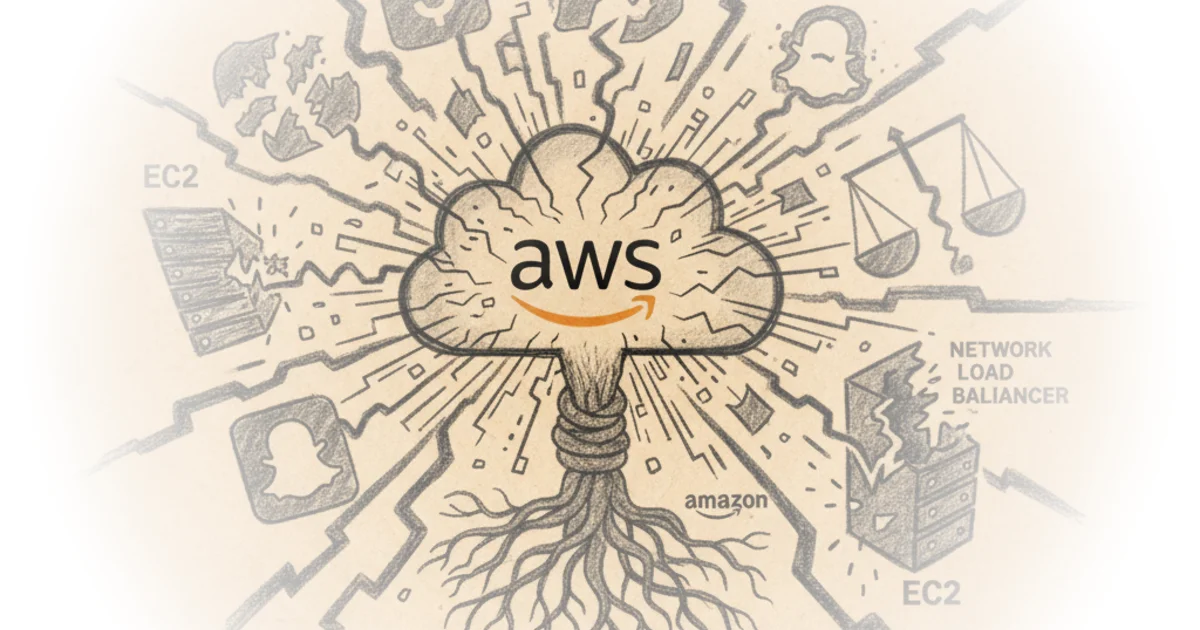
The author's decision to center the narrative on Senior Principal Engineer Gavin McCullagh provides a level of operational detail rarely seen in post-mortems. Orosz writes, "Operating distributed systems is simply hard, and it's even harder when several things go wrong at once." This sentence encapsulates the article's core thesis. The coverage details how the team initially chased a red herring—a minor network packet loss event—while the real killer, a race condition in the DNS Enactor service, went undetected. The narrative arc here is compelling because it mirrors the chaos of the actual event; the reader feels the frustration of the engineers as they pivot between two simultaneous crises.
"The team had never had to manually overwrite the DNS zone files before, as they had a system that could reliably do this!"
This observation highlights the "automation paradox," a concept that deserves more attention in engineering circles. The very automation that makes the system efficient became a liability when it broke, leaving the team without a practiced manual override procedure. Critics might argue that this is a failure of basic operational hygiene, but Orosz's account suggests it is an inevitable byproduct of optimizing for normalcy at the expense of edge-case preparedness.
The Mechanics of Failure
Orosz excels at translating high-level technical failures into a coherent story of cause and effect. The outage wasn't a single point of failure but a cascade triggered by an "unlucky, unexpected lock contention across the three DNS enactors." To understand the gravity of this, one must appreciate the underlying architecture. The system used an optimistic locking mechanism to ensure only one enactor wrote to the DNS at a time. This approach, reminiscent of how Optimistic Concurrency Control manages database writes without locking the entire table, works beautifully until the timing of updates creates a deadlock. The article notes that the team considered using DynamoDB for this locking but rejected it to avoid a circular dependency, a decision that ironically left them vulnerable to the very race condition that occurred.
The commentary on the "follow the sun" oncall rotation adds a human dimension to the technical analysis. With teams in Seattle, Dublin, and Sydney, the response was continuous, yet the complexity of the problem outpaced the standard protocols. Orosz describes how the call was split to handle the networking issue and the DynamoDB issue in parallel, a tactical decision that likely prevented total paralysis. "The root cause of the issue with DynamoDB ended up being identified as a race condition within a DNS Enactor service," he explains, emphasizing that the fix required manual intervention to overwrite the broken alias records pointing to a non-existent tree.
The article also touches on the historical context of Metastability, where a system appears stable but is actually teetering on the edge of a state change. The outage was a textbook metastable failure: the system didn't crash immediately; it degraded slowly, confusing the monitoring tools and leading the team to misdiagnose the root cause. This nuance is vital for busy leaders who need to understand why their dashboards might look green even when the system is failing.
The Path Forward
The final section of the piece moves from diagnosis to prevention, outlining how the administration of the cloud is evolving. Orosz notes that improvements from a 2023 outage helped contain the damage this time, proving that the feedback loop of incident response is working. However, the solution goes beyond better checklists. "There's a plan to use formal methods for verification, even for systems like DynamoDB's DNS services," Orosz writes. This is a significant pivot. Formal methods, which use mathematical proofs to verify system correctness, are traditionally reserved for safety-critical hardware or aerospace, not high-scale cloud infrastructure. Adopting them for DNS services signals a fundamental shift in how the industry views reliability.
"The incident summary overlooked questions such as why it took so long to resolve, and some media coverage sought to fill the gap."
By filling that gap with the actual mechanics of the fix, the article restores a sense of agency to the engineering community. It suggests that the path to resilience isn't just about hiring more people or retaining talent, but about fundamentally rethinking how we build and verify complex systems. The vulnerability here is that formal methods are expensive and slow to implement; the industry may not be willing to pay that price for every service. Yet, as this outage demonstrated, the cost of failure is becoming too high to ignore.
Bottom Line
Gergely Orosz's coverage is a masterclass in demystifying technical catastrophe, replacing sensationalist headlines with a rigorous, human-centered analysis of system design flaws. Its greatest strength is the refusal to blame people, instead exposing the inherent fragility of the automation we rely on. The piece's biggest vulnerability is the implicit admission that even the best teams and the smartest architects cannot fully predict these edge cases, leaving readers with a sobering reminder that total reliability may be an impossible goal. Watch for how the industry adopts formal methods; if they succeed, the next major outage may be a thing of the past.