Dave Borlace cuts through the diplomatic fog of climate summits to deliver a stark verdict: the window for avoiding catastrophic loss is not just closing, it is slamming shut. Unlike standard reports that dwell on abstract temperature targets, this analysis forces a confrontation with the immediate, irreversible collapse of the ecosystems that sustain human civilization. The evidence presented suggests we have already crossed critical thresholds where adaptation is no longer a choice, but a desperate scramble for survival.
The Architecture of Doom
Borlace anchors his argument in the latest assessment from the Intergovernmental Panel on Climate Change (IPCC), the United Nations body that synthesizes tens of thousands of peer-reviewed studies. He frames the report not as a prediction, but as a risk assessment that has already turned grim. "The report finds that climate change is already killing human beings destroying nature and making the world poorer," Borlace writes, establishing a tone of urgency that rejects the notion of a distant future crisis. The core of the argument is that the meeting of twenty thousand delegates at COP 26 in Glasgow failed to put the world on track, leaving humanity past many of the tipping points scientists have warned about for decades.
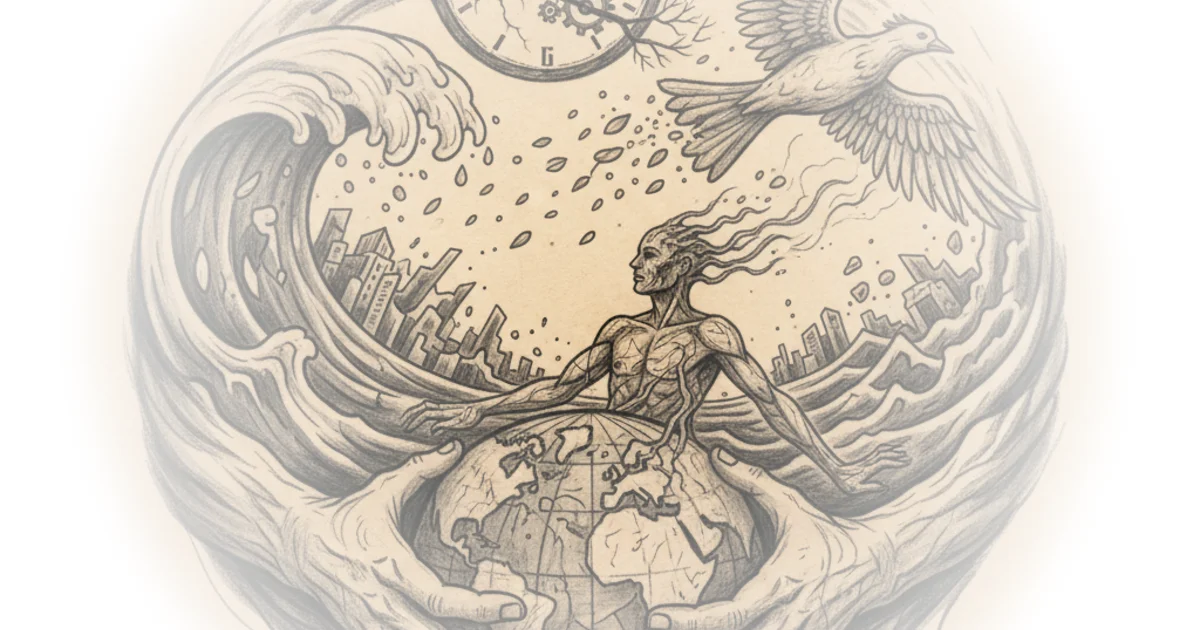
This framing is effective because it shifts the blame from abstract "future generations" to current policy failures. Borlace visualizes the problem as an "anti-wheel of fortune," where the center holds the interconnected variables of climate hazards, vulnerability, and exposure. He notes that while skeptics often demand absolute guarantees about the climate in eighty years, modern science can now provide "very robust ranges of projected future outcomes" that allow policymakers to assess risk. The implication is clear: we have the data to act, but we lack the political will.
"We've known for decades that human society especially western human society has been releasing increasingly larger amounts of greenhouse gases... so the ecosystems that human beings and all other species rely on for survival are getting clobbered from all angles."
Critics might argue that focusing solely on the "vicious circle" of damage ignores the resilience of certain ecosystems or the potential for rapid technological breakthroughs. However, Borlace counters this by highlighting that nature is responding to change so quickly that "losses and damage are inevitable and unavoidable in the coming years." The argument holds weight because it relies on observed data—such as the disappearance of kelp forests and the bleaching of coral reefs—rather than speculative models alone.
The Illusion of Adaptation
The most provocative section of Borlace's commentary addresses the concept of "maladaptation." He warns that short-term, knee-jerk reactions by governments to demonstrate action can actually lock in greater risks for the future. "Those adaptations will be carefully considered and targeted instead of knee-jerk and reactionary," he argues, contrasting the current chaotic response with the "virtuous circle" the IPCC urges us to pursue. He cites specific examples where well-meaning actions backfire, such as building seawalls that increase long-term exposure or indiscriminate tree planting that destroys the natural albedo of the ground.
This is a crucial distinction often missed in mainstream climate coverage. Borlace points out that "indiscriminately planting trees wherever there's a bit of available space could be disastrous if that patch of land has never had trees on it before." He further notes that these policies often negatively impact indigenous people, who "are almost always the ones who cop for the consequences of policies and actions imposed upon them by us westerners." The argument here is that without deep, systemic planning, adaptation efforts may simply accelerate the collapse they aim to prevent.
"If we fight amongst ourselves then we can pretty much be assured of mutual destruction sooner or later but if we find a way to genuinely work together as a international community then we might just achieve an orderly and planned relocation and resettlement of what could be as much as a third of our global population."
The scale of the challenge Borlace outlines is staggering. He notes that even if global warming is limited to a mid-range scenario, the projections show we are in "pretty big trouble." The data indicates that if warming exceeds 1.5 degrees Celsius, even briefly, some impacts will trigger the release of yet more greenhouse gases, creating a feedback loop that is irreversible. "The fact is that millions of people are going to be displaced from uninhabitable regions," Borlace writes, framing the climate crisis as an imminent geopolitical and humanitarian emergency that requires peace and cooperation, not just carbon reduction.
The Final Countdown
Borlace concludes by stripping away the diplomatic language to reveal the hard math of the situation. The report uses "shared socioeconomic pathways" to project outcomes, and the current trajectory is alarming. "Our global carbon budget gives us fewer than eight years of emissions left at current rates," he states, emphasizing that the time for kicking the can down the road is over. The argument is that we have reached the end of the road, having delayed action for three or four decades.
"Time's up."
This blunt conclusion serves as a necessary shock to the system. While some might argue that eight years is still a window for innovation, Borlace's analysis suggests that the window for avoiding catastrophe is already closed, leaving only the window for managing the fallout. The strongest part of his argument is the refusal to offer false hope; he acknowledges that while a "glimmer of hope" exists to salvage something from the wreckage, it requires a fundamental transition in human systems that we are currently failing to make.
Bottom Line
Borlace's commentary is a masterclass in translating complex scientific consensus into a clear, actionable narrative about survival, effectively arguing that the era of incremental change is over. Its greatest strength is the focus on "maladaptation," forcing readers to question whether current "solutions" are actually making the problem worse. The biggest vulnerability is the sheer magnitude of the societal transformation required, which the author admits is unlikely given current political inertia, leaving the reader with a sobering choice between chaotic collapse and a radical, unified global effort.