Laura Rozen delivers a chilling diagnosis of a moment where the machinery of state appears to be reorienting itself toward perpetual conflict, even as diplomatic channels lie in ruins. The piece's most startling claim is not merely that military force is being used, but that the very identity of the defense apparatus is being surgically altered to reflect a doctrine of aggression rather than protection. This is not standard political posturing; it is a structural shift with immediate, potentially catastrophic implications for civil liberties and international stability.
The Rebranding of Aggression
Rozen anchors her analysis in a specific, symbolic act: the executive order to rename the Department of Defense. She notes that while the administration publicly campaigns for a Nobel Peace Prize, the internal machinery is being rewired for a different purpose. "The name 'Department of War' conveys a stronger message of readiness and resolve compared to 'Department of Defense,' which emphasizes only defensive capabilities," the White House fact sheet claims, according to Rozen. This framing is significant because it strips away the pretense of deterrence and replaces it with an explicit mandate for offensive action. The administration is signaling that the era of defensive posture is over, replaced by a doctrine that equates strength with the willingness to strike first.
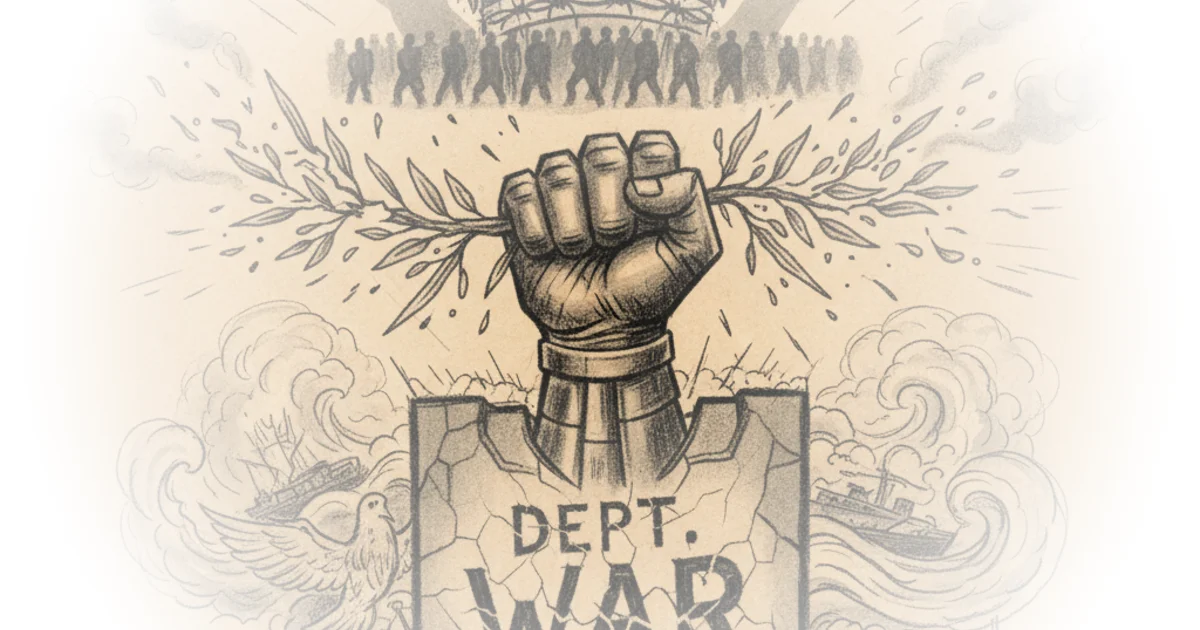
The author highlights the enthusiasm of the new leadership in this transition. "'Department of War!' the ever desperate to be seen as a tough guy Pete Hegseth tweeted tonight, evidently relishing his new title, Secretary of War," Rozen writes. This reaction underscores a cultural shift within the executive branch where the aesthetics of violence are celebrated over the complexities of strategy. Critics might argue that a name change is merely semantic and holds no legal weight, but Rozen correctly identifies that language shapes policy; when the highest levels of government adopt the lexicon of total war, the rules of engagement inevitably loosen.
The administration is signaling that the era of defensive posture is over, replaced by a doctrine that equates strength with the willingness to strike first.
The Pretext of Cartel Warfare
The commentary then pivots to the tangible application of this new doctrine: the kinetic strikes in Latin America. Rozen points out the disturbing lack of transparency surrounding these operations. "The administration has yet to provide evidence of exactly who and what was on the boat the U.S. military blew up Sept. 2, and where exactly the strike took place, except to say that it took place in international waters," she observes. This opacity is dangerous. By designating cartels as foreign terrorist organizations and then conducting unilateral strikes without public verification, the executive branch is creating a shadow war where accountability is impossible.
Rozen details how the administration has constructed a narrative to justify these actions, linking drug trafficking directly to national security threats. She quotes the President's own rambling account of the event: "'We just, over the last few minutes, literally shot out a boat, a drug-carrying boat,' Trump said... 'And there's more where that came from.'" The casual, almost casual tone of this announcement, delivered while the President was reportedly avoiding public scrutiny for a week, suggests a detachment from the gravity of taking human life. The human cost here is abstracted into a political victory, a "great general" briefing, and a tweet.
The author argues that this is not a response to an immediate threat, but a search for targets. "The timeline suggests that Trump has been wanting to go to war against drug cartels in Latin America, and was looking for targets to blow up in the hemisphere," Rozen posits. This reframing is crucial: it moves the conversation from counter-narcotics to a premeditated expansion of military power. A counterargument worth considering is that the administration believes these strikes are necessary to disrupt supply chains that fuel domestic addiction. However, Rozen's evidence suggests that without judicial oversight or clear evidence of the targets, these operations risk becoming a dangerous game of brinkmanship that could destabilize the entire region.
The Erosion of Domestic Law
Perhaps the most alarming section of Rozen's piece is the intersection of this foreign aggression with domestic policy. The article draws a direct line between the rhetoric of war abroad and the deployment of troops at home. Rozen notes that the administration is leveraging the same logic to justify sending National Guard troops into Democratic-governed cities. "'Chicago is a hellhole right now. Baltimore is a hellhole right now,' Trump said... 'If I didn't send the National Guard into Los Angeles,… I would be making an announcement today,'" she quotes. This language dehumanizes entire cities and their residents, framing them as enemies to be subdued rather than constituents to be served.
The legal ramifications are severe. Rozen highlights a federal judge's ruling that the use of military troops in Los Angeles was illegal, violating the Posse Comitatus Act. "President Trump's recent executive orders and public statements regarding the National Guard raise serious concerns as to whether he intends to order troops to violate the Posse Comitatus Act elsewhere in California," Judge Charles Breyer wrote. Yet, the administration's response is one of defiance. Rozen captures the administration's dismissal of the rule of law: "'The judge said, but you can leave the 300 people that you already have in place,' he said. 'They can continue to be in place.'"
This creates a terrifying precedent where the executive branch views the judiciary as an obstacle to be managed rather than a check on power. The author argues that the administration is effectively attempting to create a national police force. "Trump and Defense Secretary Pete Hegseth ran the risk of 'creating a national police force with the President as its chief,'" Rozen writes, citing the judge. This is the ultimate realization of the "Department of War" concept: a military force that answers only to the President, deployed against American citizens under the guise of public safety.
Bottom Line
Rozen's strongest contribution is her ability to connect the symbolic renaming of a department to the very real, very violent actions of the military in the hemisphere and on American soil. The piece effectively argues that the administration is not just changing a name, but fundamentally altering the social contract between the state and its citizens. The biggest vulnerability in the administration's position is the lack of evidence for the strikes and the clear violation of established laws, yet the political momentum seems to favor force over fact. Readers should watch for the next escalation: if the courts cannot stop the deployment of troops domestically, the executive branch may be on the verge of a permanent, militarized domestic policy that ignores the Constitution.
The administration is attempting to create a national police force with the President as its chief, a move that treats American citizens as an enemy to be subdued rather than a constituency to be served.