Adam Tooze has identified a seismic shift in the philosophy of American central banking that goes far beyond interest rates. The presumptive next chair of the Federal Reserve, Kevin Warsh, is not merely a technocrat seeking to tighten policy; he is an ideological operative aiming to dismantle the very concept of the modern administrative state. Tooze's analysis is essential because it reveals that the debate over the Fed's future is no longer about inflation targets, but about whether the central bank should serve as a tool for social engineering or retreat into a narrow, conservative definition of neutrality.
The Architect of Retrenchment
Tooze argues that Warsh's resume is misleading. While often dismissed as a lawyer without deep monetary credentials, his true significance lies in his alignment with the conservative movement's war on the "administrative state." Tooze writes, "Reading Warsh's speeches and papers of the last five years, it would seem that his desire to see the Fed 'return to its lane' has less to do with the standard 1990s arguments for central bank independence than with the increasingly vociferous campaign on the American right to roll back the administrative state." This reframing is crucial. It suggests that the Fed's independence is not under attack by external political pressure alone, but from within by a leadership that views the institution's expanded post-2008 role as illegitimate.
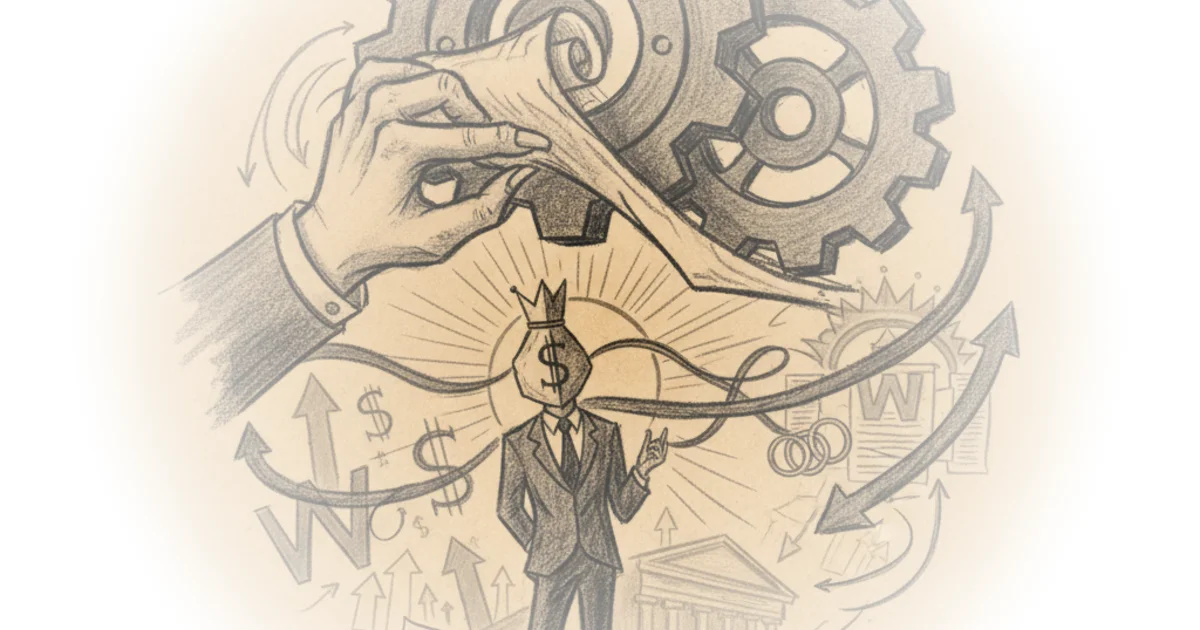
Tooze traces this ideological lineage back to Woodrow Wilson, noting that for Warsh, the Fed's very existence in 1913 is suspect because it was a creation of the "first self-consciously liberal President of the 20th century." The implication is that the central bank's expansion during the financial crisis and the pandemic was not a necessary evolution, but a deviation from its original, limited purpose. Tooze highlights Warsh's warning: "The Fed has acted more as a general-purpose agency of government than a narrow central bank." This is not just a critique of balance sheet size; it is a rejection of the idea that the Fed should manage systemic risks beyond price stability.
"Modern Wilsonians may be discomfied by my words… granting boundless power to government agencies to solve the world's problems does not square with my disposition."
This quote captures the essence of Warsh's vision. Tooze points out that Warsh views the Fed's crisis-fighting role as acceptable only as a temporary measure. Once the emergency passes, the institution must contract. Tooze paraphrases Warsh's concern about "path dependency," where each intervention expands the Fed's scope, creating a cycle of dependency and misallocation. The danger, according to this view, is that the Fed becomes a "sorcerer's apprentice," misusing its powers and creating future shocks. Critics might argue that this perspective dangerously ignores the reality that modern financial crises are systemic and require broad, coordinated responses that a "narrow" central bank cannot provide. However, Tooze suggests that for Warsh, the risk of overreach outweighs the risk of underperformance.
The Cultural Front: Climate and Inclusion
Tooze identifies Warsh's rhetoric on climate change and employment as coded language for a broader cultural battle. Warsh explicitly rejects the Fed's involvement in "climate change" and "inclusion," labeling them as "politically-charged issues" that belong to elected officials, not technocrats. Tooze notes that Warsh's criticism of the Fed's "Network of Central Banks and Supervisors for Greening the Financial System" is not just about economic efficiency, but about the legitimacy of the agency to address social goals. Tooze writes, "'Climate change' and 'inclusion' are politically-charged issues. People of good conscience have their own views and motivations. Elected officials are tasked with evaluating data, synthesizing views, charting policy, and granting authority, if desired, to executive branch agencies."
This stance has profound implications for how the Fed interprets its dual mandate. Tooze explains that Warsh's opposition to the "broad-based and inclusive" definition of maximum employment is a dog whistle. By rejecting the focus on specific demographic groups, Warsh is signaling a return to a strict inflation-fighting priority, even if it means accepting higher unemployment among marginalized communities. Tooze observes, "He isn't going to say this out loud. He doesn't need to. The audience he cares about understands." This is a stark departure from the approach of the Yellen and Powell administrations, which explicitly considered labor market disparities as central to their policy framework.
"Neither the modern university nor the central bank has a comparative advantage as a social justice institution. They should avoid taking positions on social and political issues unless such matters plainly threaten the core missions of those institutions."
Tooze connects this to the "Chicago Principles" of institutional neutrality, arguing that Warsh wants the Fed to be a neutral arbiter of money, not a participant in social justice debates. This aligns with the broader conservative critique of the administrative state, which views agencies as overstepping their bounds when they engage in cultural or social policy. The irony, as Tooze points out, is that this "neutrality" is itself a highly political position that favors the status quo of market outcomes over active redistribution or inclusion. A counterargument worth considering is that in a polarized society, true neutrality is impossible, and the Fed's decisions on interest rates and regulation inevitably have distributional consequences that cannot be ignored.
The Bottom Line
Adam Tooze's analysis exposes the ideological underpinnings of the potential Warsh chairmanship, revealing a plan to fundamentally shrink the Federal Reserve's role in the economy and society. The strongest part of this argument is its ability to decode the "dog whistles" in Warsh's rhetoric, showing that his call for "neutrality" is actually a call for a specific, conservative vision of limited government. The biggest vulnerability, however, is the assumption that the Fed can simply retreat to a pre-2008 model in a world where financial instability and climate change are inextricably linked to monetary policy. As Warsh prepares to lead, the real test will be whether the Fed can maintain its legitimacy while actively rolling back the very tools it used to stabilize the economy in the past.