Naomi Kanakia challenges a deeply entrenched literary snobbery: the idea that a novel with a clear social agenda is inherently artistically bankrupt. In a cultural moment where contemporary fiction often prides itself on ambiguity, she argues that the "problem novel"—a genre designed to persuade readers toward a specific moral conclusion—possesses a distinct, often overlooked power that modern literature has abandoned. This is not a nostalgic plea for propaganda, but a rigorous defense of rhetoric as an art form, suggesting that our current obsession with "beauty" and "complexity" may have blinded us to the utility of "truth" and "goodness."
The Art of Persuasion
Kanakia begins by dismantling the binary that separates literary quality from political intent. She notes that critics often claim "any political or social aim is incompatible with literary quality," a stance she finds impossible to reconcile with her own experience of enjoying books like Uncle Tom's Cabin. Her central thesis is simple yet provocative: "I am not trying to argue that this type of novel can be good; I am just describing the fact that I do indeed perceive literary quality in many of these books." This distinction is crucial. She is not asking readers to lower their standards; she is asking them to expand their definition of what constitutes a standard.
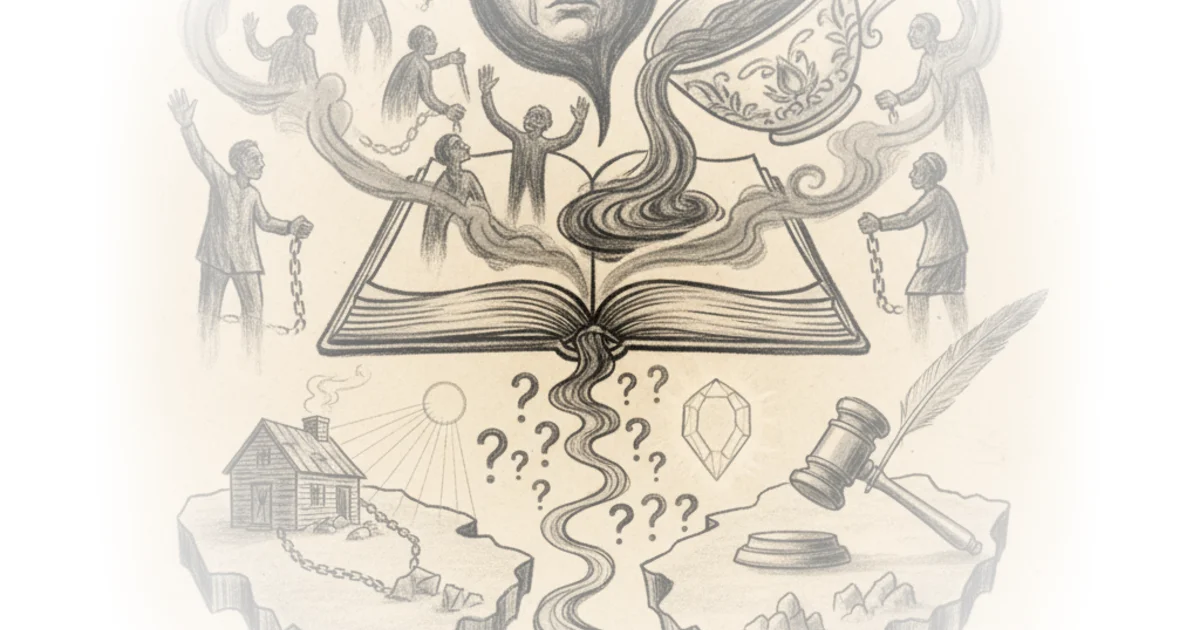
To illustrate this, she turns to Dorothy Canfield Fisher's 1924 novel The Home-Maker. Kanakia describes how Fisher uses a domestic crisis—a husband's injury that forces a gender-role reversal—to argue that people are suited for different kinds of work. The narrative is blunt, yet Kanakia finds it compelling because of its "fervency and frankness." She highlights a pivotal moment where the father, realizing his absolute power over his terrified son, cries out, "As I would not be a slave, so I would not be a master!" This quote serves as the emotional anchor of the argument, demonstrating how a "problem novel" can deliver a moral shock that feels both immediate and universal.
If art isn't capacious enough to hold books like these, then the concept of art is itself flawed and incomplete.
Kanakia's analysis of the novel's ending is particularly sharp. She notes that the story resolves not through a societal shift, but through a medical relapse that allows the family to return to the status quo, a "cunningly-crafted" ending that exposes the rigidity of social norms. The villain, she argues, is not a person but "this couples' unthinking adherence to social norms." This reframing is effective because it shifts the critique from individual malice to systemic inertia, a technique that remains potent today. However, critics might argue that such didacticism inevitably flattens character complexity, turning people into mere vessels for an argument rather than fully realized human beings. Kanakia counters this by insisting that "the characters need to be types, but they also need to be individuals," a balancing act that Fisher allegedly achieved.
The Lost Tradition of the "Problem Novel"
The piece then broadens its scope to examine the historical ecosystem that nurtured these works. Kanakia points out that Fisher was not a fringe figure but a titan of early 20th-century publishing, serving as the influential editor of the Book of the Month Club. She notes that Fisher championed Richard Wright's Native Son, a choice Kanakia finds "mind-boggling" given the opt-out subscription model that mailed the book to hundreds of thousands of white households. This historical context is vital; it reminds readers that "problem novels" were once the mainstream, not the fringe.
Kanakia contrasts this era with the present, arguing that while contemporary fiction features social issues, it rarely functions as a true problem novel. She observes that modern books often avoid "overdetermination," preferring messy, self-destructive protagonists over "ideal victims." She asks a piercing question: "But, if discrimination is bad, then surely it must ruin some lives, no?" This rhetorical move forces the reader to confront the possibility that our current literary aversion to clear-cut moral causality might be a form of denial. She suggests that the energy of the problem novel has migrated to narrative nonfiction, citing The Short and Tragic Life of Robert Peace as a modern example where the "literally true" nature of the story allows for a moral argument that fiction can no longer sustain.
Yet, Kanakia acknowledges the limitations of this shift. Even in nonfiction, she notes, the manipulation of the reader is inevitable, as seen in The Immortal Life of Henrietta Lacks, where the reader is left "gung-ho to do something about this injustice" but unsure of the solution. This admission adds nuance to her argument; she is not claiming these books offer easy answers, but rather that they successfully identify the problem. A counterargument worth considering is that the modern reluctance to write "ideal victims" stems from a desire to avoid stereotypes, a valid concern that Kanakia perhaps underestimates. By focusing on the loss of the "problem novel," she risks overlooking the gains in psychological realism that contemporary fiction has achieved.
The War Between Truth and Beauty
In her concluding analysis, Kanakia situates the debate within a broader philosophical history. She references the classic triad of art: good, true, and beautiful. She posits that "Right now, what's most valuable is beauty, but in the late 19th and early 20th-century it felt like the war was really between truth and goodness." This historical lens reframes the current literary landscape not as a progression, but as a pendulum swing. She suggests that the debate between novelists like Sinclair Lewis, who sought to show "the truth of what America was really like," and Fisher, who wanted to show "what it could be like," has been forgotten because "they both ended up losing."
Kanakia's defense of the "blunt instrument" is her most striking contribution. She compares problem novels to the Pyramids and Marcel Duchamp's The Fountain, arguing that their utility does not negate their artistic merit. "You might say these problem novels were blunt instruments, but many highly-regarded artifacts from the past... are equally blunt—to say they're 'not art' seems to miss the point." This is a powerful defense of functional art. It challenges the reader to consider whether the demand for ambiguity is a sign of sophistication or a retreat from the hard work of moral persuasion.
The debate between these two camps has been forgotten, because they both ended up losing, but I'm sure it'll be re-staged someday, and perhaps with very different results.
Bottom Line
Kanakia's argument is a necessary corrective to the prevailing literary orthodoxy that equates moral clarity with artistic failure. Her strongest point is the historical evidence that some of the most impactful books in American history were explicitly designed to persuade, and that their power lay in their willingness to be "blunt." The vulnerability in her case is the assumption that modern fiction's avoidance of "ideal victims" is a failure of imagination rather than a necessary evolution to avoid caricature. Ultimately, she leaves the reader with a compelling challenge: to judge a book not by its adherence to the conventions of ambiguity, but by its ability to move us toward a better understanding of the world. As she notes, "There's an art to rhetoric," and ignoring that art leaves our cultural conversation impoverished.