Sarah Longwell, Tim Miller, and Bill Kristol identify a seismic shift in Democratic strategy that defies decades of conventional wisdom: the party is no longer ignoring the pews, but actively recruiting the clergy to reclaim the "God Gap." This is not merely a roster update; it is a desperate, high-stakes attempt to prove that faith and progressive policy are not mutually exclusive, a narrative the authors argue is essential for survival in a country where religious identity remains a primary political fault line.
The Shepherd's Call
The authors frame the current crop of Democratic candidates not as career politicians, but as reluctant shepherds responding to a moral crisis. They highlight figures like James Talarico, a middle school teacher and aspiring Presbyterian minister, and Matt Schultz, a pastor running in Alaska, who view their candidacies as a direct response to executive overreach. As Longwell, Miller, and Kristol write, "People of faith are more and more stepping forward to run for office because part of the job of being a pastor is, to use the metaphor, 'to be a shepherd.'" The piece argues that these candidates feel a spiritual imperative to intervene against what they perceive as state-sanctioned cruelty, particularly regarding immigration and the dismantling of the social safety net.
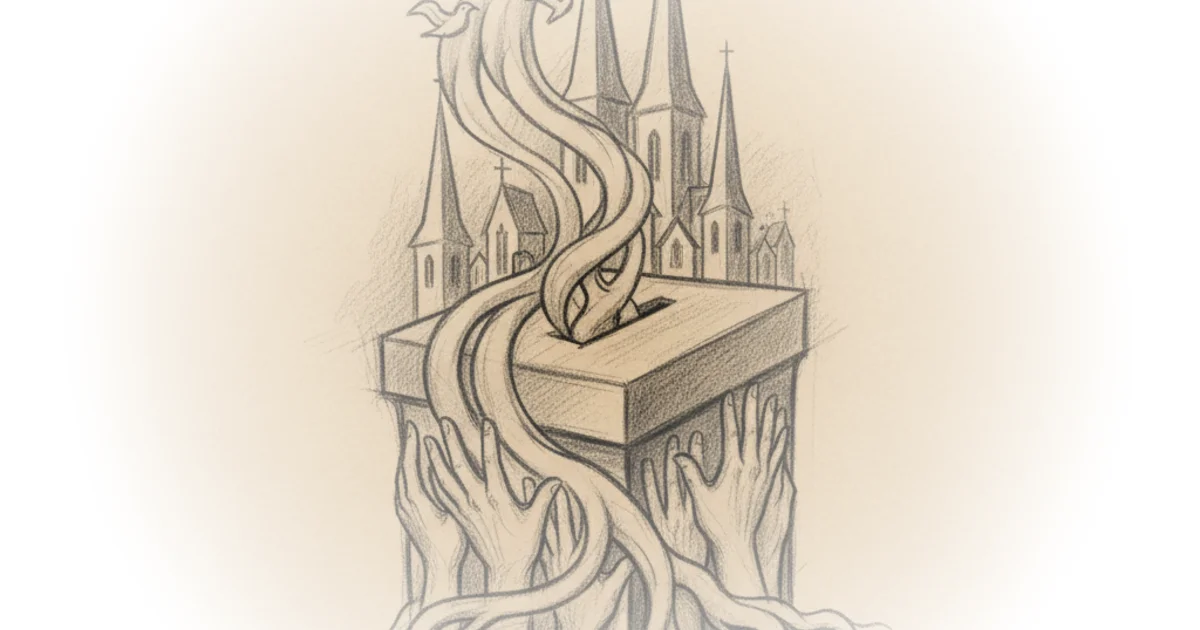
This framing is compelling because it moves beyond policy disputes into the realm of moral duty. The authors capture the visceral reaction of these candidates to the current administration's actions. Matt Schultz, speaking from Anchorage, tells them, "All of these people are coming to me and saying, 'Please, won't you help me? Please, won't somebody do something to stop this onslaught of cruelty? We're crying out in pain.'" The commentary suggests that for these candidates, the political arena is simply the only place left to stand "between the abusers and the abused."
"People of faith are more and more stepping forward to run for office because part of the job of being a pastor is, to use the metaphor, 'to be a shepherd.'"
Critics might note that framing political opposition as a moral crusade risks alienating the very secular voters the Democratic coalition relies on, creating a new internal tension. However, the authors argue this is a necessary risk to address the party's long-standing disconnect with religious communities.
The Internal God Gap
The coverage pivots to a more uncomfortable truth: the divide is not just between the parties, but within the Democratic party itself. Longwell, Miller, and Kristol cite Michael Wear, a former director of faith outreach for Barack Obama, to illustrate this fracture. They paraphrase his warning that ignoring the religious identity of working-class voters leaves a vacuum that the opposition fills with ease. "One of the ways to navigate that is to just take it off the table," Wear is quoted as saying, "But the problem when you take it off the table is you leave a pretty profound lane for someone like Donald Trump to say, 'Well, they don't care about you. They don't hear you, but I do.'"
The authors use stark data to underscore the urgency. Since 2008, the percentage of Christians in the Democratic coalition has plummeted by 20 points, while the Republican share has remained relatively stable. The piece notes that while the "nones" (the religiously unaffiliated) are a growing demographic, nearly 70 percent of Americans still identify as religious. The argument here is that the party's elite, often secular, have failed to understand the country they govern. As one Democratic official told the authors, "The country is overwhelmingly religious. But the people who run our party, buy our ads, and shape our message don't actually see or understand it at all."
This analysis is sharp, but it risks oversimplifying the "God Gap." A counterargument worth considering is that the decline in Christian voters for Democrats is less about a lack of outreach and more about the party's consistent stance on social issues like abortion and LGBTQ+ rights, which many religious voters find non-negotiable. The authors acknowledge this tension, noting that candidates like Sarah Trone Garriott, a Lutheran minister, face intense scrutiny over their pro-choice stance, and Talarico is frequently pressed on his support for trans rights.
The Historical Hurdle
The authors do not shy away from the difficulty of this mission. They remind readers that the Democratic party has a deep, historic connection to the black church, citing the legacy of Sen. Raphael Warnock and the Ebenezer Baptist Church, which served as a hub for the civil rights movement. However, they argue that rebuilding a sustainable majority requires bridging the gap with white Christian voters, a demographic that has drifted significantly toward the Republican party. The piece points to the resilience of white evangelical support for the administration, noting that even after the revelation of the Stormy Daniels affair in 2018, support among this group actually rose to a record high.
Longwell, Miller, and Kristol write, "Self-identifying Christians, particularly white evangelicals, have shown a remarkable attachment to the Republican party... despite his being far from the most pious occupant of the Oval Office." They cite a Public Religion Research Institute survey showing the administration won 85 percent of the white evangelical vote in 2024. This statistic serves as a sobering reality check: running pastors may not be enough to overcome a deep-seated cultural and political alignment.
The authors suggest that the path forward requires more than just religious candidates; it requires a shift in how the party discusses faith. "Democrats who are running in contested districts are going to need to show not just that they can talk about faith, but that their faith, and the way they view the role of faith in America, actually affects their thinking," Wear is quoted as saying. The piece concludes that while the strategy is bold, the historical precedent suggests the hill to climb is steep. The authors note that even in a favorable midterm climate, the party's previous attempts to engage this demographic have often fallen flat.
"The problem when you take it off the table is you leave a pretty profound lane for someone like Donald Trump to say, 'Well, they don't care about you. They don't hear you, but I do.'"
Bottom Line
The strongest element of this piece is its unflinching diagnosis of the Democratic party's internal disconnect with religious voters, moving beyond surface-level strategy to address a fundamental identity crisis. Its biggest vulnerability lies in the assumption that candidate identity alone can reverse decades of realignment on social issues, a challenge that may prove insurmountable without a broader shift in the party's cultural messaging. Readers should watch whether these clergy-candidates can successfully navigate the tightrope of their faith and the party's secular base without alienating either group.