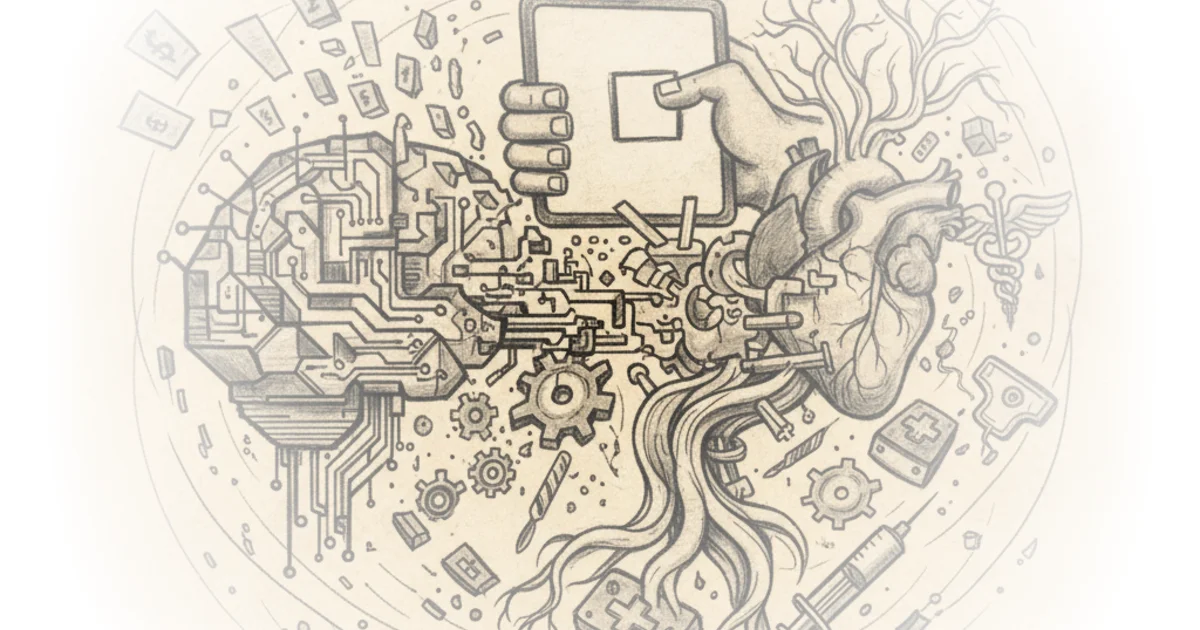
In an era where technology promises to decode the human body, Rohin Francis delivers a scathing critique of the Silicon Valley obsession with data, arguing that the drive to measure everything often creates more harm than health. The piece is notable not for rejecting innovation, but for exposing how the "move fast and break things" mentality becomes catastrophic when applied to the messy, unpredictable reality of human biology. Francis challenges the assumption that more data equals better outcomes, suggesting instead that it frequently leads to a dangerous cycle of over-diagnosis and unnecessary medical intervention.
The Illusion of Precision
Francis opens by dismantling the allure of the "tech bro" approach to longevity, a movement dominated by wealthy men who believe they can optimize their existence through relentless quantification. He targets the specific mindset that equates novelty with improvement, noting that "while this normally holds true for computing and we're all familiar with Moore's Law it very commonly isn't true in medicine." This distinction is crucial; the author argues that the medical field cannot simply adopt the software development mantra of rapid iteration without risking patient safety. The core of the argument is that the sheer volume of data generated by these enthusiasts often outpaces our ability to interpret it meaningfully.
"The urge to measure everything is not limited to Tech Bros it appears to be human nature... but it's what we do with that data that is the problem."
Francis illustrates this with the example of Peter Diamandis, a prominent entrepreneur who advocates for annual full-body health uploads. While Diamandis presents this as the pinnacle of preventive care, Francis satirizes the absurdity of the practice, pointing out that such aggressive screening can lead to a "continual state of CT scanning" that exposes patients to unnecessary radiation. The author's framing is effective because it uses the very language of the tech world—"optimizing," "data," "upgrades"—to reveal the underlying medical nonsense. However, critics might argue that Francis occasionally leans too heavily on satire, potentially alienating readers who view these technologies as legitimate, albeit experimental, frontiers in personalized medicine.
The Danger of Incidentalomas
The commentary then shifts to the clinical reality of screening asymptomatic individuals. Francis explains that the human body is inherently "complicated" and "messy," filled with variations that do not always signify disease. When a scan is performed on a healthy person, radiologists often find "incidentalomas"—benign spots, blobs, or smudges that require no treatment but trigger a cascade of anxiety and further testing. He writes, "if you're having a screening scan... I see some blob in your abdomen... I have no idea if some of them none of them all of them are significant." This uncertainty forces patients into a loop of repeat scans and biopsies, turning a healthy life into a medicalized nightmare.
"Screening scans do not improve mortality they just increase health anxiety they increase the costs to the individual and often to the health system as well."
The author's analysis of "exceptionalism bias" is particularly sharp here. He argues that many proponents of these technologies believe they are immune to the risks that affect the general population, assuming that early detection will always save them. Francis counters this by citing cases where asymptomatic heart disease was "operated on" only to expose patients to surgical risks without any proven survival benefit. This evidence holds up well against established cardiology guidelines, which generally advise against invasive procedures for asymptomatic conditions. The framing effectively highlights the disconnect between the desire for control and the statistical reality of medical outcomes.
The False Positive Trap
Moving from high-end imaging to consumer wearables, Francis addresses the proliferation of devices like the Apple Watch that claim to detect irregular heart rhythms. He acknowledges that for the elderly, these tools can be useful, but for the vast majority of younger users, they are a source of confusion. The author notes that because atrial fibrillation is rare in young people, "false positives will dwarf true positives," leading to a situation where a healthy person is flagged as sick. He describes the engineering trade-off where devices are designed to be "more sensitive than specific," resulting in "loads of bycatch flapping around on the deck."
"If you get an alert from your watch it's almost certain to be incorrect unless you're elderly."
Francis extends this critique to continuous glucose monitors, which are life-saving for diabetics but have been co-opted by the longevity community to monitor blood sugar in non-diabetics. He points out that the medical community has not yet established what constitutes a "normal" fluctuation in a healthy person, making the data largely speculative. "We've never monitored people constantly like we can do with wearables so what is the cutoff between where normal ends and abnormal begins?" he asks. This highlights a significant gap in current medical knowledge that the tech industry is rushing to fill with unproven algorithms.
"The human body is complicated it's got squishy bits hard bits walls between those bits cavities protuberances and holes it's not color coded like in textbooks."
This vivid description serves as a powerful reminder that biology does not adhere to the clean, binary logic of computer code. The author's insistence on the complexity of the human body serves as a necessary counterweight to the reductionist view that a dashboard of metrics can fully capture human health. While the piece is strong in its critique of over-medicalization, it could have benefited from a deeper exploration of how legitimate research is being conducted to better interpret this flood of new data, rather than focusing solely on the misuse of it.
Bottom Line
Francis's strongest argument lies in his demonstration that the pursuit of perfect data often undermines the very health it seeks to protect, turning healthy individuals into patients through the sheer weight of uncertainty. The piece's biggest vulnerability is its heavy reliance on mocking the behavior of specific tech figures, which may distract from the more systemic issue of how regulatory frameworks are failing to keep pace with consumer health technology. Readers should watch for how the medical establishment responds to this data deluge, as the tension between technological optimism and clinical caution is likely to define the next decade of preventive care.