This story exposes a terrifying gap between official safety assurances and the lethal reality facing hundreds of thousands of hotel guests in London. Michael Macleod reveals that for eight years, an Ibis hotel near Wembley Stadium remained open despite housing cladding with "no flame-retardant properties," a danger masked by a suspiciously altered fire report. The piece is not just about one building; it is a forensic look at how corporate opacity and regulatory hesitation can turn a high-rise into a potential death trap while the public sleeps upstairs.
The Anatomy of a Cover-Up
Macleod's investigation centers on billionaire landlord Asif Aziz, whose company, London Property Company Limited, owned the freehold of the Wembley Ibis. The author does not shy away from the severity of the situation, noting that "hundreds of thousands of people stayed at the Ibis Wembley hotel over an eight-year period without knowing they were inside a tall building coated in material that was 'similar to that used on Grenfell Tower'." This framing is crucial; it shifts the narrative from abstract regulatory failure to immediate human risk, forcing the reader to imagine themselves as one of those unknowing guests.
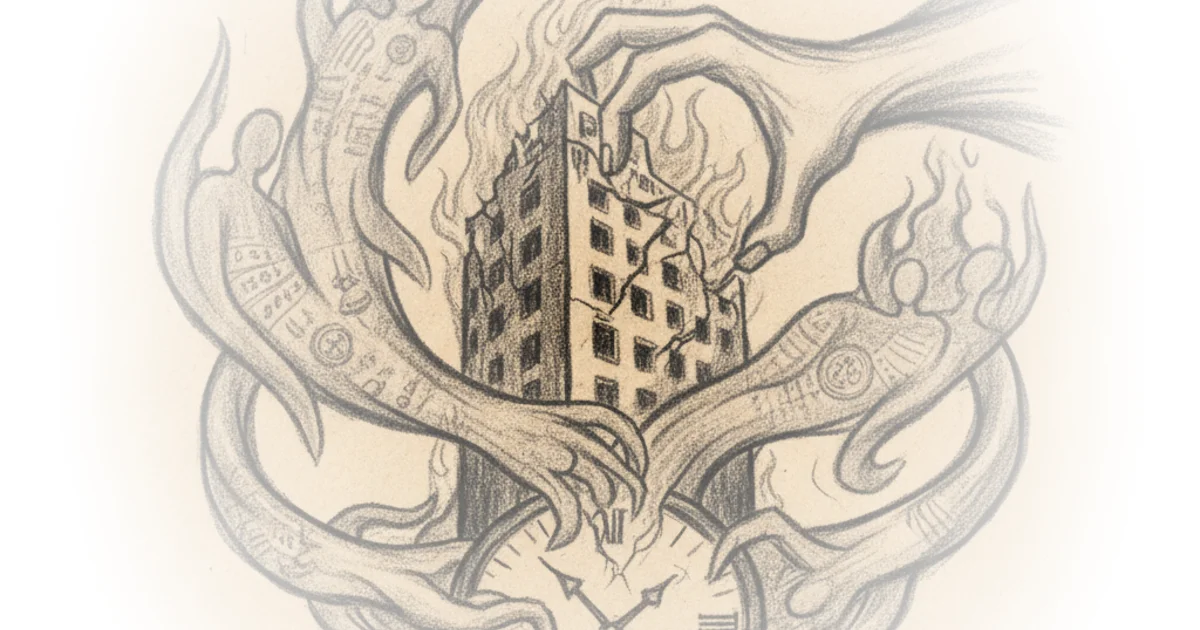
The core of Macleod's argument rests on the bizarre circumstances surrounding a 2018 fire safety test. He writes that "what then happened is something of a mystery," describing how an unknown individual provided a sample of pure aluminum cladding for testing, which passed all standards, despite the building actually being covered in flammable material. The author highlights the High Court judge's skepticism, quoting the finding that there was a possibility someone was "positively misleading [fire safety consultants] Clarke Banks by providing it with a sample which could not have come from the hotel building."
This section of the reporting is effective because it refuses to accept "error" as a sufficient explanation for such a catastrophic oversight. Macleod points out that even after this initial test, when consultants recommended further checks, Aziz's company demanded the report be rewritten to remove those caveats. The result was a sanitized document that gave the building a clean bill of health. As Macleod puts it, the intention was clearly "to remove the 'caveats contained in the first version' which recommended additional testing." This deliberate sanitization suggests a pattern of prioritizing profit and reputation over occupant safety, a dynamic that mirrors broader issues seen in cases of regulatory capture, where the entities meant to be regulated effectively dictate the terms of their own oversight.
"The decision left hundreds of people attending that summer's Oasis gigs with nowhere to stay and the hotel remains closed."
Critics might argue that without definitive proof of intent, labeling this a cover-up is speculative. However, Macleod counters this by highlighting the judge's observation that the business displayed a "firm reluctance to have any further invasive investigations undertaken by any independent consultants." This behavioral evidence, combined with the history of fake certificates and mass evictions previously uncovered by the outlet, builds a compelling case of systemic negligence rather than isolated incompetence.
The Human Cost of Delayed Action
The timeline presented in the article is particularly damning. Macleod notes that safety concerns were raised immediately following the Grenfell disaster in 2017, yet "it took until late 2024 before a proper fire safety test was carried out." This seven-year delay meant that vast numbers of people slept there after major events at Wembley Stadium, completely unaware of the risk. The author emphasizes the personal involvement of Aziz, stating that an employee had to "obtain instructions from Mr Aziz for all major matters," contradicting the claim that he was merely a distant "big picture" investor.
The judge's criticism of Aziz's absence from court is also highlighted by Macleod: "My strong suspicion… is that much of the evidence in this case in reality emanates from… Mr Aziz, who in my view plainly could and should have been called as a witness." This omission speaks to a culture where powerful figures can insulate themselves from accountability while their companies manage the fallout. The author draws a sharp contrast between Aziz's public image as a philanthropist and his private actions, noting he left the UK in early 2025, relocating to Abu Dhabi, potentially to avoid the tax burden of the new Labour government.
This narrative choice connects the specific incident to wider themes of wealth and mobility. While the article mentions Aziz's donations and his funding of Ramadan lights, Macleod suggests these acts do not absolve him of the "intolerable fire risk" he allowed to persist. The piece also touches on his future expansion plans with 'Zedwell' hotels, raising the question of whether similar safety compromises could be happening in his windowless basement rooms.
Institutional Failures and Future Risks
The article concludes by examining the broader implications for London's housing stock. Macleod writes that Aziz "will soon become one of the biggest hotel operators in London," expanding a model that has already faced scrutiny for its safety standards. The author notes that the judge found witnesses from Aziz's company to be "somewhat unconvincing and unreliable," further undermining the defense's credibility.
This coverage serves as a stark reminder of how quickly safety protocols can erode when oversight is weak. It echoes the lessons from sandwich panel disasters, where composite materials with flammable cores were used in construction despite known risks. Just as those panels hid danger behind a fire-resistant skin, the "mystery" sample and rewritten reports at Wembley hid lethal cladding behind a facade of compliance.
The piece also briefly touches on other local issues, such as Pizza Pilgrims appearing on City Hall's Rogue Landlord checker for housing violations, suggesting that safety lapses are not unique to high-profile billionaires but are part of a wider ecosystem of neglect in the rental market. However, the focus remains firmly on the scale of Aziz's operations and the specific mechanisms used to bypass safety checks.
Bottom Line
Michael Macleod delivers a masterclass in investigative accountability, proving that "mystery" is often just a euphemism for deliberate obfuscation. The strongest part of the argument is the detailed reconstruction of how a fire report was actively manipulated to protect an asset rather than people. Its biggest vulnerability lies in the legal inability to definitively prove criminal intent, yet the behavioral evidence presented leaves little room for doubt about the negligence involved. Readers should watch closely as Aziz's 'Zedwell' expansion proceeds, as this case demonstrates that without rigorous, independent oversight, profit will consistently trump safety.