Natalie Wexler delivers a sobering reality check for the education sector: simply buying a "knowledge-building" curriculum is not a silver bullet for reading comprehension. While the industry has pivoted toward content-rich materials, a new SRI study reveals that without a radical shift in how teachers are trained and evaluated, those same materials are being reduced to mere vehicles for skills drills. This is not just a pedagogical nuance; it is the difference between students who can decode a text and those who actually understand the world it describes.
The Implementation Gap
Wexler anchors her argument in a rigorous observational study conducted during the 2024-25 school year, which she describes as "methodologically one of the strongest observational studies of comprehension instruction in the last 50 years." The findings are stark. Despite using high-quality curricula like Core Knowledge Language Arts and Wit & Wisdom, researchers found that "most reading comprehension instruction—about two-thirds of the lessons observed—supported 'surface-level' rather than 'robust' understanding." This distinction is critical. Surface-level instruction treats reading as a series of isolated tasks, such as identifying the setting or finding evidence, whereas robust instruction prioritizes the overall meaning of the text.
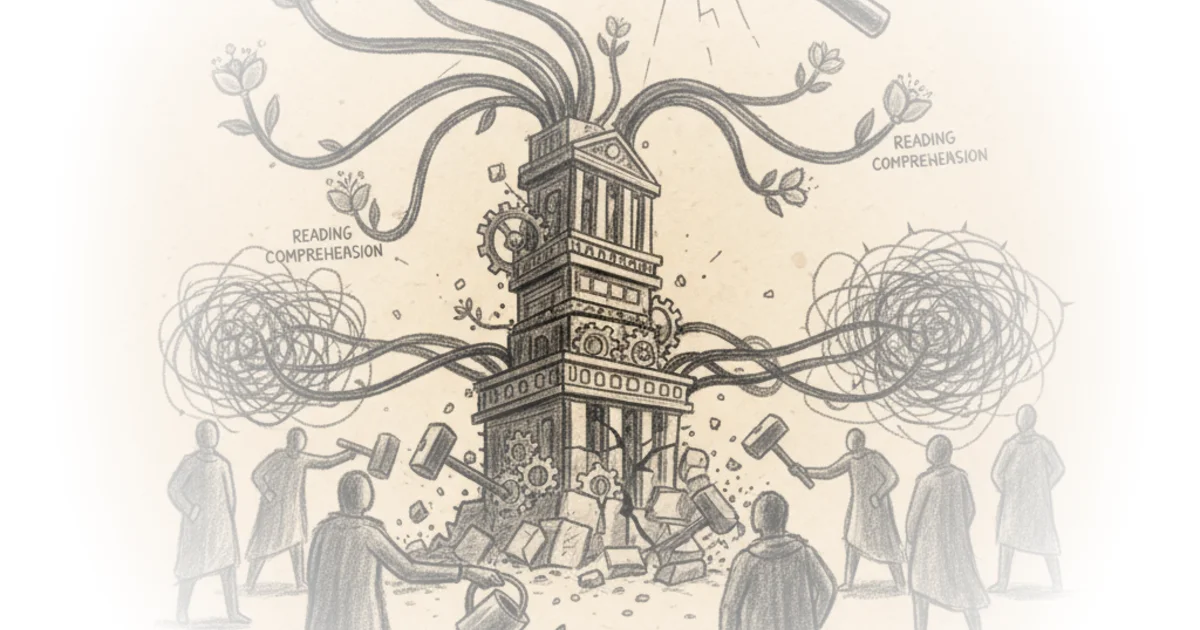
To illustrate this, Wexler contrasts two third-grade lessons on the same book about the moon landing. In one classroom, the teacher stopped after having students identify literal and nonliteral language. In the other, the teacher pushed further, asking what Neil Armstrong meant by calling his step "one giant leap for mankind." The former checks a box; the latter builds a mind. This echoes the work of E. D. Hirsch, who long argued that reading comprehension is not a transferable skill but a function of background knowledge. Yet, as Wexler notes, even when that knowledge is present in the curriculum, it is often sidelined.
"The curriculum a district was using didn't determine how many comprehension lessons were surface-level rather than robust."
This finding dismantles the common assumption that a better textbook automatically yields better results. Wexler points out that in one district using Core Knowledge Language Arts, only 7 percent of lessons were robust, while another district using the same curriculum saw 30 percent. The variable isn't the book; it's the teacher's approach, which is often dictated by external pressures.
The Tyranny of Standards and Data
Why are teachers stripping the meaning out of rich texts? Wexler identifies a systemic confusion driven by "standards-based comprehension tests" and "data-driven instruction" (DDI). Teachers are often told to "unpack the standards" rather than engage with the text. A consultant quoted by Wexler describes professional learning sessions where educators are advised to modify a lesson on Don Quixote to focus on the abstract skill of "identifying character traits" rather than analyzing the character's actions in the specific chapter. The result is a lesson where students might talk about traits without ever discussing the text itself.
Wexler argues that this approach is fundamentally flawed because skills like "identifying character traits" cannot be mastered in isolation; they are entirely dependent on the complexity of the specific text being read. Furthermore, the data used to drive these decisions is often misleading. Standardized tests present passages unrelated to the curriculum, framing student performance as a lack of skill when it may actually be a lack of background knowledge. As Wexler writes, "Data-driven instruction makes sense only if the data are telling you something meaningful." When the data is divorced from the content students are learning, it leads to "unhelpful practices that reinforce surface-level instruction."
Critics might argue that standards exist to ensure equity and that abandoning them risks leaving some students behind without a common benchmark. However, Wexler suggests that the current interpretation of standards has become an obstacle to the very equity it claims to support, forcing teachers to prioritize testable mechanics over deep understanding.
"You can say a student has 'mastered' short vowel sounds or math facts. But anything conceptual, that's going to send you down the wrong path."
A Path Toward Robustness
The solution, according to Wexler and the SRI report, requires a return to the text itself. Districts must invest in deepening teachers' content knowledge, ensuring they understand the material they are teaching—whether it's the War of 1812 or the evolutionary adaptations of frogs. Professional learning should not be about how to remediate a skill gap but about anticipating where students might struggle with a specific text. As Wexler notes, when teachers read the text themselves and discuss "what will be tricky in it for kids," they can better guide students through the complexity.
This shift also requires a change in how assessments are viewed. Wexler highlights that content-rich curricula come with their own assessments designed to measure retention and reasoning, which are often more useful than generic standardized tests. In districts where leaders prioritize these curriculum-specific assessments, instruction naturally shifts toward meaning. The goal is to create classrooms where the text is in the foreground, and skills are the tools used to unlock it, not the end goal.
"Helping teachers engineer instruction that facilitates more robust understanding of texts might not only improve students' comprehension achievement but also create more joyful classrooms."
Bottom Line
Wexler's most compelling contribution is her refusal to let the education sector off the hook with a simple curriculum purchase; she exposes the deep structural inertia that turns rich content into shallow drills. The argument's greatest strength is its reliance on hard observational data that proves implementation matters more than the product, yet it leaves the reader with the difficult task of how to dismantle a testing culture that rewards surface-level compliance. The path forward is clear, but it demands a courage that few districts currently possess: the courage to trust the text over the test.