Marc Rubinstein identifies a quiet but seismic shift in how commerce functions: the arrival of autonomous AI agents that don't just search for products, but execute transactions without human intervention. While most observers focus on the holiday shopping rush, Rubinstein argues that the real story isn't the volume of sales, but the changing identity of the shopper itself. This matters now because the infrastructure built today will determine who captures the trillion-dollar economy of tomorrow.
The Rise of the Machine Shopper
Rubinstein begins by contrasting the familiar chaos of Black Friday with a new, silent reality. "As of this writing, Shopify has ushered 24 million unique shoppers through its platform since Black Friday commenced; Stripe has processed 92 million transactions." He notes that while tariffs may be squeezing margins, the sheer volume of activity suggests consumers remain undeterred. However, the critical distinction lies in who is behind the screen. "What makes this year different is that both companies have AI agents wandering through their pipes alongside regular human users." This is not merely an incremental improvement in search; it is a fundamental restructuring of the buyer-seller relationship.
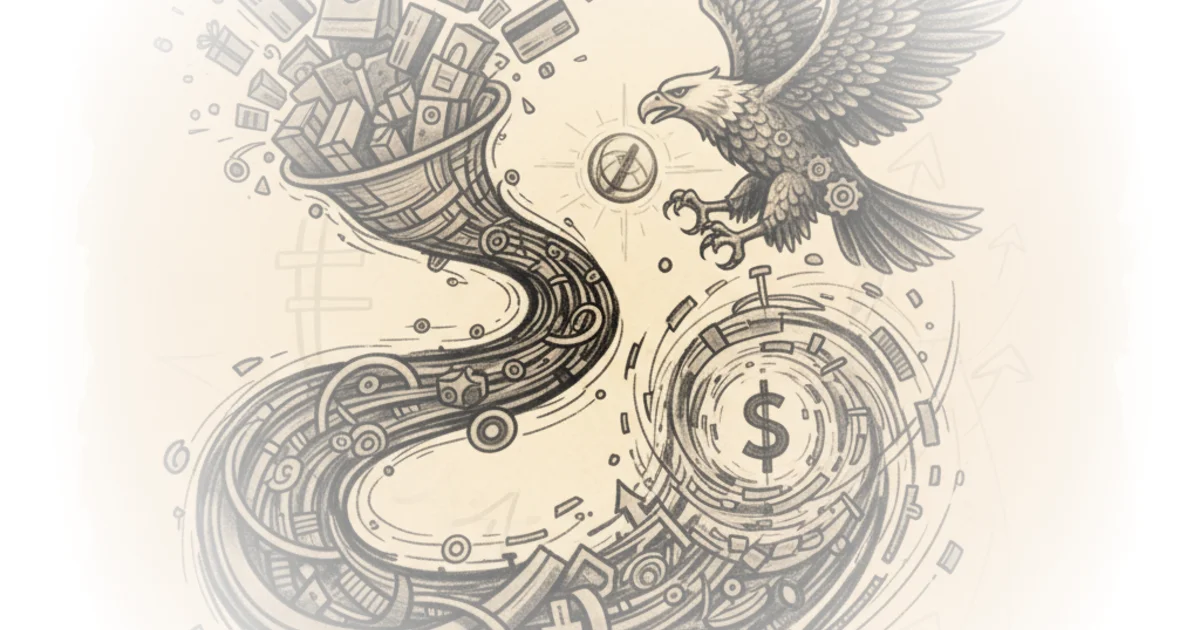
The data supports a rapid acceleration. Rubinstein points out that "Shopify has already seen AI-driven traffic to its stores increase seven-fold since January, with orders attributed to AI searches increasing by 11x." This exponential growth suggests we are past the early adoption phase and into a period of integration. A recent survey by Bain indicates that 17% of US consumers plan to start their holiday shopping with general AI assistants, a number that will inevitably climb as these tools become more capable. The implication is that the traditional funnel of browsing, comparing, and clicking is being replaced by a direct command structure.
"We're entering what is likely to be a whole new era of agentic commerce."
Rubinstein highlights the vision of industry leaders who see this not as a niche experiment, but as the future default. Shopify president Harley Finkelstein's statement to investors captures the magnitude of the shift. The core of the argument is that AI will soon handle the entire lifecycle of a purchase. As Rubinstein paraphrases the potential interaction, a user might simply say, "Find me a pair of waterproof hiking boots in a size 8 under $150 that can be delivered by Friday," and the agent would independently "scan available options, query product data in real time, check return policies, read shipping estimates, verify availability and place the order." This level of autonomy removes the friction of human decision-making, potentially unlocking a massive surge in transaction velocity.
The Trillion-Dollar Horizon
The financial stakes are staggering, and Rubinstein leans heavily on institutional forecasts to ground his optimism. He cites a McKinsey report estimating that "by 2030, its consultants estimate the US business-to-consumer retail market alone could see up to $1 trillion in orchestrated revenue from agentic commerce, with global projections as high as $3 trillion to $5 trillion." Even more conservative estimates, such as those from payment platform Adyen, project €2 trillion ($2.3 trillion) by the end of the decade. These numbers are not speculative; they are the basis for the strategic pivots currently happening in the C-suites of major tech firms.
Rubinstein notes that "Amazon's Andy Jassy goes further: 'I do think that the exciting part of this, and the promise, is that AI and agentic commerce solutions are going to expand the amount of shopping that happens online.'" The argument here is that automation doesn't just shift existing demand; it creates new demand by making purchasing effortless. If the barrier to entry for a transaction is reduced from minutes of browsing to seconds of processing, the total addressable market expands significantly. Shopify CEO Tobi Lütke reinforces this, telling Stripe's president that agentic commerce "will be done a lot and might even be a majority of commerce on the internet." This framing suggests that companies failing to integrate agent-ready APIs will find themselves irrelevant in a market where the primary customers are no longer people, but algorithms.
Critics might note that these projections rely on the assumption that consumers will fully trust autonomous agents with their financial data and purchasing power. There are legitimate concerns regarding privacy, the potential for algorithmic bias in product selection, and the risk of agents being manipulated by bad actors to drive up prices or promote specific vendors. Rubinstein acknowledges the scale of the opportunity but perhaps underplays the friction of building trust in a system where the buyer is a black box.
Bottom Line
Rubinstein's most compelling contribution is his reframing of the holiday shopping season not as a test of consumer spending power, but as a stress test for autonomous commerce infrastructure. The strongest part of his argument is the concrete evidence of exponential growth in AI-driven traffic, which validates the shift from theoretical potential to active reality. However, the biggest vulnerability lies in the assumption that the ecosystem is ready to handle agents at scale without significant friction or regulatory pushback. Readers should watch closely how payment processors and retailers adapt their APIs in the coming months, as the winners of this new era will be those who can seamlessly integrate with the machines that are rapidly becoming the primary shoppers.