Brian Potter doesn't just explain how things are made; he reveals that the invisible architecture of modern life is a series of fragile, interconnected transformations. By dissecting the humble light bulb, he exposes a truth that most of us ignore: every object we touch is the endpoint of a sprawling, global chain of labor and physics that could unravel at any single step.
The Anatomy of Transformation
Potter begins by stripping away the mystique of invention to focus on the mechanics of creation. He notes that while Thomas Edison's 1880 patent for the light bulb was the result of decades of research, the physical object itself was deceptively simple: "a filament, a thin glass tube in which the filament was mounted, a pair of lead-in wires, a base, and the glass bulb itself." Yet, the path from raw sand to that glowing tube was anything but simple.
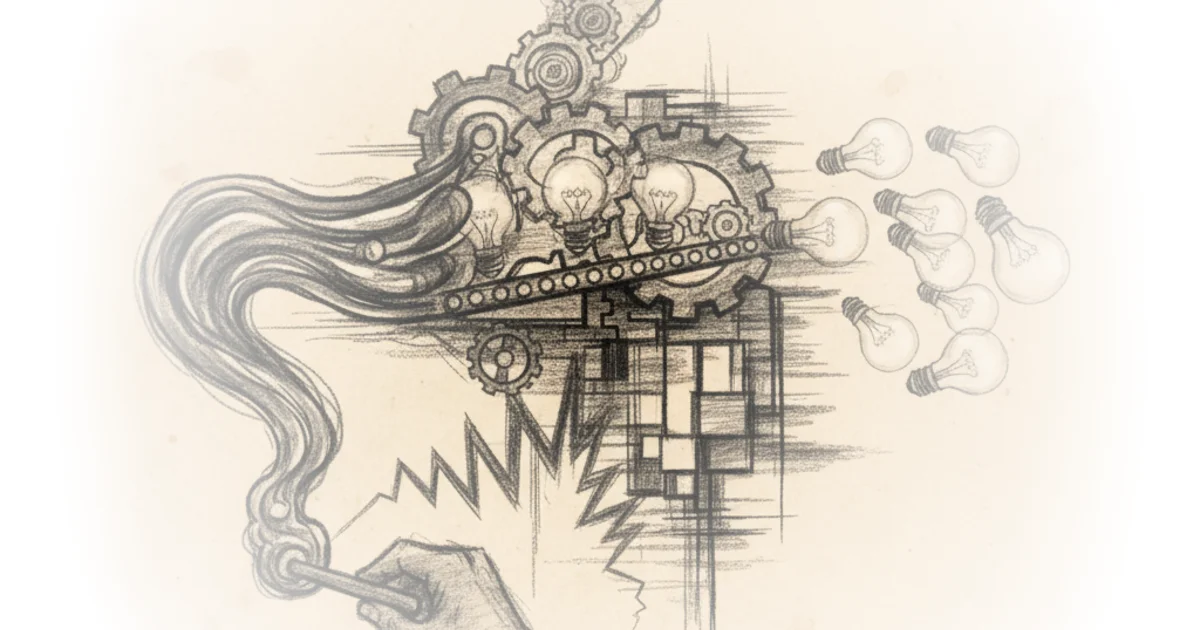
The author argues that we must view production not as a magical act of assembly, but as a specific sequence of changes. "Making bulb blanks is an example of what we'll call a production process—a series of steps through which input materials are transformed incrementally into a finished product," Potter writes. This framing is crucial because it shifts our focus from the final product to the friction points in the middle. He illustrates this by tracing the glassmaking process at Corning, where workers mixed sand, lead, and potassium carbonate, melted them, and then blew the molten glass into molds.
This historical context is more than just a nostalgia trip; it highlights the sheer complexity hidden in plain sight. Potter reminds us that the potassium carbonate used in those early bulbs was itself the output of the Leblanc process, a chemical method developed in the late 18th century. "Outside of the small number of things we can obtain directly from nature, all products of civilization are the result of some sort of production process," he asserts. This is a powerful reframe for busy readers who often view goods as static commodities rather than the result of dynamic, energy-intensive systems.
Outside of the small number of things we can obtain directly from nature, all products of civilization are the result of some sort of production process—some series of transformations that take in raw materials, energy, labor, and information and produce goods and services.
The Five Levers of Efficiency
To make sense of this complexity, Potter introduces a rigorous framework. He identifies five distinct factors that define any production process: the transformation method, the production rate, the inputs and outputs, the buffer size, and the variability of the output. This is where the piece moves from history to actionable analysis.
He explains that the transformation method itself is often a simplification. While a machine might perform a step with near-perfect consistency, human labor introduces variation. "A person might perform the same step slightly differently each time and modify their technique over time as they get more skilled," Potter observes. This nuance is vital; it acknowledges that efficiency isn't just about speed, but about the stability of the human element within the system.
Next, he tackles the concept of time and volume. "It obviously makes a big difference whether the bulb blank factory can produce 10 or 10,000 bulbs a day," he writes. Potter uses the example of early glassblowers, noting that with molds, three workers could produce roughly 1,500 bulbs a day. This stark contrast between hand-crafting and early industrialization underscores how small changes in the transformation method can exponentially alter the production rate.
Critics might argue that this model is too mechanical, ignoring the social or environmental costs of scaling production. However, Potter anticipates this by including indirect inputs like rent and administration in his cost analysis. He argues that to truly understand efficiency, one must account for the "indirect inputs—things that aren't used directly by the process but are nevertheless necessary." This broadens the definition of cost beyond just the price of raw materials.
The Hidden Cost of Variation
Perhaps the most insightful part of Potter's analysis is his focus on variation. In a world that demands precision, he points out that no two outputs are ever exactly alike. "No two bulbs were exactly alike," he notes, citing differences in glass composition and thickness. He explains that this variation is not just a nuisance; it is a fundamental characteristic of any process that must be managed.
He draws a parallel to the famous 1958 essay "I, Pencil" by Leonard Read, which detailed the millions of people required to make a simple pencil. Potter uses this to illustrate the "sprawling mass of complexity" that exists even in everyday objects. "If we follow the chain of production further back... we find a sprawling mass of complexity for even the simplest products of civilization," he writes. This serves as a reminder that the fragility of our supply chains is not a new phenomenon; it has always been there, masked by the reliability of the final product.
The goal of any efficiency improvement is to minimize the costs of producing something. If we're running a bulb blank factory, we want to figure out how to produce those bulb blanks as cheaply as possible, which means using the fewest, lowest-cost inputs we can.
Potter also touches on the concept of "work in process"—the material sitting in buffers waiting to be worked on. He explains that in the bulb factory, if crucibles were filled once a week, there would be a half-week's worth of molten glass waiting at any given time. This insight into inventory management is timeless, applicable from 19th-century glassworks to modern just-in-time manufacturing.
Bottom Line
Potter's greatest strength is his ability to make the invisible visible, turning the mundane act of making a light bulb into a masterclass in systems thinking. His framework of five factors provides a clear, logical lens for analyzing any production challenge, from manufacturing to services. However, the model's greatest vulnerability lies in its assumption of steady states; in reality, the variables he describes are often in chaotic flux, influenced by external shocks that no amount of process optimization can fully predict. For the busy reader, the takeaway is clear: efficiency is not a destination, but a constant negotiation between method, time, cost, inventory, and variation.