Stephen West of Philosophize This! tackles a philosophical dead-end that has trapped Western thought for centuries: the idea that we are isolated minds staring out at a world of dead objects. In a field often bogged down by dense jargon, this piece cuts through the noise to argue that our primary reality is not observation, but immersion. It challenges the listener to abandon the comforting illusion that they can strip away their history and culture to find a "pure" truth, suggesting instead that our biases are the very lens through which existence becomes intelligible.
The Cartesian Trap
The piece begins by dismantling the foundation of modern philosophy, which West identifies as the legacy of René Descartes. The standard view assumes a "subject" (the thinker) exists separately from "objects" (the world). Philosophize This! writes, "The assumption is that that's the starting point of any further analysis we're going to do. Assumptions like: I am a self, a subject, a mind. I exist in a spatial realm of objects that is outside of me." This framing has dominated science and philosophy for centuries, creating a dualistic split that West argues is fundamentally flawed. The commentary effectively highlights how this separation forces us into impossible philosophical problems, such as proving the external world exists or solving the free will debate.
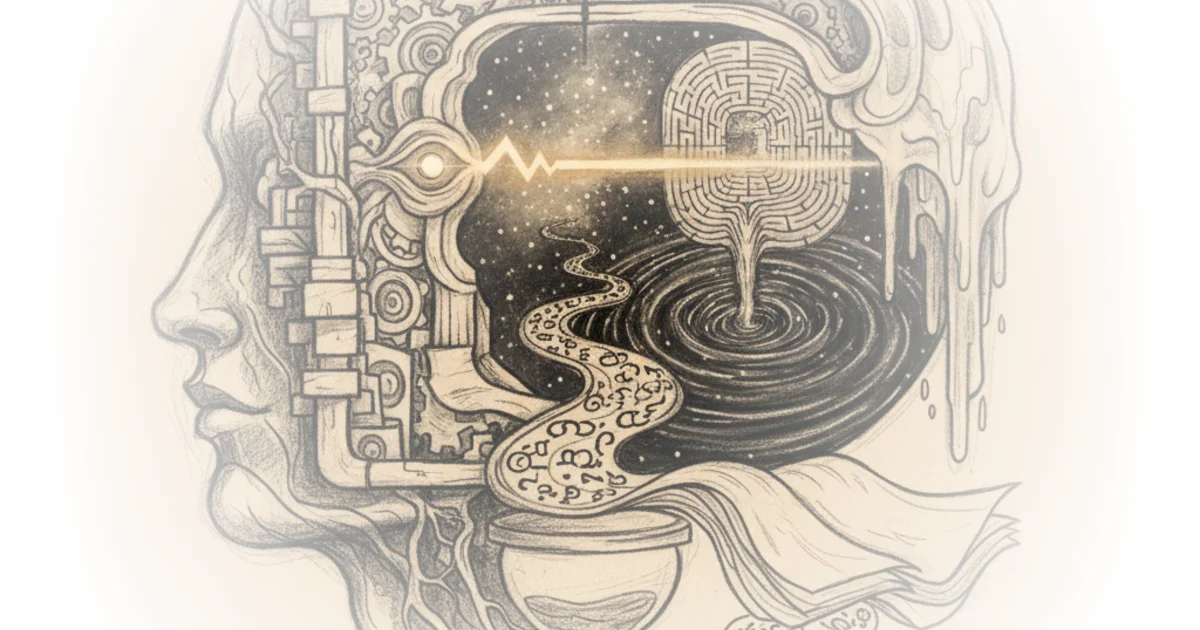
Critics might note that Descartes' method of doubt was intended as a tool for certainty, not a literal description of human psychology, and that discarding it entirely risks losing the rigor of scientific inquiry. However, the author's point is descriptive rather than prescriptive; he is not saying we cannot do science, but that science is a secondary layer built upon a more fundamental way of being.
Dasein and Being-in-the-World
To replace the subject/object split, West introduces Martin Heidegger's concept of Dasein, or "being-there." The core of the argument is that we are not entities in a world, but rather our existence is defined by our engagement with it. As Philosophize This! puts it, "We are not a being that is in the world. We are: being-in-the-world." This distinction is crucial. It suggests that before we ever analyze a keyboard as a collection of plastic and silicon, we experience it as an extension of our intent to write an email. The tool disappears into the background of our action, becoming "ready-to-hand."
"Dasein is a type of being that is always already in a world, involved, immersed in a kind of fascination and care for the things in that world."
This reframing dissolves the traditional problem of free will. If humans are not isolated objects subject to causal chains like rocks, but are instead beings who project themselves into the future based on possibilities, then the question of whether we are "determined" by physics becomes a category error. West explains that trying to apply causal explanations meant for the physical world to human existence is "like asking how much the number three weighs." The strength of this section lies in its ability to make abstract ontology feel immediately relevant to daily life.
The Modern Cave
Perhaps the most striking claim in the piece is the reimagining of Plato's Allegory of the Cave. The traditional trap is thinking we are seeing shadows instead of reality. West argues that for the modern person, the trap is believing that if we just remove our cultural and linguistic biases, we will finally see the "truth." Heidegger rejects this entirely. Philosophize This! writes, "Heidegger thinks this is nonsense and that it misunderstands a fuller picture of what human existence is." The argument posits that our language, history, and biases are not barriers to truth, but the very structures that make truth possible.
This is a radical departure from the Enlightenment ideal of the objective observer. It suggests that meaning is not something we find "out there" in a cold universe, but something that reveals itself through our engagement. As the author notes, "when I look out at the world and understand anything about it—that is not me accessing the truth of the universe; that is being revealing itself through me in some very partial way." While this challenges the reader's desire for absolute objectivity, it offers a more humane and grounded view of human agency.
Bottom Line
The strongest part of this argument is its successful translation of Heidegger's dense ontology into a practical critique of how we view our own agency and the world around us. Its biggest vulnerability is the potential for misinterpretation: without careful reading, one might mistake this for a rejection of science rather than a clarification of its limits. Readers should watch for how this "being-in-the-world" framework applies to emerging technologies that attempt to quantify human behavior, as the piece suggests such efforts fundamentally misunderstand the nature of human existence.