This is not a story about a legal victory for a tech giant; it is a story about how the government's understanding of the modern internet has become dangerously obsolete. Casey Newton's reporting on the collapse of the Federal Trade Commission's antitrust case against Meta reveals a startling disconnect: regulators are trying to apply 20th-century market definitions to a digital ecosystem that has fundamentally rewritten the rules of competition. The most surprising element isn't the verdict itself, but the specific, simple experiment that proved the government's entire premise was flawed.
The Flaw in the Market Definition
Newton opens by dismantling the core argument of the FTC: that Meta operates in a distinct market called "personal social networking," isolated from broader entertainment platforms. The agency insisted that apps like Facebook and Instagram were unique because they connected friends and family, distinct from the content-driven models of YouTube or TikTok. Newton notes that this framing was already shaky when the case was filed in 2020, pointing out that TikTok had already amassed 800 million users and was reshaping consumer behavior. "In December 2020, when the FTC filed its case, I predicted that the government would lose due to its shoddy market definition," Newton writes. This prediction wasn't guesswork; it was based on internal documents showing that when TikTok was banned in India, Instagram usage surged, proving the two were direct rivals.
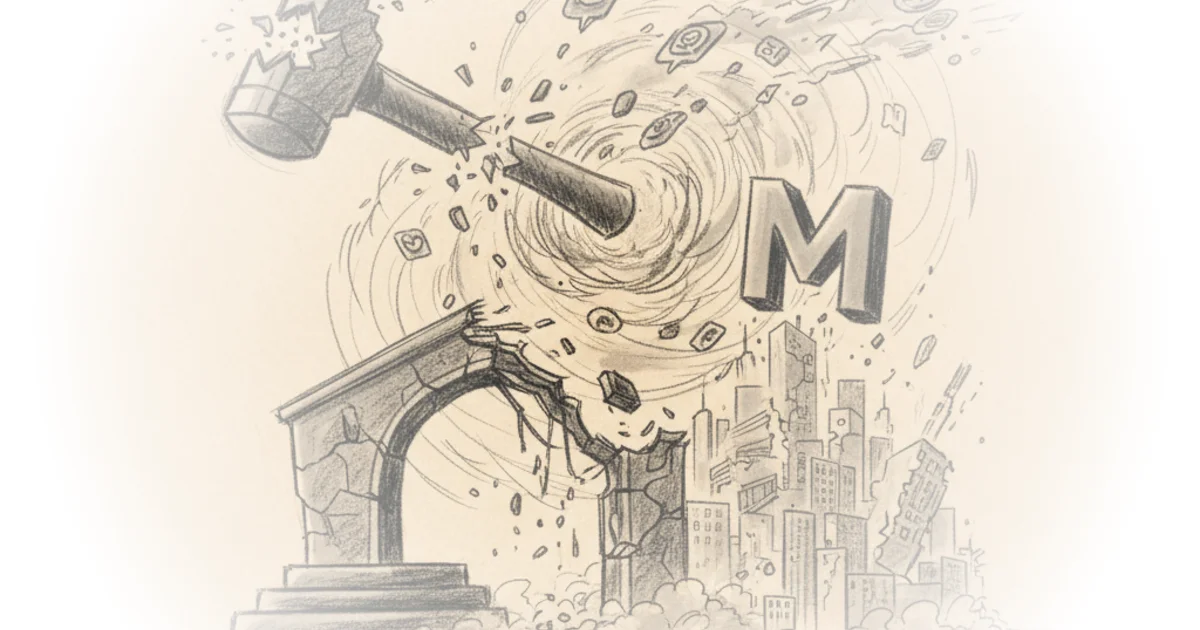
The argument here is compelling because it relies on actual user behavior rather than theoretical categories. The FTC tried to draw a static line around "social networking," but Newton highlights how the judge, James E. Boasberg, recognized that the market had moved on. "The social graph no longer has the power it once has," Newton explains, noting that the judge observed how friend lists have become "an often-outdated archive of people they once knew." This shift from connecting with known contacts to consuming algorithmic content is the critical pivot point the regulators missed. A counterargument worth considering is that the FTC was trying to protect the specific mechanism of connection, not just the content, but as Newton points out, users clearly do not distinguish between the two in their daily habits.
"Like Heraclitus's river, the rapids of social media rush along so fast that the Court has never even stepped into the same case twice."
Newton draws a powerful parallel to the ancient Greek philosopher Heraclitus, whose concept of the ever-changing river perfectly encapsulates the legal struggle. The judge noted that when the case first began, the word "TikTok" didn't even appear in the opinions. By the time of the ruling, the existence of that platform had effectively decided the outcome. This historical reference adds necessary depth, reminding us that antitrust law often struggles to keep pace with technological evolution, much like the 1998 United States v. Microsoft Corp. case where the definition of a "browser" was central to the debate over operating system dominance.
The Experiment That Broke the Case
The turning point of the coverage is the detailed account of a substitution study conducted by John List, a professor at the University of Chicago. Newton describes how Meta paid 6,000 participants to stop using Facebook or Instagram for an hour, paying them $4 per hour of abstinence. The results were decisive. "The No. 1 destination for those shut out of Facebook and Instagram was YouTube. The No. 2 destination was whichever Meta app they weren't being paid to avoid," Newton writes. The study found that when Meta apps became "costly," users turned to TikTok, YouTube, and Snapchat, with no other app notably standing out.
This evidence is devastating to the FTC's case because it moves the debate from legal theory to empirical data. The government had argued that if a grocery store sells pet food, it doesn't become a competitor to a pet store. Newton reports that Judge Boasberg rejected this analogy, noting that consumers treat TikTok as a replacement for the very "friends' posts" the FTC claims have no substitute. "This experiment, which in the Court's judgment offers the single best evidence of what consumers consider alternatives to Meta's apps, tells a clear and consistent story," Newton quotes the judge. The strength of Newton's coverage lies in how he lets the data speak for itself, showing that the market is defined by where people actually go, not where regulators think they should go.
Critics might argue that paying people to stop using an app creates an artificial scenario that doesn't reflect organic switching behavior. However, Newton addresses this by noting that the study controlled for normal usage patterns and was corroborated by natural experiments, such as the massive outage of Meta services in October 2021, which saw a surge in TikTok and YouTube usage.
The Aftermath and the Path Forward
The ruling has significant implications for how the executive branch approaches tech regulation. Newton points out that while the FTC failed to prove a monopoly, the case did have a "salutary effect": it froze Meta's acquisition spree for five years. "For the past five years, Meta has struggled to acquire any other company in its space," Newton observes. This pause allowed new competitors to emerge, such as OpenAI with ChatGPT, and forced Meta to overhaul its own AI efforts. The market, left to its own devices, began to innovate in ways the regulator's static model could not predict.
Newton concludes by noting the irony that the administration's attempt to check Meta's power may have inadvertently strengthened the competitive landscape by forcing the company to innovate rather than acquire. "The moment didn't last for long, though," Newton writes regarding the stagnant market, noting that Meta remains a formidable $1.51 trillion company. The piece ends with a sobering reality check: if the US government wants to check the power of tech giants, it will have to try something else, as the current legal toolkit is ill-suited for a market that changes as fast as the "rapids of social media."
Bottom Line
Casey Newton's analysis is a masterclass in connecting technical market dynamics to high-stakes legal outcomes, proving that the FTC's failure was a failure of imagination rather than evidence. The strongest part of the argument is the reliance on the substitution study, which provided irrefutable proof that the market is far broader than the government claimed. Its biggest vulnerability is the lack of a clear alternative framework for the administration to use, leaving regulators with a powerful warning but no new map for the future. Readers should watch for how the administration pivots next, as the tools of the past are clearly insufficient for the digital present.