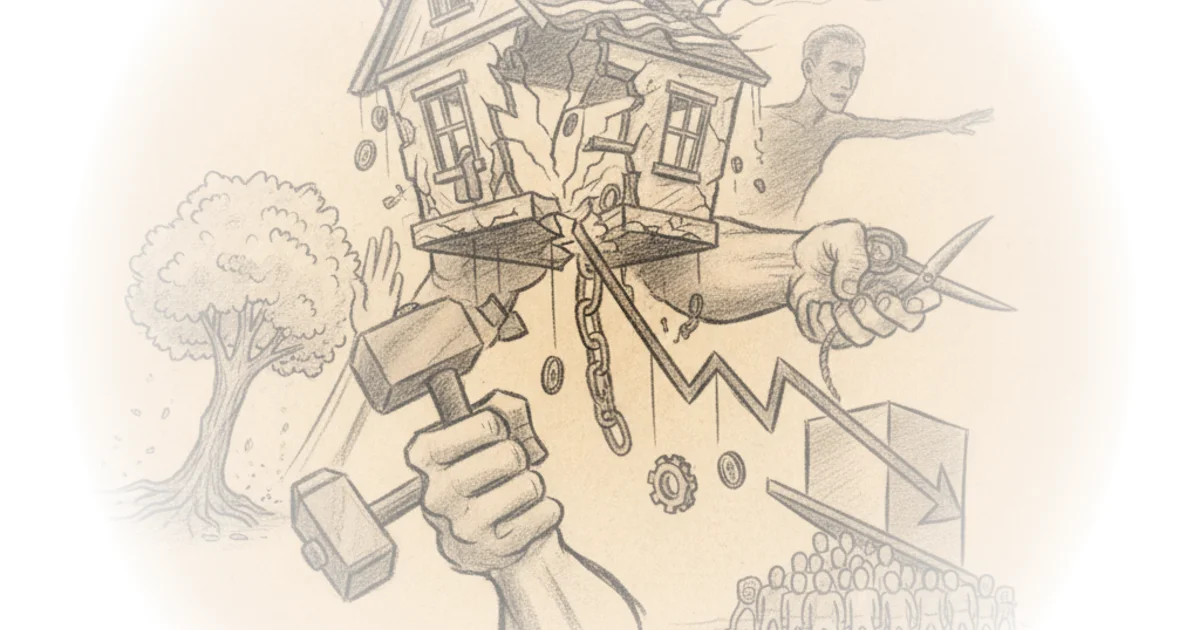
Most economic histories treat the mid-1980s as a period of recovery, but Kahlil Greene's recent analysis reframes it as a deliberate dismantling of the mechanisms that sustained the American middle class. The piece is notable not for discovering new data, but for connecting the firing of 11,000 air traffic controllers to a systemic shift in tax policy and financial deregulation that permanently altered the balance of power between labor and capital. For a listener trying to understand why wages have stagnated for decades despite rising productivity, Greene offers a specific, actionable timeline of institutional choices rather than vague economic cycles.
The End of the Strike Threat
Greene anchors his argument in a single, decisive moment: the 1981 confrontation between the executive branch and the Professional Air Traffic Controllers Organization (PATCO). He notes that while wages had already begun to flatten around 1973, "What Reagan did was take away the tools American workers used to claim a share of what they produced." This distinction is crucial; it separates long-term economic trends from specific policy interventions. The author highlights that the administration gave the controllers 48 hours to return to work, and when they didn't, "Reagan fired more than 11,000 controllers and permanently barred them from federal employment."
The commentary here is sharp because it contrasts this event with the 1970 postal strike, where workers walked off the the job illegally but faced no such existential threat. Greene writes, "He destroyed the strike as a functional threat," a phrase that captures the psychological shift in the labor movement. Before 1981, the idea of firing strikers was largely taboo, even if technically legal under a 1938 Supreme Court ruling. After the air traffic controllers were removed, private executives took notice. As Greene puts it, "By 1982, a group at the Wharton School circulated a manual urging business leaders to study what Reagan did to PATCO."
This historical pivot point explains the precipitous drop in major work stoppages, which fell from an average of 300 a year before 1981 to just 16 by the 2010s. The author argues that without the credible threat of a strike, the link between productivity and pay was severed. Joseph McCartin, a labor historian cited by Greene, estimated that "average hourly pay would sit about $10 higher if that relationship held after 1981." Critics might argue that globalization and automation were the primary drivers of wage stagnation, but Greene's focus on the removal of bargaining power provides a compelling counter-narrative that explains why productivity and pay diverged so sharply in the US compared to other nations with stronger labor protections.
The strike was not the sole cause of union decline, but Reagan removed the remaining leverage of the workers who still held union cards.
Shifting the Tax Burden
The second pillar of Greene's argument examines how the federal tax code was rewritten to favor capital over labor. The author points to the Economic Recovery Tax Act of 1981, signed at the president's ranch, which slashed the top marginal income tax rate from 70 percent to 50 percent. However, the most damaging move for the average worker came in 1983. Greene explains that to fix Social Security's finances, the administration and Congress "accelerated scheduled payroll tax increases and delayed a cost-of-living adjustment by six months."
The result was a structural shift where the burden of funding the government moved from corporations to wages. Greene writes, "While Congress raised the payroll tax, corporate income tax collections fell to their lowest level since World War II." This is a vital distinction for listeners to grasp: payroll taxes apply only to wages up to a cap, meaning a machinist earning a modest salary paid the full rate on every dollar, while those living on dividends paid nothing. The author notes that by 1982, corporate receipts averaged under 10 percent of federal revenue, down from 15 percent in the 1970s. This reframing challenges the popular narrative of the era as a time of universal tax relief, revealing instead a targeted transfer of fiscal responsibility onto the working class.
Deregulation and the S&L Crisis
Finally, Greene connects the erosion of worker power to the financialization of the economy through the savings and loan crisis. The author details how the administration signed the Garn-St. Germain Depository Institutions Act in 1982, which allowed thrifts to make riskier commercial loans while federal deposit insurance remained unchanged. Greene observes that "Thrifty operators chased high returns with money the federal government guaranteed," leading to a scenario where "More than 1,000 savings and loans failed by 1989."
The human cost of this financial gamble was immense, with the direct cost to taxpayers reaching $124 billion by 2004. Greene argues that this collapse "helped push the country into the 1990 recession" and decimated the housing market, with new construction falling to World War II levels. The author's synthesis of these events suggests a coherent strategy: weaken labor, tax wages more than capital, and remove safety nets for financial institutions. As Greene concludes, "American workers held their position in 1980 because they could still stop production and because Congress still taxed capital more heavily than wages, and Reagan ended both conditions."
Bottom Line
Kahlil Greene's most powerful contribution is the synthesis of labor law, tax policy, and financial deregulation into a single narrative of institutional dismantling, proving that the decline of the middle class was not an inevitable economic force but a series of deliberate choices. The argument's greatest strength is its specificity regarding the PATCO strike and the 1983 payroll tax hikes, though it could benefit from more nuance on the global economic pressures that also constrained policy options. Listeners should watch for how these historical precedents are being invoked in current debates over unionization and corporate taxation.