The Trump administration's Iran war is unraveling in real time. That much is clear from the contradictory messages emerging from the White House and the Department of War in recent days — where the president says the conflict is "very complete" while his own defense secretary insists "we have only just begun to fight." But what makes this story urgent isn't just the confusion. It's that the US fundamentally miscalculated Iran's response, and now finds itself trapped in a war it cannot win on its own terms.
The War Goals That Kept Changing
From the start of the US-Israeli war on Iran, President Trump has had no coherent plan. The objectives have shifted almost daily: first regime change, then destroying Iran's nuclear program, then eliminating ballistic missiles. Eleven days in, none of these goals have been achieved. What's remarkable is how openly this dysfunction has played out.
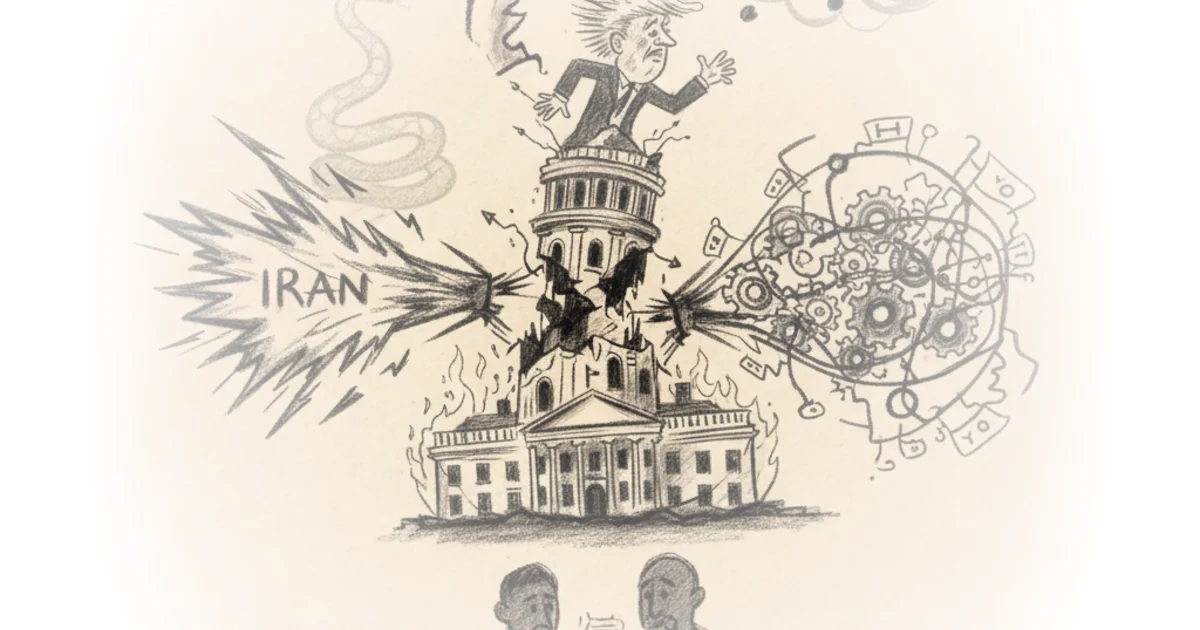
On Monday alone, the White House put out at least three different positions within just a few hours. The chaos began when CBS published an interview with Trump where he said the war was "very complete" — claiming Iran has no navy, no air force, no anti-aircraft equipment, no radar, no telecommunications, and no leadership. Hours later, his secretary of war Pete Hegeth contradicted that completely.
"We have only just begun to fight... We will not relent until the enemy is totally and decisively defeated."
Either Iran is crushed or it isn't. Either the war's aims have been met or they haven't. The administration can't answer this basic question.
Markets and Messaging
Earlier that day, markets had responded badly to Israeli bombing of oil depots near Tehran — with oil prices surging to almost $120 per barrel, the highest since Russia's invasion of Ukraine in 2022. Share prices also tumbled amid fears of inflation and economic disruption.
US officials were said to be furious about the Israeli strikes. One Israeli official told colleagues the message from the US was simply: "WTF." Trump's comments to CBS appeared to calm markets temporarily — by the close of trading, oil had dropped to under $90 a barrel and stocks recovered.
But this messaging boost for markets was directly contradicted by his own Department of War posting just hours later: "We have only just begun to fight."
Why Israel Is Uncomfortable
The Trump administration isn't just playing to markets. They have another partner in this war — Israel — and that partner may not be happy with the suggestion that it's Trump alone who will decide when the conflict ends.
Speaking to The Telegraph, the former head of Israel's National Security Council warned: if Trump decides the time has come to end the war while key threats remain unresolved, it would put Israel in an uncomfortable position. If he did so without proper undertakings, that would give the Iranian regime a huge boost of confidence and problems will persist into the future.
Iran's caretaker leader Ali Larajani, also the Security Council Secretary, delivered a sharp response: the timing of the end of the war is not up to Trump. The Islamic Revolutionary Guard Corps declared it is "we who will determine the end of the war." The equations and future status of the region are now in the hands of Iran's armed forces.
The Hormuz Factor
The Strait of Hormuz — through which 20% of the world's supply of petroleum and natural gas passes from the Gulf — remains closed. Only two ships have braved the passage since last Friday. Normally, 140 would pass through each day on average. This tiny sliver of water between the Arabian Peninsula and Iran puts mounting global economic pressure on Trump to end the war.
Trump posted on Truth Social: "If Iran does anything that stops the flow of oil within the Straight of Hormuz, they already are, they will be hit harder by the United States of America 20 times harder than they have been hit thus far... Death, fire, and fury will reign upon them."
This is incoherent even by Trump standards — threatening to "hit them 20 times harder" while simultaneously claiming the war is nearly over.
Why Iran's Response Surprised Everyone
Kieran Andrea, speaking on the show, made a crucial observation: Trump's team has clearly come down on the Iranians "like a ton of bricks," claiming they've destroyed Iran's military but now threatening to increase potential destruction twentyfold. The language is increasingly violent — but nothing anyone says is bankable.
The administration fatally underestimated three things:
First, they underestimated Iran's stockpile of ballistic missiles and the degree to which those missiles were fortified under fortified geology. Second, they underestimated how deeply martyrdom is valued in Islam — how willing Iran was to sit back, take its beating, and fire out these missiles raising costs across the region.
Third, and this connects everything else, they overestimated their ability to control the narrative at home. They overestimated Trump as "the political weather maker" on the American right. But this war was never popular with the American right. And it will get considerably less popular if more service personnel come back in body bags.
The Experience Gap
The chaos is also rooted in a serious lack of experience in Trump's second administration. In Trump Part One, there were people like Mike Pompeo, Mike Pence, Rex Tillerson — figures from the business world and security establishment with deep Washington experience. Those figures have either been repelled by the toxicity of the project or designed out because Trump wants inexperienced loyalists.
One exception is Senator Marco Rubio. Generally speaking, there's a serious deficit of experience. And in complex military warfare, inexperience can be a virtue in some domains but here it's completely insane.
There was a sharp tweet circulating: "You can be a madman in politics and get away with it. You can't in warfare. You can't talk your way out of unforeseen circumstances when it's literal life or death for the people you're meant to represent on the world stage."
The School Strike
When the US and Israel launched their war against Iran, it resulted in the killing of over 165 people at a girls' school in Minab, Iran. Most were young girls aged between 7 and 12. Footage released by Iran appeared to show a US Tomahawk missile striking an IRGC base near the school at around the same time with rising smoke suggesting the school had been hit.
The New York Times and other outlets determined the missile was American. The US has not claimed responsibility for this crime against children.
When asked about this attack, Trump said: "My opinion based on what I've seen — that was done by Iran."Pressed further, he insisted even his own defense secretary wouldn't say it was Iran when asked standing on Air Force One. It's worth noting: the only person in government claiming Iran bombed its own elementary school is Trump.
Critics might note that framing this entirely as a failure of Trump's messaging ignores deeper questions about the war's legitimacy and purpose — which remain contested among those who support the conflict but question its execution.
Bottom Line
The strongest thread running through this chaos is the consistent pattern: Trump and his team consistently miscalculated Iran's response, and now face a war they cannot win on their own terms. The messaging contradictions aren't accidental — they're symptoms of an administration that genuinely doesn't know what it's doing. The most dangerous vulnerability is that nobody in Trump's inner circle appears to have the experience necessary to manage complex military operations. What happens when the next unforeseen consequence arrives? That remains to be seen.