In a landscape saturated with sensational crash compilations, Devin Stone cuts through the noise by applying a rigorous legal framework to chaotic footage, transforming mere spectacle into a masterclass on liability. While most commentators focus on the physics of the wreck, Stone zeroes in on the often-overlooked question of who actually pays, revealing that the driver behind the wheel is rarely the only party on the hook. His analysis of everything from snow-covered highways to police misconduct offers a startling counter-narrative: sometimes, the law is less about who was driving and more about who was negligent in designing the road or enforcing the rules.
The Limits of "Acts of God"
Stone begins by dismantling the assumption that weather automatically absolves everyone of responsibility. When analyzing a massive pileup on a snowy hill, he acknowledges the intuitive desire to blame the elements but quickly pivots to the state's duty of care. "Theoretically, you might be able to sue the state of California or the state of Nevada, depends on where in Tahoe that is," Stone notes, highlighting that road design is a human choice, not a divine one. He distinguishes between unavoidable weather and known hazards, citing a Tennessee case where the state was held liable because it knew a factory was creating dangerous fog. This distinction is crucial; it shifts the conversation from "bad luck" to "preventable negligence."
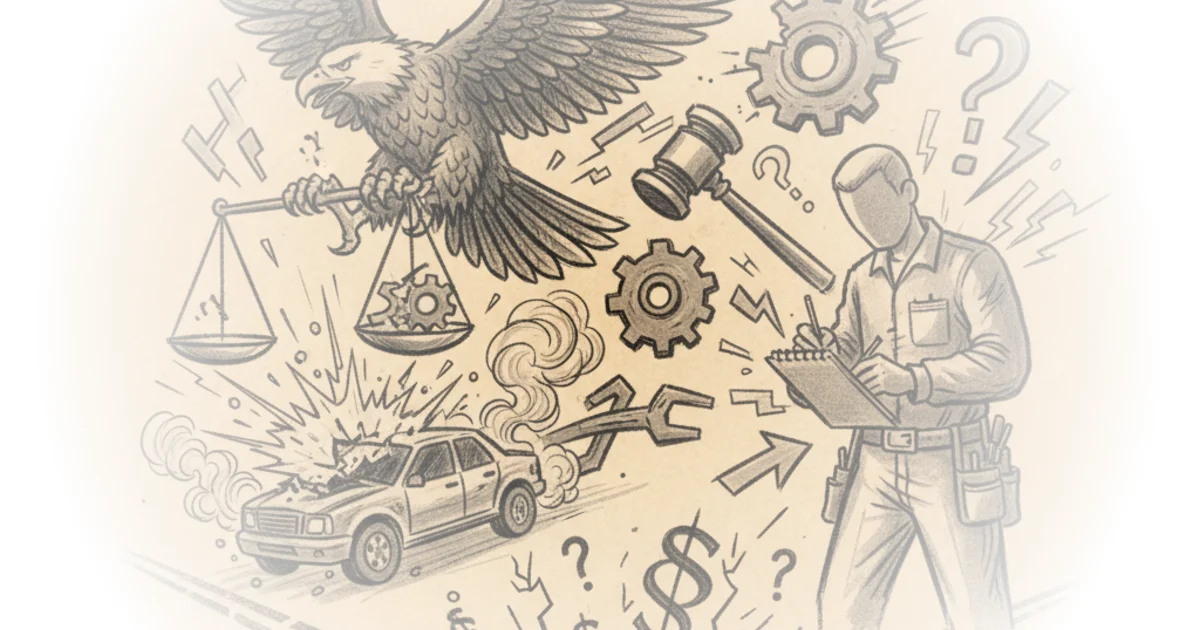
However, Stone is careful not to overpromise on liability. He suggests that in many weather-related scenarios, insurance companies will likely argue that "each individual driver was at fault and therefore the driver is responsible for the the their own damage to their own car." This pragmatic view of the insurance industry's incentives is a sobering reality check for victims hoping for a government payout. While critics might argue that this places too much burden on individual drivers in uncontrollable conditions, Stone's reliance on the concept of "comparative fault" provides a nuanced middle ground where liability is split rather than binary.
"If that person is considered 50% at fault, then they'd be required to pay 50% and only 50%."
The Mechanics of Mechanical Failure
The commentary takes a skeptical turn when addressing a viral clip of a teenager claiming his accelerator was stuck. Stone's reaction is immediate and grounded in mechanical reality. "That's really like hard to believe. It's a Hyundai. It's not that complicated, I think," he argues, pointing out that even with a stuck pedal, a driver should theoretically be able to shift to neutral or apply the brakes. He acknowledges that while a manufacturing defect is possible, the driver's inability to perform basic emergency maneuvers strains credulity.
Stone's analysis here is particularly sharp because it separates the emotional narrative of the victim from the technical facts of the vehicle. He notes that while "it could be 100% Hyundai's fault," the lack of evidence regarding a brake override system failure makes a lawsuit difficult. This section serves as a reminder that in the court of public opinion, a dramatic story often wins, but in a court of law, the burden of proof requires more than just a claim of malfunction. The author effectively uses this clip to illustrate the high bar required to prove product liability against major manufacturers.
The Standard of Care on the Track
Perhaps the most controversial segment involves a racer who loses his brakes and drives off the track into a parking lot. Stone challenges the viewer's instinct to root for the driver's survival at all costs, arguing that the "standard of care" for a professional racer is to stay on the track. "I think if you're uh racing a car, probably the standard of care is that you need to stay on the track if at all possible and slam into the wall," Stone asserts. He suggests that the driver's decision to veer into public traffic was a failure of judgment that could open him up to significant liability.
This is a bold legal stance that prioritizes the safety of the general public over the driver's immediate panic. Stone admits that his initial instinct was to tell the driver to hit the wall, but he corrects himself to emphasize the legal duty to avoid creating new hazards. A counterargument worth considering is whether the panic of a sudden brake failure truly allows for such calculated decision-making, but Stone's point stands: when you choose to race, you accept a higher duty of care than a normal driver. The clip effectively demonstrates how the context of an activity—racing versus commuting—fundamentally changes the legal expectations.
Power, Privilege, and the Law
The tone shifts dramatically when Stone analyzes a clip where a tow truck driver is arrested for repossessing a detective's car. Here, Stone's legal expertise shines as he identifies the clear misuse of authority. "The police are not above the law. And generally speaking, the police are not even allowed to break the law," he states, calling the situation "super super messed up." He points out that the arrest for "possession of stolen property" was legally baseless since the tow was authorized by the bank, not a theft.
Stone uses this example to highlight a broader issue of police entitlement, noting that the officers' actions reek of "misuse of authority." He contrasts this with a personal anecdote about a ticketing dispute to illustrate how law enforcement can sometimes overreach when they feel disrespected. While some might argue that police have discretion to investigate potential crimes, Stone's analysis suggests that in this specific case, the evidence of a legal repossession should have been immediate and sufficient to prevent an arrest. His conclusion is unambiguous: the tow truck driver should have sued, and the police should face consequences for using their power to shield a colleague from legal process.
"Insurance companies are the bad guys."
The Bottom Line
Devin Stone's coverage succeeds because it refuses to accept the surface-level narrative of viral videos, instead digging into the complex legal doctrines of negligence, comparative fault, and duty of care. His strongest argument is the consistent application of a "reasonable person" standard, even in chaotic or high-stress scenarios, which provides a clear framework for understanding liability. However, the piece's biggest vulnerability lies in its reliance on the assumption that drivers and racers always act with perfect rationality, a condition rarely met in real-world emergencies. Readers should watch for how courts continue to balance the duty of care between individuals and the state in an era of increasing litigation over road design and vehicle safety.