Jonathan Rowson transforms a mundane birthday into a profound meditation on how ordinary obligations anchor us against the chaos of a fractured world. In an era of performative celebration and digital noise, his refusal to curate a perfect day offers a startlingly effective antidote to modern anxiety. This is not a story about aging; it is a blueprint for finding stability when the ground beneath us feels unsteady.
The Theology of the Ordinary
Rowson begins by reframing his 48th birthday, which fell on Good Friday, not as a missed religious observance but as a lived experience of "Easter Saturday." He writes, "The best way to understand my birthday on Good Friday is that it felt more like Easter Saturday: In the Christian tradition, the time between Good Friday when Christ was crucified and his resurrection on Easter Sunday is a moment of repose between despair and hope." This theological pivot is the essay's intellectual engine. Rowson argues that we do not hear much about Easter Saturday because "we live it every day," suggesting that the human condition is defined by this suspended state between tragedy and redemption.
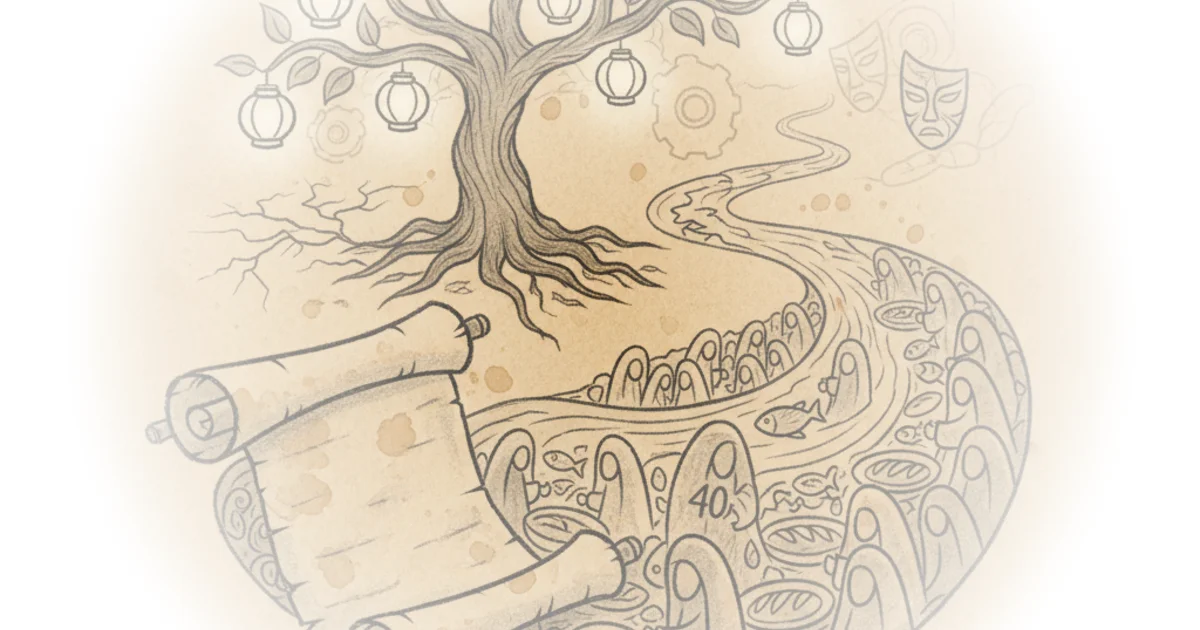
The author's choice to strip away the rituals of celebration—no cake, no candles, no social media clamor—reinforces this theme. He notes that the lack of external validation was a relief, describing the day as a "holding pattern of love and attention" that felt "solid and mercifully light." By embracing the mundane, Rowson finds a quiet dignity in the gap between high expectations and low-key reality. Critics might argue that this romanticization of neglect—such as forgetting to tell his sons about the birthday—risks normalizing emotional distance within families. However, Rowson frames these omissions not as failures, but as necessary space for a different kind of connection to emerge.
Perhaps the reason we don't hear much about Easter Saturday is that we live it every day.
The Sanctuary of the Unfinished
The physical setting of the essay is as significant as the philosophical one. Rowson spends his day in a "back room" that is essentially a wreck: "full of excess kitchen units, without a proper floor and ceiling, concealed cement on the walls, no working lighting above, just one electric point, and no heating." Yet, he declares, "But I love it. It's the closest thing I have to a man cave." This unrenovated space becomes a metaphor for the author's own internal state—a place of "gonzo DIY" where he is trying to "nurse that room into viability."
Rowson's description of covering ceiling holes with cushions held by double-sided tape is a brilliant image of improvisational resilience. He admits, "It was a ridiculous act, and they will probably fall down, but there was nobody there to stop me." This moment captures the essence of his argument: happiness is found in the act of doing what is necessary, however imperfectly, rather than waiting for ideal conditions. The room serves as a refuge from the "fluctuating moodscapes" of the wider world, allowing him to focus on the immediate task of clearing junk and creating order.
Responsibility as the Anchor
The essay culminates in a dinner with his sons, where a conversation with a waitress from Taiwan pulls the narrative from the domestic sphere to the geopolitical stage. The waitress discusses the complexities of dual nationality, noting that it is "a blessing in times of peace, but tricky in times of war." This interaction reminds Rowson of the "joyous struggle in the lives of other people," grounding his personal reflection in the harsh realities of global conflict and displacement.
It is here that Rowson introduces the core of his argument, citing writer Ted Gioia to explain why he feels "relatively good" despite the state of the world. He quotes Gioia directly: "A man achieves happiness in life by delivering on his responsibilities." Rowson adopts this framework, writing, "When I find that I am doing too much parenting or housework or other admin, and I am not able to get to what I want to be doing, and feel my best creative years are dwindling, it feels easier when I can see clearly that the things detaining me are also just as much my responsibility." This reframing of duty from a burden to a source of meaning is the piece's most powerful insight. It suggests that the antidote to despair is not escaping our obligations, but embracing them as the very things that give life structure.
A real man goes out into the world and gets things done in order to fulfill these obligations.
A counterargument worth considering is that this focus on traditional masculine values of "toughness, perseverance, and endurance" may feel exclusionary or outdated to some readers. Yet, Rowson's application of these values is deeply personal and inclusive of his role as a father and husband, stripping the rhetoric of its aggressive edge and replacing it with a sense of stewardship. He concludes by reflecting on his son's transition to sixteen, noting that the "infinite field of possibility" of youth puts his own age in perspective, but ultimately asserts, "But there's no age I would rather be."
Bottom Line
Rowson's essay succeeds because it rejects the pressure to curate a perfect life, offering instead a robust philosophy of finding meaning in the messy, unfinished work of daily responsibility. Its greatest strength is the seamless integration of domestic detail with existential weight, proving that the "back room" of our lives is often where the most important work happens. The only vulnerability lies in the risk that this perspective could be misread as resignation rather than active engagement, but the author's clear-eyed acceptance of reality makes that distinction difficult to miss.