The Alligator Doesn't Let Go
Political death spirals are rarely dramatic. They look like registration forms, donor spreadsheets, and candidates who showed up to the fight already exhausted. Eli McKown-Dawson's piece captures something important about Florida: the Democratic collapse there isn't an accident or a single bad cycle. It is structural, self-reinforcing, and getting worse with each election.
The Death Roll
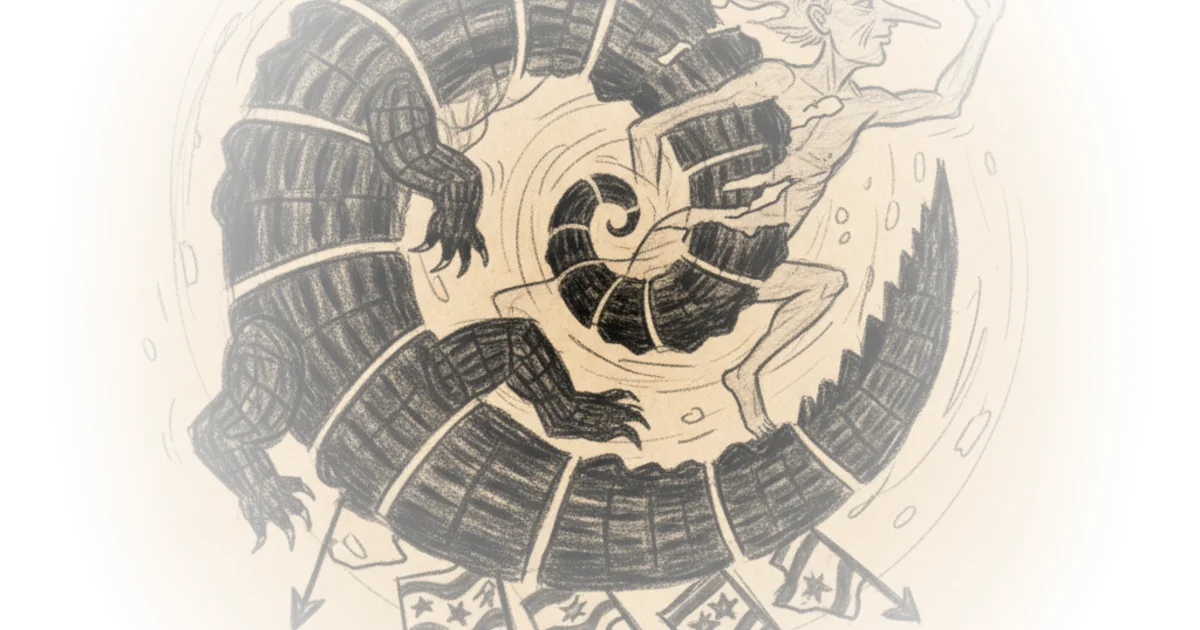
McKown-Dawson opens with an image that does heavy lifting. "After alligators drag their prey into the water, they'll perform what's known as a death roll, repeatedly rotating their body 360 degrees to dismember the poor creature in their jaws." The metaphor holds because it explains the mechanism: each loss makes the next loss more likely. "A short-term bad beat can easily become a death spiral that turns a well-funded, competent state party into a shell of its former self."
Florida did not go red overnight. Twenty-five years ago, it was the archetypal swing state — decided by 537 votes in a presidential election. Barack Obama carried it twice by margins under three points. Then the losses accumulated. The last Democratic Senate win was 2012. The party has not held a majority in the state's Congressional delegation since 1988. Republicans now hold two-thirds supermajorities in both legislative chambers.
After alligators drag their prey into the water, they'll perform what's known as a death roll, repeatedly rotating their body 360 degrees to dismember the poor creature in their jaws. Being bitten by an alligator isn't ideal to begin with, but the death roll makes an already bad situation worse because it disorients the prey animal and makes it harder to fight back or escape.
The Registration Cliff
The numbers behind the collapse are stark. "The percentage of registered Florida voters affiliated with the Democratic Party has plunged from 69 percent in 1972 to just 31 percent in 2025." Part of that shift reflects the rise of independent voters — nearly 29 percent now register with no party affiliation. But the Republican share has also grown, jumping from 35 percent to 41 percent since 2020 alone.
Migration explains some of this, but not all of it. Post-pandemic arrivals leaned heavily Republican: roughly 45 percent of new registrants who had previously voted in other states signed up as Republicans, compared to just 24 percent as Democrats. Yet McKown-Dawson notes a crucial caveat from longtime Florida Democratic operative Steve Schale: "There aren't that many more registered voters today in Florida than there were in 2020."
The deeper story is demographic realignment among existing residents. "Hispanic voters in Florida moved from D+27 in 2016 to R+16 in 2024." That is a 43-point swing in eight years. Meanwhile, voters without college degrees have shifted 16 points toward Republicans across the past three presidential cycles. Gains among white college-educated voters have not come close to offsetting those losses.
Critics might note that party registration is a lagging indicator — it measures who bothered to fill out a form, not who will actually show up on Election Day. Turnout operations can sometimes overcome registration gaps. But in a state this far gone, that is a thin reed.
The Infrastructure Problem
McKown-Dawson refuses the easy answer that the Florida Democratic Party is simply incompetent. "The most common thing you hear about the FDP is that it's a complete and total mess full of ineffectual grifters," he writes. "I'm barely exaggerating here." The evidence is there: nominating a former Republican governor for the top of the ticket, primary losers now running the party, a steady stream of state legislators defecting to the other side.
But the real problem is money and how it gets spent. In the final quarter of 2025, the state Republican Party raised nine times what the Democrats did. The leading Democratic gubernatorial candidate has raised more than a million dollars; the Republican frontrunner has pulled in five million.
Critics might argue that this fundraising gap simply reflects rational donor behavior — no one wants to throw money into a black hole. But that rationality is precisely what makes the death spiral self-sustaining. Donors leave because the party loses. The party loses because donors leave.
The Wrong Tool for the Job
After the 2008 Obama victory, Florida Democrats made a fateful choice. Instead of building out the state party apparatus, they funneled money into donor-backed outside groups. "The idea was that 'if we stand up some organization that's focused towards Puerto Ricans, that they'll understand how to talk to Puerto Ricans better than the Democratic Party ever could,'" McKown-Dawson reports, citing Schale.
Those groups did raise and spend meaningful money initially. But they could not do what a real party does: coordinate directly with candidates, run partisan voter registration drives, build long-term field operations. "We as a state have not built partisan infrastructure, really at all, in any meaningful way," Schale said.
The result is a party that tries to contest everything and wins nothing. In 2024, Democrats ran candidates in every state legislative seat. As former state representative Alan Williams put it: "We're an inch deep and a mile wide as it relates to the resources." About five million dollars went into two special Congressional elections last year. Democrats overperformed their baselines — and still lost both races by comfortable margins.
Most of that money came from outside Florida. Individual donations to one Senate campaign were only 12 percent in-state before the candidate dropped out. Out-of-state money signals less enthusiasm than local investment. It looks like a national committee checking a box, not a homegrown movement.
The Exit Ramp
What would a recovery look like? McKown-Dawson is appropriately modest. Getting out of the legislative superminority — picking up two state Senate seats or five state House seats — is the first attainable goal. That would give Democrats actual leverage as the state pursues mid-decade redistricting, which could add roughly three more Republican Congressional seats to the current already-GOP-favorable map.
Focusing resources on competitive races instead of running everywhere would help. Rebuilding a farm system of local candidates would reduce reliance on party-switchers and political tourists. Raising ten million dollars for the state party apparatus, as Schale demands, would be a starting point.
None of it sounds heroic. "If 'getting out of the superminority so we can maybe soften the blow of mid-decade redistricting' sounds like a sad goal," McKown-Dawson writes, "that's because it is."
Bottom Line
Florida Democrats are not suffering from bad luck or poor messaging. They are caught in a feedback loop where lost races drive away donors, which produces weaker candidates, which produces more lost races. Escaping requires a patient, expensive, unglamorous rebuild — the kind of work that rarely wins headlines and almost never produces quick results. A decade to fall in. A decade to climb out. The alligator, as always, is patient.