Mick Ryan cuts through the diplomatic fog of recent peace talks with a stark, unvarnished reality: the current negotiations are not a path to peace, but a theater of delay. While officials in Miami and Abu Dhabi trade phrases like "productive" and "constructive," Ryan argues that the fundamental incentives for the Russian leadership make a genuine settlement impossible right now. This is not a story about broken trust, but about a leader who has bet his regime on a war he cannot afford to lose, even as that war consumes his nation.
The Cost of Stalemate
Ryan's central thesis is that Vladimir Putin is trapped by his own rhetoric and the catastrophic costs of the invasion. He writes, "There is no way that the Russian president can afford to end the war now." This claim is backed by a grim accounting of Russia's losses: over 1.2 million casualties, the depletion of Cold War-era munitions, and a demographic hemorrhage of 1.3 million citizens fleeing since the invasion began. The author notes that despite these staggering figures, Russia has achieved none of its original political objectives; Ukraine remains a free democracy, and its military is larger and more capable than before the conflict started.
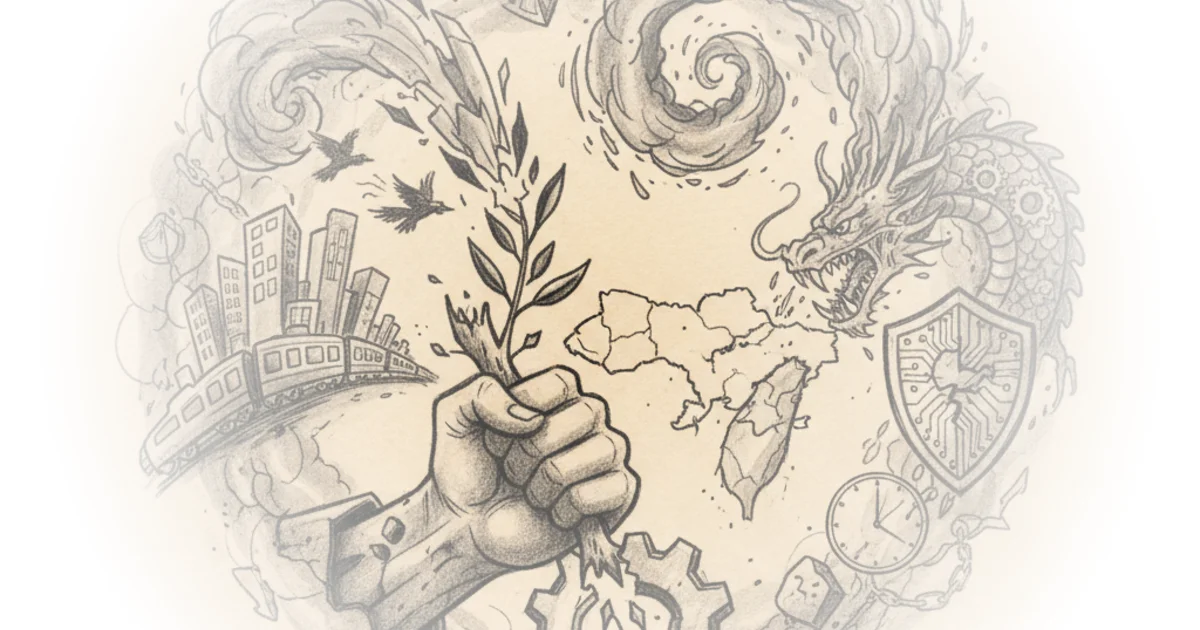
The author's framing of the human toll is particularly effective, refusing to let the geopolitical chess game obscure the reality on the ground. Ryan points out that for every single day of the war, Russia has suffered an average of over 850 casualties, a rate that dwarfs the worst year of the Iraq War for American forces. "If this was the United States four years after its 2003 invasion of Iraq, we would call this out clearly as 'losing the war'," Ryan observes. This comparison is jarring but necessary, forcing the reader to confront the sheer scale of the attrition. Critics might argue that comparing a defensive war for national survival to an invasion of a sovereign neighbor is flawed, yet the metric of daily casualties serves to highlight the unsustainable nature of Russia's current strategy.
Putin has transformed Russia into a 'war' nation... He has to show to his people some kind of return on that investment, which at present, he cannot.
This domestic pressure creates a paradox. Putin cannot stop the war because he needs a victory to justify the sacrifice, yet continuing the war guarantees further losses that erode his narrative of inevitable triumph. Ryan suggests that the Kremlin is now worried about the reintegration of hundreds of thousands of angry veterans, noting that "neither Putin nor his ruling clique of billionaires want that" political strife. The author draws a historical parallel to the "Twelve Years' Truce," suggesting that just as past ceasefires were often preludes to renewed conflict, any agreement struck now would likely be a temporary cessation of hostilities rather than a true peace. As Ryan writes, "Even the final decision of a whole War is not always to be regarded as absolute. The conquered State often sees in it only a passing evil."
The Pacific Theater and Military Evolution
Shifting focus to the Indo-Pacific, Ryan analyzes the evolving military dynamics between the United States, Taiwan, and China. He highlights the establishment of a Joint Fires Coordination Centre, a move he likens more to the U.S. support structure in Ukraine than the traditional U.S.-South Korea alliance. "The U.S. provides intelligence and mensuration data to the Taiwanese forces that would conduct medium and long-range strikes," Ryan explains, emphasizing the shift toward deep operations and integrated targeting. This development is significant because it moves beyond mere defense to a capability for strategic counter-strike, fundamentally altering the calculus for any potential aggression.
Ryan also addresses Taiwan's decision to integrate conscripted soldiers into regular brigades. He argues this is a logical step to "expose new, inexperienced soldiers to their more experienced, professional colleagues," thereby uplifting the overall competence of the force. This mirrors the rapid professionalization seen in Ukraine, where the integration of reservists and regulars has been crucial to sustaining the defense. However, Ryan cautions against over-interpreting recent purges within the Chinese People's Liberation Army (PLA). While the removal of senior generals is notable, he warns, "let's not forget that even in democracies, senior military personnel are rotated regularly." He suggests that these changes might actually signal a push for faster military transformation rather than a sign of weakness. "No one is saying the U.S. military can't do its job, and it has removed even more senior military officers since January 2025 than China has!" he notes, grounding the analysis in the universal reality of military career cycles.
The countdown clock in Taiwan steadily ticks down the seconds, days, weeks and months until 1 January 2027.
This date, set by Chinese leadership for military readiness, looms over the region. Ryan's commentary here is sobering; he rejects the notion that internal Chinese politics will derail the timeline, instead pointing to the concrete steps being taken to integrate U.S. doctrine and technology. The reference to the "Hai Kun-class submarine"—Taiwan's first indigenous submarine launch—serves as a tangible symbol of this growing self-reliance and capability. The integration of these new assets with U.S. intelligence creates a deterrent that is far more complex and dangerous for any aggressor than the status quo of a few years ago.
The Future of Command
Finally, Ryan turns to the intellectual challenges of modern warfare, specifically the role of artificial intelligence in command and control. Citing Frank Hoffman's concept of "System 3" thinking, Ryan explores how AI is becoming an integral part of the decision-making loop, alongside human intuition and analytical reasoning. He emphasizes a crucial caveat from Hoffman: "AI should enhance a commander's intuition, not displace it." This distinction is vital. As warfare becomes more automated, the risk of commanders abdicating their agency to algorithms grows. Ryan's inclusion of this reading underscores that the next great battle may not just be over territory, but over the cognitive domain and the ability of human leaders to maintain control in an age of machine-speed conflict.
The author's selection of readings on the "narrative war" around China's "Justice Mission" exercises further reinforces the idea that information and perception are as critical as kinetic power. "Winning the story of a war is as important as winning the war itself," Ryan writes, reminding us that the battle for legitimacy is fought in the information domain just as fiercely as on the battlefield. This holistic view—connecting the physical destruction in Ukraine, the strategic posturing in the Pacific, and the cognitive shifts in military theory—makes the piece a comprehensive guide to the current state of global conflict.
Bottom Line
Ryan's most compelling argument is that the current peace talks are a mirage, driven by a Russian leadership that is too politically fragile to accept a settlement that admits defeat. The piece's greatest strength lies in its refusal to separate the military stalemate from the human cost, grounding high-level strategy in the grim reality of 850 daily casualties. The biggest vulnerability, however, is the assumption that the U.S. administration will remain a consistent variable; the piece acknowledges the risk of a favorable outcome for Russia through political maneuvering, but the ultimate trajectory remains uncertain. Readers should watch for the next phase of the "energy truce" and whether the new U.S.-Taiwan coordination center can translate into tangible deterrence before the 2027 deadline approaches.