Daniel Tutt resurrects a century-old Marxist framework to diagnose a modern crisis: the way imperialist logic quietly rewires our culture, our politics, and even our sense of what is "normal." While most contemporary analysis treats chauvinism as a moral failing or a personality trait, Tutt argues it is a structural byproduct of monopoly capitalism that convinces workers their exploitation is natural. This is not just a history lesson on Lenin; it is a sharp, unsettling lens for understanding why solidarity fractures in the face of global crisis today.
The Anatomy of Chauvinism
Tutt begins by dismantling the idea that nationalism or racism are merely individual prejudices. Instead, he posits that they are strategic tools used to fragment the working class. He writes, "Chauvinism is defined as the tendency to distort and manipulate the worker's movement in such a way that exploitation is construed as normal or natural." This reframing is crucial because it shifts the blame from individual bigots to the economic system that incentivizes their worldview. The author suggests that when the proletariat becomes financially tied to the spoils of empire, they adopt a "bourgeoisified" perspective that sees war and domination as inevitable rather than constructed.
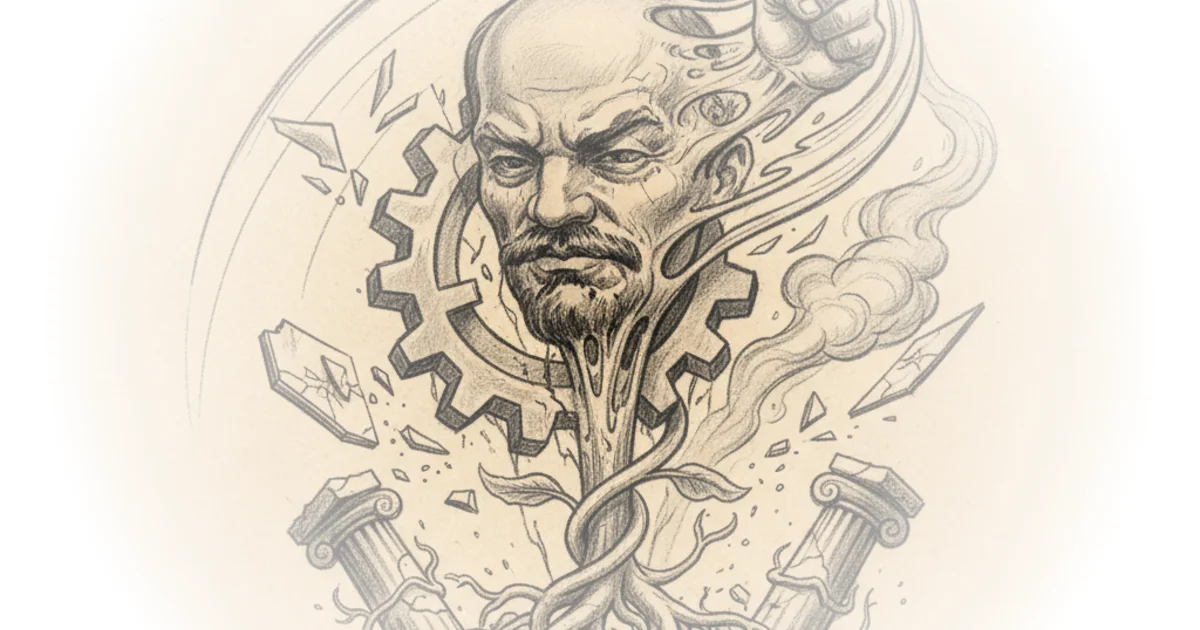
The piece draws heavily on the work of Georg Lukács to explain how this happens. As Daniel Tutt puts it, "Chauvinism emerges as rampant in imperialist times but chauvinism is not to be understood as a moral critique and nor is it reducible to an individualist posture of racism or bigotry; it is rather an effect of opportunism." This distinction is the article's intellectual backbone. It forces the reader to ask not "Why are people so hateful?" but "What economic conditions make hate a rational strategy for survival?"
Critics might argue that this structural determinism downplays the agency of individuals who choose to embrace reactionary ideologies, but Tutt's focus is on the systemic currents that make those choices so seductive. The danger, he notes, is that this mindset leads to a "depoliticizing tendency" where the status quo becomes unchallengeable.
"The problem of both opportunism and chauvinism is thus strategic: when a worker adopts either position they adopt a faulty perspective on the nature of the class struggle itself, one that leads other workers to see exploitation as normal."
The Failure of "Peaceful" Capitalism
Moving from theory to history, Tutt critiques the early 20th-century theorist Karl Kautsky, whose ideas on "Ultra-Imperialism" suggested that rival powers could form a peaceful alliance to manage capitalism without war. Tutt argues this was a fatal error that blinded the left to the reality of conflict. He writes, "Kautsky failed to see how imperialism can offer a true revolutionary break," instead dreaming of a "peaceful federated Christendom" that would never materialize.
The author connects this historical failure to the definition of imperialism itself, which Lenin saw as synonymous with "monopoly capitalism." According to Tutt, the core contradiction is no longer just about trade, but about the concentration of production and the rise of global bank dominance. When leaders or intellectuals advocate for a "better" version of capitalism that avoids these contradictions, they are engaging in revisionism. As Daniel Tutt notes, "The revisionist condemns the dialectic because they work to improve the proletariat within bourgeois society." This is a stinging critique of modern reformists who believe the system can be tamed without addressing its imperialist roots.
The argument here is that the administration's foreign policy, driven by the logic of monopoly capital, inevitably leads to conflict, and any attempt to smooth over these contradictions is merely a delay tactic. The volatility of the market and the violence of war are not bugs in the system; they are features of its current stage.
Culture as a Battleground
Perhaps the most striking section of the piece is its analysis of how imperialism corrupts culture and art. Tutt argues that the ruling class, facing a "moribund" stage of capitalism, shifts its worldview to justify brutality. He observes, "Art and culture begin to reflect worldviews of the human based on zero-sum logics of power, the possibility of social cooperation is pessimistically denied and competition is theorized as natural." This explains why contemporary culture often feels so cynical and why the idea of collective action seems increasingly impossible.
Tutt extends this critique to the philosopher Friedrich Nietzsche, whom Lukács viewed as a prophet of reaction. The author writes, "What Nietzsche provided was a morality for the socially militant bourgeoisie and middle-class intelligentsia of imperialism." By linking Nietzsche's "will to power" to the imperatives of empire, Tutt suggests that the very ideas we use to justify individualism and dominance are shaped by the needs of a decaying capitalist order. This is a bold move, connecting high theory to the gritty reality of modern alienation.
However, the piece could benefit from more concrete examples of how this "cultural regression" manifests in current events beyond the generalities of "tech oligarchs." While the theoretical link is strong, the bridge to specific, tangible cultural moments feels slightly abstract.
"Imperialist imperatives are made diffuse in intellectual and cultural life and the bourgeoisie inevitably shifts their worldview to accommodate war, brutality and social chaos."
The Path to Class Consciousness
Finally, Tutt addresses the solution: how can workers regain a clear picture of their reality? He returns to Lenin's What Is To Be Done, emphasizing that class consciousness cannot be learned from books alone. "To become class conscious, the worker must have a clear picture in his mind of the economic nature and the social and political features of the landlord and the priest," Tutt writes. The key is observing concrete political facts and understanding the "strong and weak points" of every other class.
The author argues that the primary contradiction between labor and capital is often obscured by imperialism, which creates "privileged sections among workers." To overcome this, the working class must coordinate internationally, standing for the freedom of all oppressed people. As Daniel Tutt concludes, "Revolutions must be proletarian in conditions of imperialism." This is a call for a global solidarity that transcends national borders and rejects the false choice between domestic labor struggles and anti-colonial movements.
The piece ends on a note of urgency, suggesting that the fragmentation caused by imperialism is the greatest threat to any meaningful change. The challenge is not just to oppose war, but to dismantle the ideological machinery that makes war seem like a natural part of life.
Bottom Line
Daniel Tutt's analysis is a powerful reminder that the normalization of war and exploitation is not accidental but engineered by the logic of monopoly capitalism. Its greatest strength lies in reframing chauvinism as a systemic strategy rather than a moral failing, offering a rigorous tool for understanding today's political fractures. However, the argument's reliance on dense historical materialism may leave some readers struggling to connect the theory to immediate, actionable political strategies. The piece demands that we look beyond the surface of current events to the imperialist imperatives driving them, a perspective that is as necessary as it is uncomfortable.