In an era where ancient wisdom is often packaged as a self-help commodity or a branding exercise for whiskey, Andreas Matthias offers a refreshing counter-narrative by championing a collection of lost Greek plays that prioritizes raw, unvarnished truth over marketability. The piece stands out not merely as a book review, but as a meditation on the fragility of knowledge itself, arguing that the most valuable insights are often those preserved by accident rather than design. Matthias suggests that we are living in a time of intellectual noise, where the quiet, distilled voice of a fifth-century compiler named Stobaeus might be the only thing that cuts through the static.
The Architecture of Loss
Matthias begins by contrasting the typical harshness of his reviews with the genuine delight he feels regarding James Romm's latest work. He writes, "I was delighted to open James Romm's little collection of ancient wisdom and immediately be enchanted by the premise of the book, the idea behind it, the selection of sources and sayings." This enthusiasm is not just about the content, but about the act of preservation. The author frames Romm's work as a "doubly distilled" edition of the Anthology of Stobaeus, a massive compilation created by Johannes Stobaeus in the 5th century AD specifically for his son, Septimius. Matthias notes that this original collection contained quotes from over five hundred authors, many of whom are now entirely lost to history.
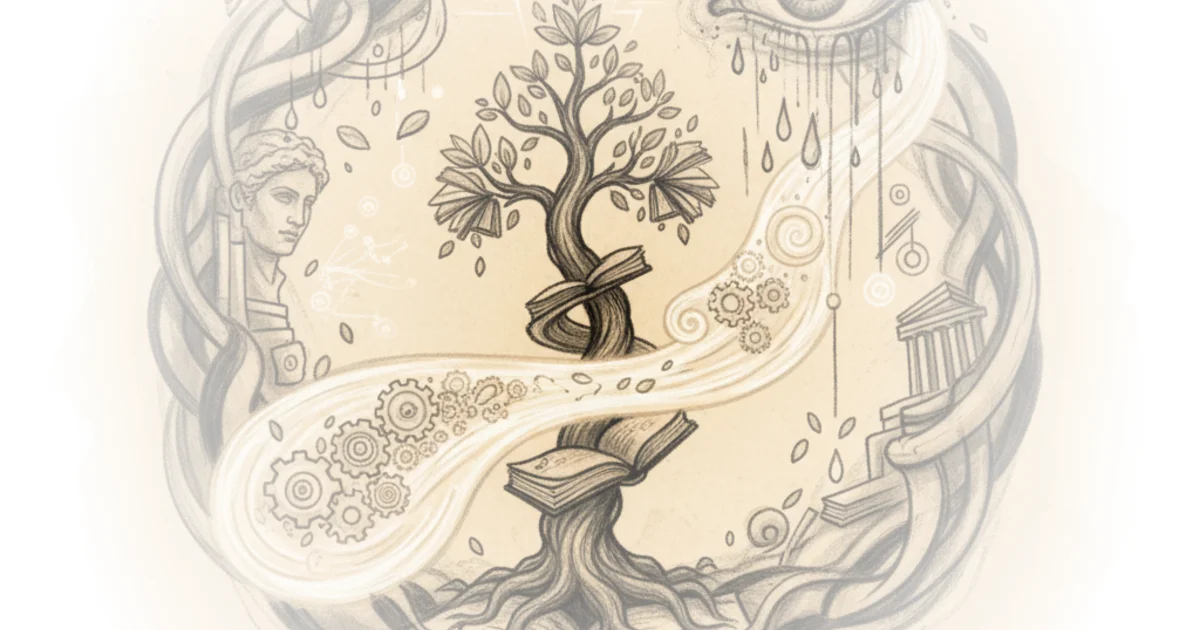
The editorial choice to focus on the "lost" nature of these texts is a powerful hook. Matthias points out that "many of the works that Stobaeus cites are today lost, and his quotes are often the only words we have from these lost books." This transforms the book from a mere anthology into a rescue operation. The argument gains depth when Matthias highlights the absurdity of the publication history: the most modern edition of the original text is over a hundred years old, yet a complete modern translation remains elusive, accessible only to university libraries or buried in the blog of a cryptocurrency lawyer. This framing effectively positions the reader as a rare beneficiary of a scholarly miracle, rather than just a consumer of content.
"This could almost be an Umberto Eco plot. If you are not intrigued by that, I don't know how to help you."
Matthias acknowledges a potential weakness in the "double-distilled" approach: the risk of decontextualization. He admits that "isolated sentences are very easy to misunderstand," noting how a Stoic quote can sound like an Epicurean one. However, he argues that the sheer quality of the selection mitigates this risk. The core of his argument is that the wisdom is so potent it survives even when stripped of its original academic scaffolding. This is a bold claim, one that relies on the reader's trust in the editor's curation. Critics might note that without context, these quotes could easily be co-opted for modern political or social agendas, stripping them of their original nuance. Yet, Matthias seems to believe that the universal nature of the human condition—fear, love, death—transcends these specific historical contexts.
The Human Condition in a Bottle
The review shifts from the history of the text to the content itself, where Matthias finds the ancient voice surprisingly modern and refreshingly unpretentious. He contrasts the book with the current "multi-billion industry" of Stoicism, which he dismisses as a "cacophony of voices." He writes, "In all this cacophony of voices, it is refreshing, for once, to not hear Ryan Holiday trying to push a memento mori coin for 30 USD down our throats." This is a sharp critique of the commodification of philosophy, suggesting that the market has turned wisdom into a product rather than a practice.
Matthias highlights specific quotes to illustrate this timelessness. He cites Antiphanes: "Our life is like wine: When there's only a little left, it turns to vinegar." He also points to an anonymous line that could have been written by Oscar Wilde: "Living's a fine thing, provided one learns how to do it." These selections serve as evidence for his broader point: that the ancients were not just philosophers in ivory towers, but people grappling with the same messy realities of existence. Matthias observes that "today, we are so much bombarded with fake quotes from every corner of the Internet that I, at least, dismiss every quote I find online as inauthentic." The book, therefore, acts as a filter, a verified source of truth in a landscape of digital noise.
The author's personal anecdote about a doctor in Hong Kong who dressed in robes and discussed Aristotle adds a human dimension to the argument. Matthias imagines this doctor as the ideal reader, someone who seeks wisdom not for career advancement but for the sake of living. He writes, "This book would make an attractive present for someone with a general interest in ancient wisdom." This framing moves the book away from academic rigor and toward a more intimate, personal utility. It suggests that the value of the book lies not in its scholarly apparatus, but in its ability to spark conversation and reflection in everyday life.
The Limits of Brevity
Despite his praise, Matthias is not uncritical. He notes that the "doubly distilled" nature of the book means it is quite short, containing around 300 quotes spread over 105 pages. He writes, "one regrets that so much of Stobaeus collection has been left out." This is a significant limitation for readers seeking a comprehensive understanding of ancient thought. The layout, with its generous white space and few lines per page, makes the book approachable but also sparse. Matthias admits, "While this makes the book look friendly and approachable, it does make one wish that the author had included a little more wisdom in his 'double-distilled' edition."
This critique highlights a tension in the book's design: it is meant to be a coffee-table companion, not a textbook. Matthias suggests that the intended audience is not the academic philosopher, but the general reader who wants a taste of the past without getting bogged down in the details. He writes, "The intended reader is certainly not an academic philosopher interested in Stobaeus or ancient sources." This is a clear demarcation of the book's scope. It is a curated experience, designed for moments of leisure rather than deep study. The question remains whether this brevity does justice to the complexity of the original texts, or if it simplifies them to the point of triviality.
"Life is definitely worth investing more in to get it right."
Matthias concludes by reflecting on the ultimate purpose of the book: to provide guidance on how to live and how to die. He notes that the book ends with meditations on old age and death, a fitting conclusion for a collection of wisdom. He cites Philetaerus: "What should a mortal do, I ask of you, but live life day by day, while gaining pleasure, as long as resources last?" This quote encapsulates the book's ethos: a pragmatic, day-by-day approach to existence that acknowledges the inevitability of decline. Matthias suggests that this perspective is particularly relevant in a world that often feels chaotic and uncertain.
Bottom Line
Andreas Matthias successfully argues that James Romm's collection is a vital antidote to the commercialization of ancient wisdom, offering a rare glimpse into the lost voices of Greek tragedy. The piece's greatest strength lies in its ability to frame the book as a rescue mission for forgotten knowledge, appealing to the reader's desire for authenticity in a digital age. However, the review also rightly points out that the book's brevity and lack of context may limit its utility for those seeking a deeper academic engagement. The reader should approach this work not as a definitive guide to ancient philosophy, but as a curated collection of sparks intended to ignite their own reflection on the human condition.