In an era obsessed with digital immortality and the promise of consciousness uploading, Justin E. H. Smith offers a startlingly different origin story for the human condition. Rather than looking to the future of technology, Smith digs into the ancient theological architecture of the Abrahamic faiths to argue that our struggle with pride and the corruption of language is not a bug in the system, but the system itself. This is not a sermon, but a sharp philosophical dissection of why the very faculty that elevates us—our intellect—is also the mechanism of our undoing.
The Architecture of Pride
Smith begins by dismantling the modern assumption that knowledge is a neutral tool for discovery. Instead, he reframes it as a sacred transmission that requires humility to be wielded correctly. He writes, "Knowledge, in this sense, is not discovery but transmission: it comes from God, who is both the origin and the final repository of all knowing." This distinction is crucial; it suggests that when we treat knowledge as something we possess rather than something we receive, we sever the moral axis that keeps it grounded.
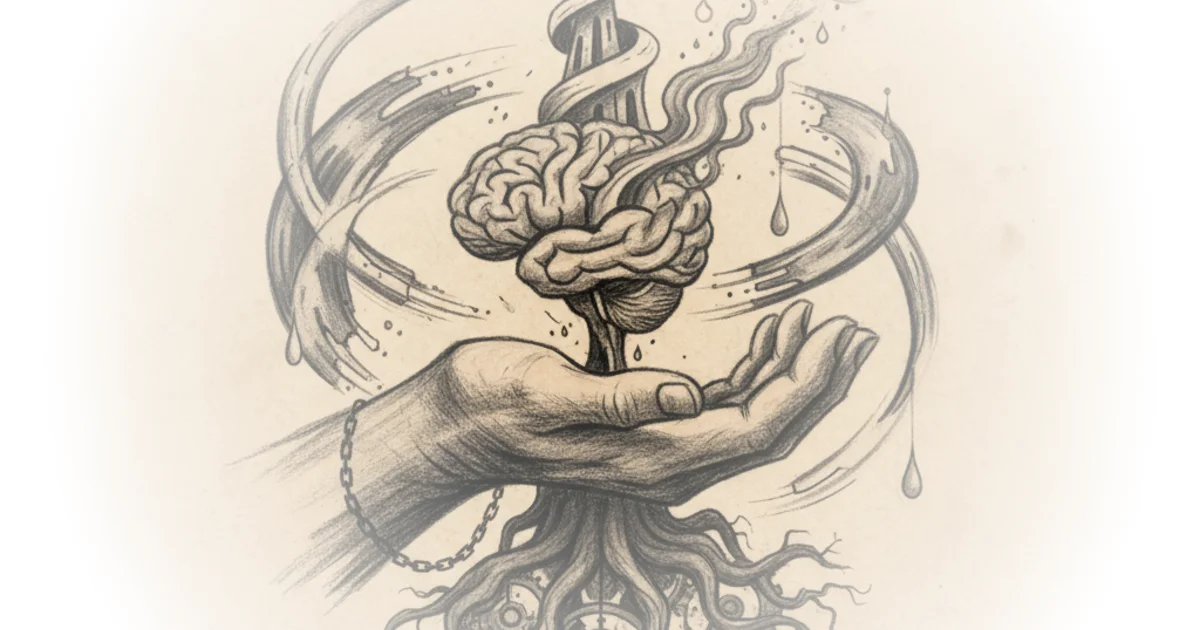
The author uses the figure of Iblīs (known as Satan in Judeo-Christian traditions) not as a cartoonish villain, but as the tragic archetype of the intellect unmoored from submission. Smith notes that Iblīs's refusal to bow to Adam was not born of ignorance, but of a "philosophical statement, a hierarchy of substances." The jinn reasoned that fire was superior to clay, a logic that was impeccable yet spiritually fatal. As Smith puts it, "It was the first instance of intellectual pride masquerading as truth."
This framing is particularly potent because it shifts the blame from simple disobedience to a failure of perspective. The tragedy is that Iblīs knew the names of the heavens but forgot the source of his own being. Smith observes, "His downfall lies in forgetting what he did." This echoes the Christian concept of the Logos found in the Gospel of John, where the Word is the presence of God translated into sound, but here, the failure is linguistic: the Word was used to construct a hierarchy rather than to acknowledge a creator. Critics might argue that this theological reading is too specific to monotheistic traditions to serve as a universal model for human error, yet the psychological insight—that intelligence without humility becomes self-destructive—resonates far beyond religious boundaries.
Knowledge, when stripped of awe, turns to rebellion.
The Weaponization of Speech
The commentary then pivots to the nature of language itself, arguing that speech is the primary battlefield where truth and deception collide. Smith asserts that "Language is the first mirror through which creation recognised itself," and that the divine command "Be" is not merely a metaphor but a force that encodes reality. This aligns with the Jewish tradition of Bereshit, where the Torah begins with God speaking the cosmos into order, and the Islamic concept of Kun, where the command creates existence instantly.
However, Smith warns that this same power is the devil's greatest weapon. He writes, "Satan's greatest weapon, then, is not fire but speech." The argument is that falsehood does not need to invent new realities; it simply needs to mimic the rhythm and syntax of revelation to distort them. Smith points out that the serpent in Genesis does not strike with violence but with a "half-turn of syntax that transforms divine instruction into doubt." This is a profound observation on how rhetoric functions in the modern age: the most dangerous lies are those that sound most like the truth.
The author draws a parallel to Milton's Paradise Lost, noting that the epic opens not with God's glory but with Satan's rhetoric: "Better to reign in Hell, than serve in Heaven." Smith interprets this as "the logic of language liberated from reverence, the grammar of pride." The danger, he argues, is that every time we use language to deceive, we are enacting a small version of the Fall. As he puts it, "To lie is to uncreate." This perspective challenges the modern view of language as a neutral medium of information, suggesting instead that it is a vessel of spiritual consequence.
The Paradox of Eternal Time
Finally, Smith tackles the concept of time and the strange immortality granted to the adversary. The article explores the Qur'anic narrative where Iblīs asks for a respite until the Day of Resurrection, and God grants it. Smith argues that this is not an act of mercy for the devil, but a condition of existence for humanity. "A timekeeper must exist for the clock of temptation to tick," he writes, suggesting that moral agency requires an enduring adversary to define itself against.
This leads to a chilling conclusion about the nature of scripture and memory. Smith posits that the devil persists because the holy texts that condemn him also preserve his story. "The adversary is archived alongside the Word," he notes, explaining that "the believer's language cannot expel him without dismantling the sentence of salvation." This creates a paradox where the act of reciting scripture to ward off evil simultaneously keeps the concept of evil alive and active in the human imagination. Smith writes, "Every time scripture is read aloud, its cosmology reactivates the light and the shadow."
This argument resonates with the Hegelian dialectic, where the negation (the devil) sustains the thesis (God) by opposing it. Smith concludes that "Iblīs exists not only by divine will but by linguistic economy." He is a necessary lexeme in the grammar of revelation. The implication is that we cannot simply wish away the shadow; as long as we speak, we are participating in the continuity of both the sacred and the profane. Smith warns, "The devil remains because words endure. He is a relic of divine speech, the unforgotten echo."
Bottom Line
Justin E. H. Smith's meditation is a masterful synthesis of theology and philosophy, offering a rigorous critique of the modern obsession with intellectual autonomy. Its strongest asset is the reframing of the Fall not as a moral failure of obedience, but as a catastrophic failure of linguistic and intellectual humility. The piece's vulnerability lies in its heavy reliance on specific theological narratives, which may alienate readers who do not share these faith traditions, though the underlying psychological insights remain universally applicable. For the busy thinker, the takeaway is clear: in an age of information overload, the most dangerous error is not a lack of knowledge, but the arrogance of believing we have mastered the source of it. Watch for how this framework applies to the current crisis of misinformation, where the "grammar of pride" is weaponized daily to uncreate shared reality.