In an era where political discourse often fractures into shouting matches, a pilot program at the University of Wisconsin-Madison offers a startlingly simple antidote: dinner. Ethics and Education reports on "Deliberation Dinners," a student-led initiative that proves the most effective way to bridge ideological divides isn't through debate, but through the shared act of eating and listening. This isn't just another campus event recap; it is a case study in how to reclaim the lost art of civil disagreement, suggesting that the skills needed to save our democracy might be learned over tofu and tea rather than in lecture halls.
The Architecture of Disagreement
The piece distinguishes sharply between two modes of conversation that are often conflated: debate and deliberation. As the editors note, "Discussion writ large is focused inquiry through speaking and listening that is purposeful, broadly collaborative, and leads to deeper understanding through analysis of different perspectives." This distinction is the backbone of the entire argument. While debate seeks a winner, deliberation seeks a better understanding of the problem and the people involved.
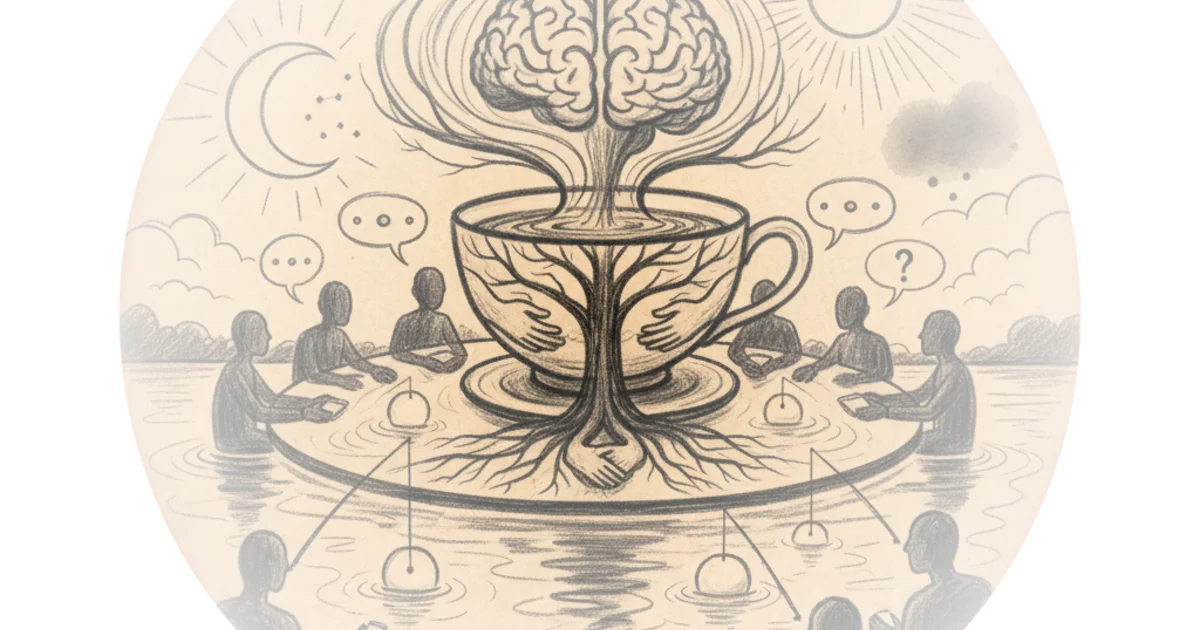
Harry Brighouse, a philosophy professor who helped facilitate the dinners, captures this nuance perfectly when he states, "You don't win a deliberation. That's not the point." The goal, he explains, is twofold: "to come to a better understanding of the thing you are discussing, and get closer to the truth about it" and "to come to a better understanding of the ideas of the people at the table around you." This reframing is crucial. It shifts the metric of success from persuasion to comprehension, a subtle but radical shift in how we approach conflict.
The program's design intentionally mirrors the Socratic method's emphasis on inquiry over assertion, yet it adds a layer of communal safety often missing in ancient philosophy. By selecting students for political diversity and placing them in small groups of ten with faculty facilitators, the organizers created a microcosm of a healthy polity. The result was unexpected depth; Brighouse recalls a session on marijuana legalization where he "was surprised by how rich and deep the discussions were that I heard." Instead of a predictable consensus, students "were able to seriously entertain the side that they opposed and think through the thing that they disagreed with."
"You can teach a class well, but you can't guarantee that there will be political disagreement or diversity in a classroom."
This observation highlights a structural failure in standard higher education. The piece argues that while classrooms are theoretically diverse, they rarely function as such for difficult topics. The Deliberation Dinners filled this gap by making the "Chatham House Rule" a central norm—a practice borrowed from the Royal Institute of International Affairs in 1927, which ensures that comments can be reported but not attributed. As one student participant noted in the text, this rule effectively means: "Don't be a gossipy bitch." While the phrasing is informal, the mechanism is serious; it removes the fear of social retribution, allowing students to explore ideas without the pressure of defending a permanent identity.
The Pedagogy of Malleability
The most compelling evidence of the program's success comes not from the facilitators, but from the students themselves. Teresa Nelson, the intern who documented the experience, admits that before the dinners, she believed "it was a sign of intelligence to have a finalized stance on political issues." After months of deliberation, her perspective shifted dramatically: "Now, after these dinners, I think it is acceptable to have a malleable opinion, and to lend an open mind to opposing viewpoints. I'd even say it's wise."
This evolution challenges the modern assumption that certainty is a virtue. The piece suggests that the ability to hold a "malleable opinion" is actually a higher-order cognitive skill. Brighouse observed this transformation in real-time, noting that students "didn't feel like they had to have everything exactly right in order to say it." The anxiety of being judged was "pretty well undermined" early in the process, replaced by a space where "people were thinking properly."
Critics might argue that this approach is too idealistic, relying on a curated group of students who are already willing to engage. They might question whether this model can scale to a polarized public sphere where bad faith actors dominate the conversation. However, the piece counters this by emphasizing that the "norms" were the key variable. The simple act of agreeing to "Presume positive intentions" and "Aim for shared participation" created a container strong enough to hold difficult topics like abortion and gun laws without devolving into the "family Thanksgiving" chaos that often plagues such discussions.
The use of custom-made background readings also deserves attention. The editors note that "custom-made background readings can be a very powerful pedagogical tool," contrasting them with primary sources which are often "not written for pedagogical purposes." By priming students with arguments that encourage "even-handed thinking," the program scaffolded their ability to engage with complexity before the conversation even began. This suggests that the failure of public discourse may not be a lack of intelligence, but a lack of preparation.
Bottom Line
The strongest part of this argument is its rejection of the "winner-take-all" mindset in favor of a collaborative search for truth, proving that civil discourse is a learnable skill rather than an innate talent. Its biggest vulnerability lies in scalability; while the intimate, facilitated dinner model works for 120 students, replicating this level of trust and safety in a national digital arena remains an unproven challenge. Readers should watch for the upcoming evaluation data mentioned in the piece, which will determine if these "deliberative muscles" persist once the students return to the unstructured chaos of the wider world.