In the wake of a high-profile assassination, a federal judge has drawn a sharp line between the grotesque celebration of violence and the protected, albeit coarse, realm of political satire. Reason reports on a decision that refuses to let the panic of the moment redefine the boundaries of free speech, even when the target is a corporate titan and the imagery evokes a history of military targeting.
The Ghost of the Iraqi Deck
The piece anchors its analysis in a striking historical parallel. It notes that "In 2003, in connection with the invasion of Iraq, the United States Department of Defense developed a deck of playing cards, titled 'Iraqi Most Wanted,' to help familiarize troops with members of Saddam Hussein's government." The article argues that two decades later, artists James Harr and Comrade Workwear LLC attempted to replicate this format to critique the power of modern healthcare and finance executives. The context is vital: the original deck was a tool of war; the new one was a tool of protest. Yet, the reaction from law enforcement blurred the distinction between a government-issued targeting aid and a citizen's satirical critique.
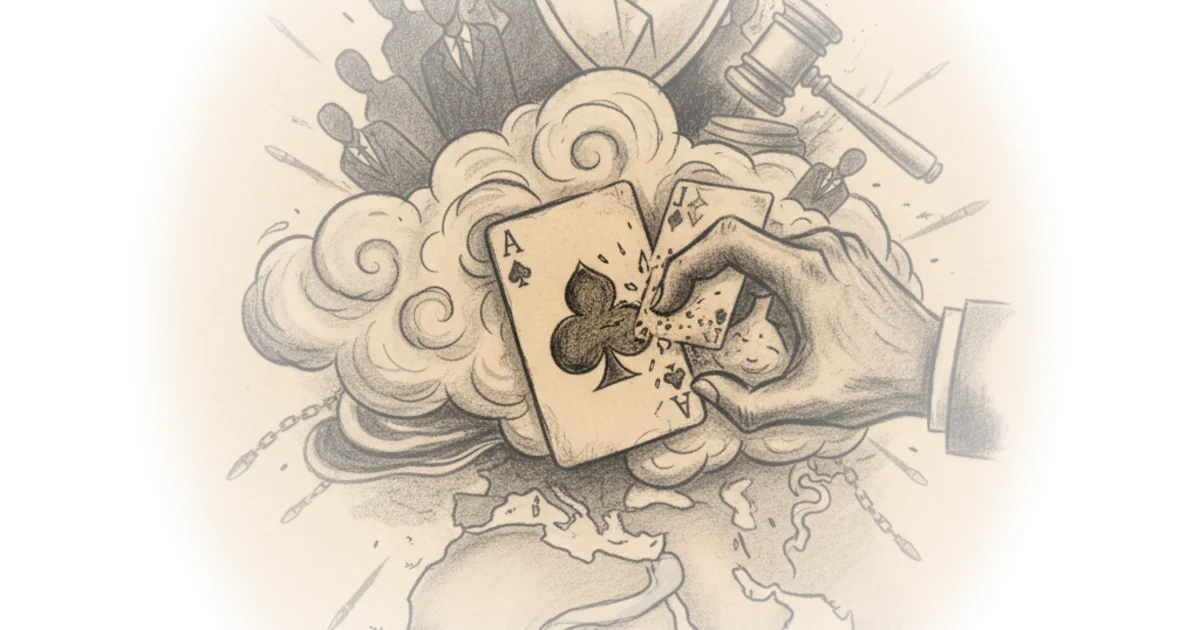
The core of the legal dispute hinged on whether the phrase "The CEO must die" constituted a "true threat." Reason reports that the court concluded the speech did not fall into this exception because it lacked a specific intent to commit unlawful violence. The piece argues that "the playing cards are not enough to convey to a reasonable listener that they were intended as a threat of violence against the 'well-known corporate executive[s]' featured on them." This distinction is crucial. The court recognized that the cards included "educational content about the harm their compan[ies] allegedly caused," transforming a slogan that could be read as a death wish into a broader, albeit aggressive, critique of capitalism.
"If anything, it does the opposite. As for Plaintiffs' statements that purportedly encouraged their social media followers to 'do more' to identify where another healthcare CEO lived, City Defendants' argument is far too speculative to establish it as a serious expression of violent intent."
This rejection of the "true threat" doctrine is the piece's strongest analytical move. It correctly identifies that the phrase "The CEO must die" was directed at an archetype, not a specific individual, and was accompanied by a disclaimer clarifying the intent was to break the structure of capitalism, not to kill a person. Critics might note that in a climate of heightened violence following the murder of Brian Thompson, such rhetoric carries a heavier weight than in calmer times. However, the court's reliance on the objective standard of a "reasonable listener" prevents the law from bending to the anxieties of the moment.
The Limits of Official Speech
The commentary then pivots to a more complex, and perhaps more frustrating, aspect of the ruling: the failure to find a First Amendment retaliation claim. The article details how NYPD Commissioner Jessica Tisch held up a copy of a New York Post article at a press conference, describing the cards as a "hit list" and the creators as "extreme activists." Reason notes that while this speech was damaging, the court found that "criticism of [a speaker] alone does not amount to an adverse action for retaliation purposes."
The piece highlights the court's skepticism regarding the causal link between the Commissioner's words and the subsequent de-platforming of the artists. It points out that the plaintiffs conceded that platforms like Instagram and Shopify acted based on their own internal policies or pressure from banking partners like Mastercard and Visa, not because of a direct order from the police. The court reasoned that "a significant amount of second- and third-order thinking is necessary to find it plausible that Commissioner Tisch's statements... were intended to set off a chain of events ultimately designed to silence Plaintiffs."
This is where the argument faces its steepest climb. While legally sound, the ruling creates a safe harbor for officials to stoke public outrage against speakers, knowing that the resulting private-sector punishment will be legally distant from their own words. The piece observes that "to interpret Commissioner Tisch's constitutionally protected speech as an adverse action would effectively flip the First Amendment on its head." This framing protects the right of officials to speak, but it leaves the artist vulnerable to a coordinated, unofficial silencing campaign that the law struggles to trace.
"Even if the Court credited Plaintiffs' speculative argument that Commissioner Tisch's statements amount to an adverse action, their First Amendment Retaliation claim would fail, nonetheless, because Plaintiffs' theory of causation is supported only by their own conclusory allegations."
The court also dismissed defamation claims, ruling that calling the creators "extreme activists" was non-actionable opinion and hyperbole. The piece notes that under New York law, such derogatory statements are protected as long as they are accompanied by a recitation of facts. This reinforces the idea that in the public square, officials can use inflammatory language to describe political opponents without fear of a lawsuit, provided they can point to some underlying factual basis for their characterization.
Bottom Line
The strongest part of this coverage is its rigorous defense of the "true threat" standard, ensuring that political satire and coarse rhetoric remain protected even when they touch on sensitive subjects like assassination. The ruling's biggest vulnerability, however, is its inability to address the real-world chilling effect of a police commissioner publicly branding activists as violent extremists, which can trigger a cascade of private censorship that the courts are ill-equipped to stop. Readers should watch for how lower courts navigate the gap between official speech and private enforcement in an increasingly polarized digital landscape.