Jordan Schneider doesn't just recount history; he dismantles the comforting myth that the U.S. has always been a master of economic statecraft. The piece's most striking claim is that the current fraying of alliances isn't a new anomaly, but a recurrence of a pattern that collapsed decades ago when Washington tried to enforce a trade embargo that was too severe for its partners to stomach. For busy leaders navigating today's geopolitical friction, this is essential context: the tools of containment are not failing because they are new, but because the coalition required to wield them is as fragile now as it was in 1952.
The Illusion of the Level Playing Field
Schneider opens by exposing the fragility of the post-Cold War consensus. He notes that the era of integration was never guaranteed, pointing to a stark reality: "At the height of the Korean War, the United States maintained a 'China differential' — trade restrictions more severe than those applied to the Soviet Union, enforced in concert with European and Asian partners." This historical pivot is crucial. It reminds us that the U.S. has swung from total engagement to total containment before, and the mechanics of those swings were driven by alliance management, not just ideology.
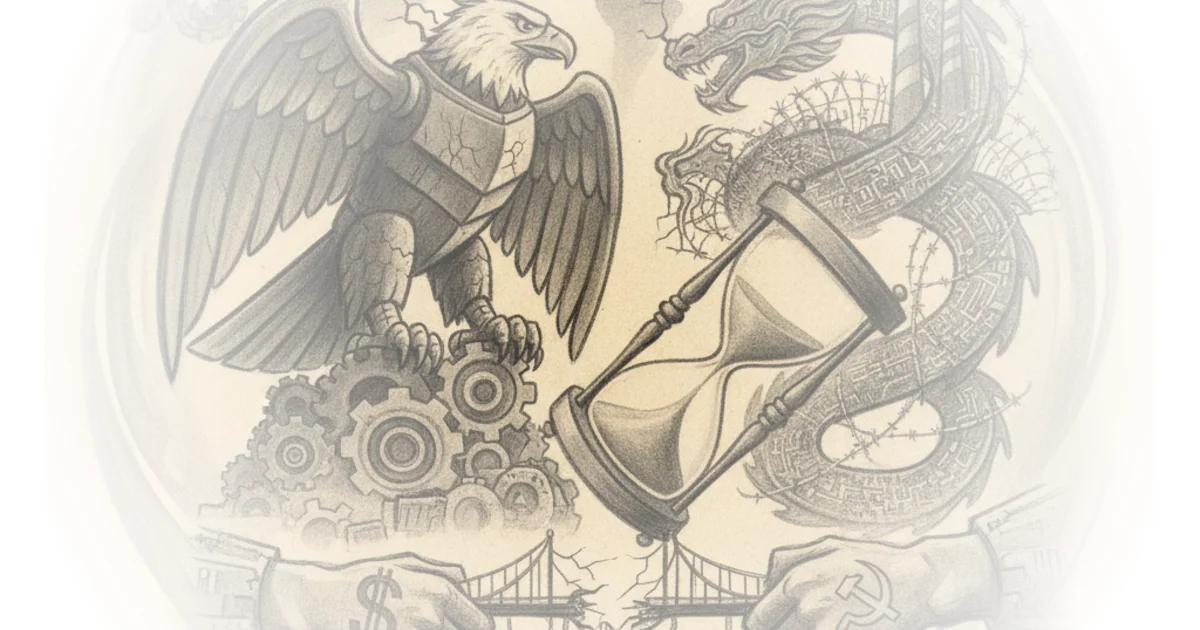
The author argues that the Truman administration's initial strategy, outlined in NSC/41, was actually quite sophisticated. It wasn't about strangling China, but about sowing discord between Beijing and Moscow. Schneider writes, "The document argued against 'severe economic restrictions' against China for four primary reasons." The first was the fear that without British support, the controls would be useless. The second was the counterintuitive insight that maximum pressure might actually "heighten domestic support for the Chinese regime, allowing it to consolidate its grip on power rather than weakening it." This is a vital lesson for today's policymakers: economic coercion can backfire by creating a siege mentality that strengthens the target regime.
The logic of the early Cold War was that economic integration could be a wedge to drive a communist alliance apart, not just a reward for good behavior.
However, the narrative takes a sharp turn with the outbreak of the Korean War. Schneider details how the cautious, nuanced approach of NSC/41 was abandoned for a "maximalist approach." He cites a 1952 decision where COCOM members raised controls on China to be stricter than those on the Soviet Union. This "China differential" was a tactical overreach. As Schneider notes, the U.S. attempted to institutionalize this through the Mutual Defense Assistance Control Act, making aid conditional on following American embargoes. The result? A fractured alliance. The U.S. found itself as the "unilateral enforcer," while allies like Britain and France resisted, arguing that such measures would jeopardize their own economic footholds in Asia.
The Cost of Unilateralism and the Japan Factor
The article's deepest cut comes when it examines the specific economic vulnerabilities of U.S. allies, particularly Japan. Schneider highlights that the U.S. often ignored the fact that its partners had different risk profiles. "Unlike other COCOM's European members, Japan was more dependent on access to Chinese raw materials and less capable of transshipping goods to China through the Eastern bloc," he explains. The numbers are staggering: 18 percent of Japanese exports went to China, and 25 percent of imports came from there.
Schneider points out that the U.S. leveraged its military occupation to force Japan into compliance, but this created a "long-run economic problem." The pressure to cut ties with China forced Japan to look elsewhere for resources, a dynamic that the Selden Map of 17th-century trade routes helps visualize. Just as historical trade routes were complex and interdependent, the modern supply chain cannot be severed without severe self-inflicted wounds. Schneider writes, "Japanese self-reliance also served as justification for U.S. military involvement in Southeast Asia," linking economic policy directly to the escalation of conflict in Vietnam and beyond. This connection is often missed in modern analyses that treat trade policy and military strategy as separate silos.
Critics might argue that the U.S. had no choice but to impose the "China differential" given the immediate threat of the Korean War. While the security threat was real, Schneider's evidence suggests that the degree of the restriction was the error. The Joint Chiefs of Staff later expressed "grave concern" that security issues were being presented as commercial ones, fearing that relaxing trade could lead to negotiated settlements with the Soviets. Yet, the intelligence community was already seeing the cracks: "a growing belief among the allies ... that there were substantial prospects for a relaxation of tensions." The U.S. insistence on maximalism was out of step with the geopolitical reality.
The Fracture of the Sino-Soviet Alliance
Perhaps the most ironic twist in Schneider's narrative is how the very policies meant to contain China inadvertently accelerated the split between Beijing and Moscow. He draws on Shu Guang Zhang's work to show that China's "lean-to-one-side" strategy was fraught with Soviet underperformance. Stalin, worried about the burden on the Soviet economy, urged China to lower growth projections, while Moscow delayed military equipment and vetoed industrial projects.
Schneider writes, "Soviet underperformance as an economic partner weighed heavily on Chinese decision-making." The U.S. embargo, by cutting off Western trade, forced China to rely entirely on the Soviets, who then exploited that dependency. This dynamic eventually drove the two communist giants apart, but not in the way the U.S. initially planned. The "China differential" didn't just fail to weaken China; it pushed China into a desperate reliance on a partner who was already failing them. This historical lesson is a stark warning for current containment strategies: if the U.S. cuts off all alternatives, it may simply force the target into a deeper, more volatile dependency on a rival, or worse, force them to innovate a path of self-sufficiency that the U.S. cannot block.
The U.S. containment strategy often assumes that economic pressure will force a regime to collapse, but history shows it often just forces a regime to find new, harder-to-reach partners.
Bottom Line
Schneider's strongest contribution is his demonstration that the "China differential" was a policy failure born of ignoring the commercial realities of allies, a mistake that is being repeated today. The piece's biggest vulnerability is its heavy reliance on declassified documents from the 1950s, which may not fully capture the complexity of modern, deeply integrated global supply chains. However, the core warning remains urgent: economic statecraft without a unified coalition is not a strategy; it is a liability. The reader must watch for whether the current administration can learn from the 1952 lesson that maximum pressure without maximum consensus leads to strategic isolation.