Dave Borlace cuts through the diplomatic fog of COP30 with a brutal simplicity: the global climate summit is a masterclass in distraction, meticulously avoiding the one thing that actually matters. While world leaders trade platitudes about innovation and adaptation, Borlace exposes a glaring omission in the official rhetoric—a complete silence on oil, gas, and coal. This isn't just a critique of a speech; it is an indictment of a system designed to delay the inevitable by selling us a future that never arrives.
The Gasoline Analogy
Borlace opens with a thought experiment that strips away the complexity of climate science to reveal a stark reality. He asks us to imagine a forest fire where technologists promise bigger drones that don't exist yet, while a child points out men pumping gasoline directly onto the flames. "Don't worry, say the technologists. We're developing a variety of much bigger drones that will do a much better job," Borlace writes, noting that these machines are often just prototypes or drawings. The analogy is effective because it exposes the absurdity of betting on unproven technology while actively fueling the crisis.
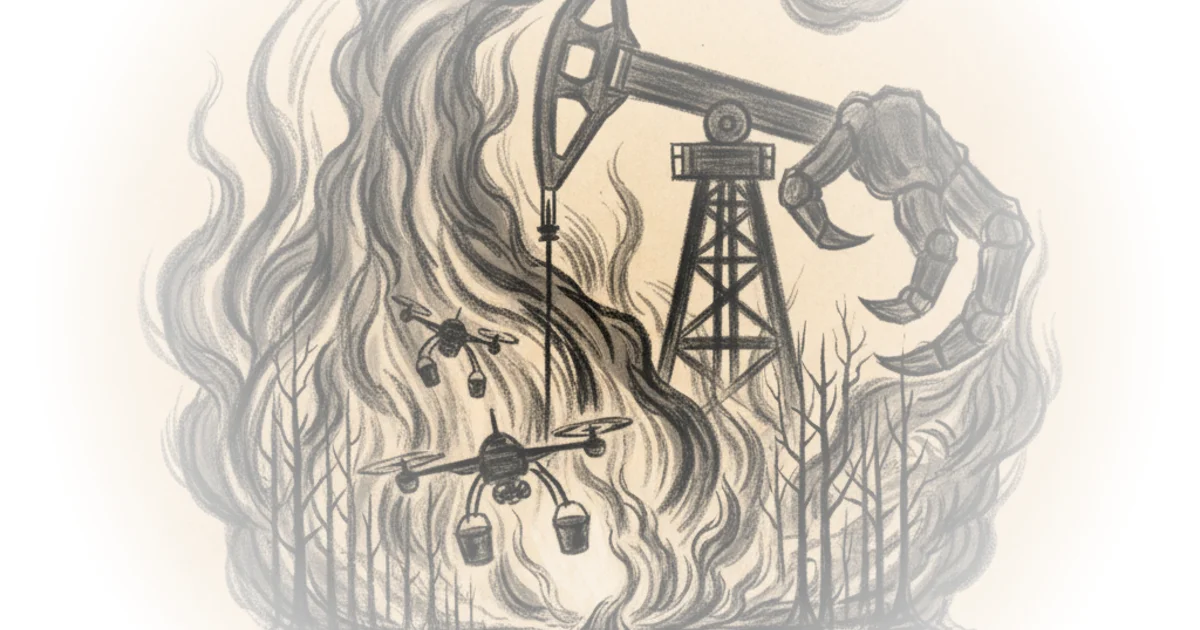
He argues that the root cause of the climate predicament is not as complicated as the conference proceedings suggest. "The root cause of and solution to our climate predicament really isn't much more complicated than that analogy suggests," he asserts. This framing forces the listener to confront the disconnect between the urgency of the crisis and the sluggishness of the proposed solutions. It is a sharp rebuke of the techno-optimism that often dominates these discussions.
The Silence of the Fossil Fuels
The core of Borlace's investigation focuses on the official letter from COP30 President Andre Arana Koha. Despite the document's length and flowery language about cooperation and justice, it contains a deliberate void. "In the entire 10-page, 5,000-word document, you will not find a single mention of the words oil or gas or coal," Borlace points out. He notes that the phrase "fossil fuels" appears only once, buried in a sentence so ambiguous it seems accidental.
This omission is not an oversight; it is a strategy. Borlace suggests that the leaders are being led by "a bunch of busy fools" or perhaps something more calculated. The absence of specific terminology allows for a narrative of progress that ignores the primary driver of the problem. Critics might argue that focusing on specific fuels distracts from broader systemic issues like land use or methane leakage, but Borlace's evidence suggests that avoiding the source of the emissions is the primary goal of the fossil fuel lobby.
The Illusion of Progress
Borlace turns his attention to the narrative of success being pushed by political leaders and figures like Bill Gates. They claim that the world has made significant strides since the 2015 Paris Agreement, reducing projected warming from over four degrees to a range of 2.1 to 2.8 degrees. "Significant collective progress towards the Paris Agreement temperature goal has been made," Borlace quotes the COP president. He then dismantles this optimism by comparing it to a nuclear reduction: "Saying the world has gone from four degrees of projected warming to somewhere between 2 and 3° is a bit like saying we've reduced our nuclear arsenal from 40,000 warheads to only 20,000."
The author highlights that while the numbers have improved, the remaining risk is still catastrophic. He scrutinizes the data, noting that the range of possible outcomes is wide and that there is only a 66% chance of staying within the current projections. "It's by no means a given," he warns. Furthermore, he points out that scientists are finding the climate is responding faster than models predicted, nudging us toward the higher end of these dangerous ranges.
The Cost of Denial
The commentary shifts to the human and economic costs of inaction, challenging the idea that we simply lack the resources to solve the crisis. Borlace cites the Lancet's 2025 report, which reveals that delays in climate action are causing millions of avoidable deaths annually. He contrasts this with the trillions being poured into fossil fuel subsidies. "15 countries even allocated more funds to net fossil fuel subsidies than to their national health budgets," he notes. This statistic underscores a perverse prioritization where governments are actively harming their populations to protect an industry.
He also addresses the influence of misinformation, pointing out that Bill Gates has donated to think tanks run by climate skeptics. "Gates himself, via the Gates Foundation, has... donated $3.5 million in recent years to a think tank run by a man called Bjorn Lomborg, who the DMOG team describe as a climate crisis denier," Borlace writes. This connection suggests that the narrative of "not enough money" is a smokescreen for the influence of the fossil fuel industry. The argument is compelling because it links financial flows directly to the erosion of political will.
The Distraction Strategy
As the piece concludes, Borlace synthesizes these points into a damning verdict on the COP process. He suggests that the goal of fossil fuel lobbyists has been to "distract, delay, obfuscate, and confuse the messaging around the need for an urgent and rapid reduction in the combustion of coal, oil, and methane gas." He argues that this strategy has been "very successfully achieved" in the face of a political landscape dominated by nostalgia for the fossil fuel era.
The goal of the mighty fossil fuel lobbyists to distract, delay, obfuscate, and confuse the messaging around the need for an urgent and rapid reduction in the combustion of coal, oil, and methane gas has been very successfully achieved.
Borlace acknowledges that the geopolitical environment, particularly with the return of pro-fossil fuel leadership in the US, fuels cynicism. However, he pivots to a final, hopeful note grounded in market reality. He argues that if subsidies are stripped away, renewables backed by storage will inevitably win the marketplace. The market forces, he implies, are the only thing that can break the political deadlock.
Bottom Line
Borlace's strongest asset is his ability to translate complex climate data and diplomatic maneuvering into a clear, moral narrative about gasoline and fire. His argument is most vulnerable where it relies on the assumption that market forces will inevitably override political inertia, a transition that history shows is rarely smooth or fast. The reader should watch for the next round of NDC submissions to see if the silence on fossil fuels finally breaks or if the distraction continues.