Andrew Henry delivers a rare, grounded look into one of America's most misunderstood religious practices, stripping away the sensationalism to reveal a complex theology of literal obedience. Rather than treating snake handling as a bizarre curiosity, he frames it as the logical endpoint of a specific theological trajectory that mainstream Christianity abandoned long ago. This is essential listening for anyone who wants to understand how faith can demand physical risk without losing its internal logic.
The Theology of Literalism
Henry begins by anchoring the practice in the Gospel of Mark, where Jesus promises that believers will pick up snakes and drink deadly things without harm. He notes that while most Christians interpret these verses metaphorically or ignore them entirely, a small group in the Appalachian Mountains takes them as a non-negotiable checklist for salvation. "They handle live venomous snakes during worship as a demonstration of faith, believing that if the Bible says true believers will pick up snakes, then doing so is a test and testimony," Henry writes. This framing is crucial because it shifts the narrative from recklessness to rigorous devotion.
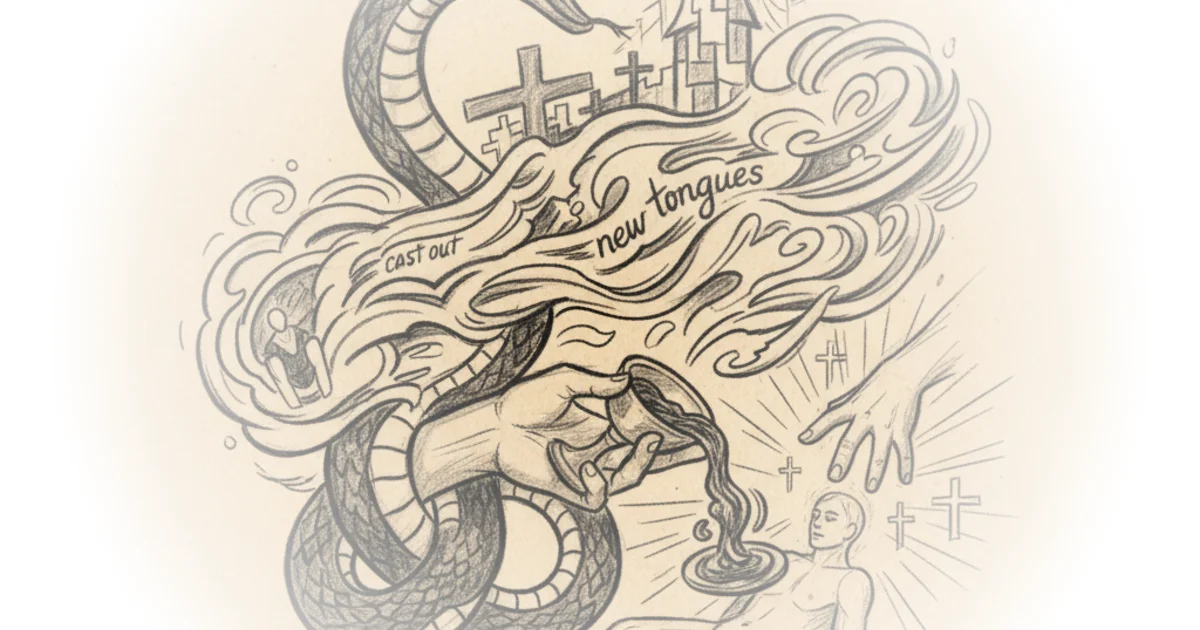
The author effectively contrasts these small, independent congregations with the massive, global Pentecostal denominations that have explicitly rejected the practice. He points out that while the Assemblies of God and the Church of God in Christ have millions of members, "neither of them recognize these snake handling churches." This distinction highlights a fascinating fracture within American Christianity: the tension between institutional growth and radical literalism. As Henry observes, "Pentecostal leaders have disavowed snake handling for decades, and they do not consider it an acceptable form of worship." The practice survives only in the margins, in about a hundred independent churches, largely because it refuses to be smoothed over for public consumption.
"It's like you to take up death in your arms and just hold it there and not worry about it."
The Physiology of Faith
One of the most compelling sections of Henry's coverage is his exploration of what is actually happening in the bodies of these worshippers. He moves beyond the question of whether they are in a trance to examine the biological reality of their experience. Citing research by scholars Ralph Hood and W. Paul Williamson, Henry explains that the state of "anointing" involves a "culturally learned, physiologically real state of focused disassociation." This is not a loss of control, but a highly specific, trained response.
He details studies showing that during these moments, handlers experience "huge spikes in adrenaline, endorphins, and cortisol, suggesting that what worshippers called the anointing is accompanied by a full body chemical rush that blunts fear and pain." This evidence is powerful because it validates the worshippers' subjective experience without necessarily proving the supernatural claim. It suggests that the human body is capable of generating a profound physiological shield when belief is absolute. Critics might note that this biological explanation risks reducing a spiritual mystery to mere chemistry, yet Henry balances this by emphasizing that the believers remain fully aware and engaged, even in the face of mortal danger.
The stakes, however, are undeniably high. Henry recounts the grim reality that "sometimes people are bitten," and when they are, the service shifts from ecstatic worship to a desperate plea for divine healing. He quotes a handler who, while being attacked, said, "Through these serpent bites, he'll take care of us. Don't worry about me. Don't cry over me when I leave this world. Rejoice. I'm going to be with Jesus." This moment captures the terrifying sincerity of the practice: for these believers, death is not a failure of faith, but a potential confirmation of it.
From Revival to Routinization
To understand why this practice exists where it does, Henry traces its lineage back to the Second Great Awakening and the Holiness movement. He identifies George Hensley, a "former moonshiner turned holiness preacher," as the figure who codified the practice in 1914. Hensley's conviction that the promises of Mark 16 were literal sparked a regional sensation, with early reports noting that "several handled it and no one was injured by them." This historical context is vital; it shows that snake handling was not an ancient tradition but a radical innovation born of a specific moment in religious history.
Henry then applies the sociological concept of "routinization of charisma" to explain why the practice died out in mainstream Pentecostalism. As these movements grew larger and sought legitimacy, they had to shed their most chaotic elements. "The more radical edges get smoothed out so the movement can survive and gain legitimacy," Henry explains. The snake handlers, by contrast, refused to compromise. They remained committed to the idea that "the church stands for the whole Bible rightly divided and it is wrongly dividing to cut out the tongues and serpents." This refusal to adapt is what keeps the practice alive today, even as it remains illegal in almost every state.
Bottom Line
Andrew Henry's strongest contribution is his refusal to mock the snake handlers, instead treating their literalism as a consistent, albeit extreme, theological position. His biggest vulnerability lies in the inherent difficulty of verifying the supernatural claims that drive the practice, though he wisely sidesteps this by focusing on the human experience rather than the divine outcome. Readers should watch for how this small, marginalized group continues to challenge the broader definition of what it means to be a faithful Christian in America.