Devin Stone exposes a terrifying disconnect between federal narrative and forensic reality in Chicago, arguing that the Department of Homeland Security weaponized the justice system to cover up a botched enforcement operation. The author's most startling claim is not just that an innocent citizen was shot five times, but that the federal government initially prosecuted her for the very act of being targeted, relying on a fabricated story of a "convoy" attack that video evidence completely dismantles.
The Architecture of a False Narrative
Stone begins by dismantling the official story released by the Department of Homeland Security (DHS) regarding "Operation Midway Blitz." The administration framed the Chicago operation as a surgical strike against violent criminals, yet the reality on the ground was a broad net cast over construction workers and nannies. As Stone observes, "Secretary Christine Owen said they were going after the worst of the worst... most of the people swept up had no criminal record at all." This gap between rhetoric and execution set the stage for the confrontation involving Maramar Martinez. The author notes that while honking at federal agents is protected speech under the First Amendment, the administration's response escalated instantly to lethal force and criminal charges.
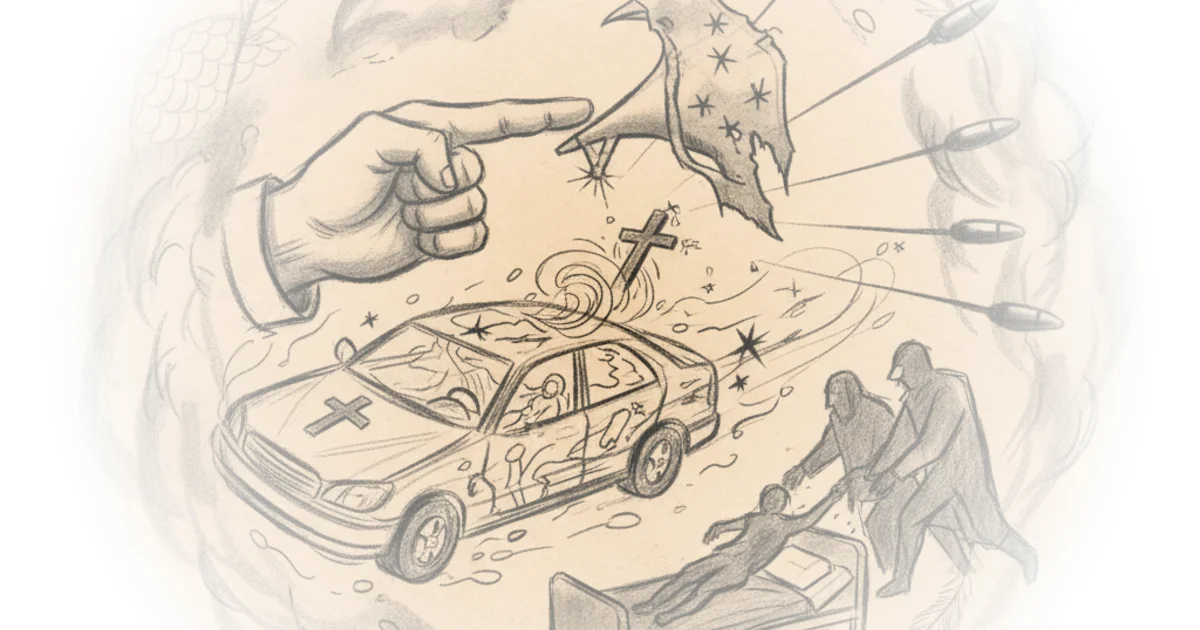
The government's initial criminal complaint painted a picture of a coordinated ambush. An FBI agent testified that a "convoy of civilian vehicles followed the Tahoe closely... culminating in the Martinez vehicle and the Ruiz vehicle, driving into and striking the CBP vehicle." Stone points out the immediate red flag in this narrative: the DHS claimed agents were "boxed in by 10 cars," a detail that would justify a massive defensive response. However, the author highlights how quickly this narrative crumbled under scrutiny. "The ICE agent's story about getting boxed in and rammed by a convoy of 10 cars didn't really add up," Stone writes. This is a crucial pivot in the piece; it shifts the reader's focus from a potential crime by citizens to a potential cover-up by the state.
The counterrevolution will definitely be televised.
This observation by Stone regarding the slick, self-congratulatory videos posted by Customs and Border Protection commander Greg Bavino underscores the performative nature of the operation. It suggests that the administration was more concerned with projecting an image of dominance than adhering to the rule of law. The subsequent failure of the prosecution reveals that the initial charges were likely a reflexive attempt to punish dissent rather than a genuine pursuit of justice.
Forensic Evidence vs. Federal Testimony
The core of Stone's argument rests on the physical evidence that contradicted the sworn testimony of federal agents. When the defense requested the vehicle involved in the alleged ramming, the government claimed it was a personal vehicle and had already returned it to Maine. Stone notes the absurdity of this: "The third car, the one that had supposedly been rammed from both sides, was clear across the country." This logistical failure forced the Justice Department to admit the vehicle was, in fact, government property, leading to a court order to retrieve it on a flatbed truck.
Once the evidence was available, the government's story fell apart completely. Body camera footage showed the street was empty seconds after the alleged collision, and the agents were never actually boxed in. Stone highlights a chilling detail from the agent's own voice: "It's time to get aggressive and get the [expletive] out because they're trying to box us in." The author argues this proves the agent initiated the contact. "Exom told the FBI officials who interviewed him that he sideswiped Martinez's car to make space," Stone writes, directly contradicting the claim that Martinez drove into him. The damage to Martinez's car was on the rear passenger side, consistent with being struck from behind or the side, not a head-on collision.
The situation deteriorates further when examining the agent's internal communications. Stone reveals that Agent Exum bragged in a group chat about the shooting, saying, "I fired five rounds and she had seven holes. Put that in your book, boys." This admission confirms the agent fired through the vehicle's side while Martinez was driving away, not toward him. Stone's analysis of these texts is devastating: "Those are what we call bad facts. and agent exam was going to be an absolutely terrible witness." The author effectively uses these internal messages to demonstrate a culture of impunity within the agency, where lethal force is treated as a game rather than a last resort.
Critics might argue that the chaos of a street confrontation makes real-time decision-making difficult for officers, and that the initial charges were a good-faith attempt to address a perceived threat. However, Stone counters this by pointing to the sheer volume of contradictory evidence that was ignored by the initial prosecutors. The fact that the charges were dropped only after the defense exposed the lies suggests the initial filing was reckless at best and malicious at worst.
The Chilling Effect on Civic Engagement
The implications of this case extend far beyond the individuals involved. Stone connects this incident to the broader "surveillance state being secretly constructed by the Department of Homeland Security to spy on American citizens." The author notes that the government attempted to silence Martinez by labeling her a "domestic terrorist" and claiming she had doxed agents, despite evidence that she had done no such thing. This tactic mirrors the aggressive legal strategies seen in other recent enforcement sweeps, creating a climate where citizens fear exercising their rights.
The piece draws a parallel to the concept of qualified immunity, where agents are often shielded from the consequences of their actions. Stone writes, "The case against Martinez and Ruiz wasn't the only one the Justice Department failed to prosecute. In fact, the Justice Department either lost or walked away from almost every non-immigration case it filed in Chicago." This pattern suggests a systemic issue where the executive branch is willing to file charges without a solid evidentiary basis, betting that defendants will not have the resources to fight back. The fact that Martinez had to sue to get the truth out highlights the failure of the standard judicial process to correct these errors in real-time.
The danger to the community was not Ms. Martinez; it was the federal agents who fired five shots at a woman driving away from them.
This editorial judgment by Stone encapsulates the moral failure of the operation. The legal system eventually corrected the record, dropping the charges and releasing the defendants, but the physical and psychological toll on Martinez was already done. She was shot five times, dragged from a hospital bed, and held in custody while her accusers remained free. The author's focus on the human cost of these bureaucratic failures serves as a stark reminder of the stakes involved in unchecked executive power.
Bottom Line
Devin Stone's commentary is a masterclass in forensic legal analysis, using video evidence and internal communications to dismantle a federal narrative that relied on fear and fabrication. The strongest part of the argument is the irrefutable proof that the agent initiated the violence, turning a story of "self-defense" into one of unprovoked aggression. The piece's biggest vulnerability is its reliance on the eventual dropping of charges as the only check on this power, leaving the question of whether accountability for the agents themselves will ever truly arrive. Readers should watch for the outcome of Martinez's civil suit, which will test whether the legal system can hold the Department of Homeland Security financially responsible for its errors.