Brad DeLong reframes the entire debate on artificial intelligence not as a race to build a silicon god, but as a crisis of human interface with our own collective history. In a landscape saturated with dystopian panic, he offers a startlingly humanist thesis: the true 'super-intelligence' we must master is the five-thousand-year-old 'Anthology Super-Intelligence' of human knowledge, and the liberal arts are the only reliable operating system for it.
The Original Toolkit for the Free Mind
DeLong begins by stripping away the modern mystique of the university to reveal a pragmatic, almost survivalist origin story. He argues that the 'artes liberales' were never about vague self-expression or elite posturing. Instead, they were the essential toolkit for the 'free man'—a specific historical figure who possessed no land, no inherited office, and no corporate privilege, yet had to navigate a complex society solely through his wits.
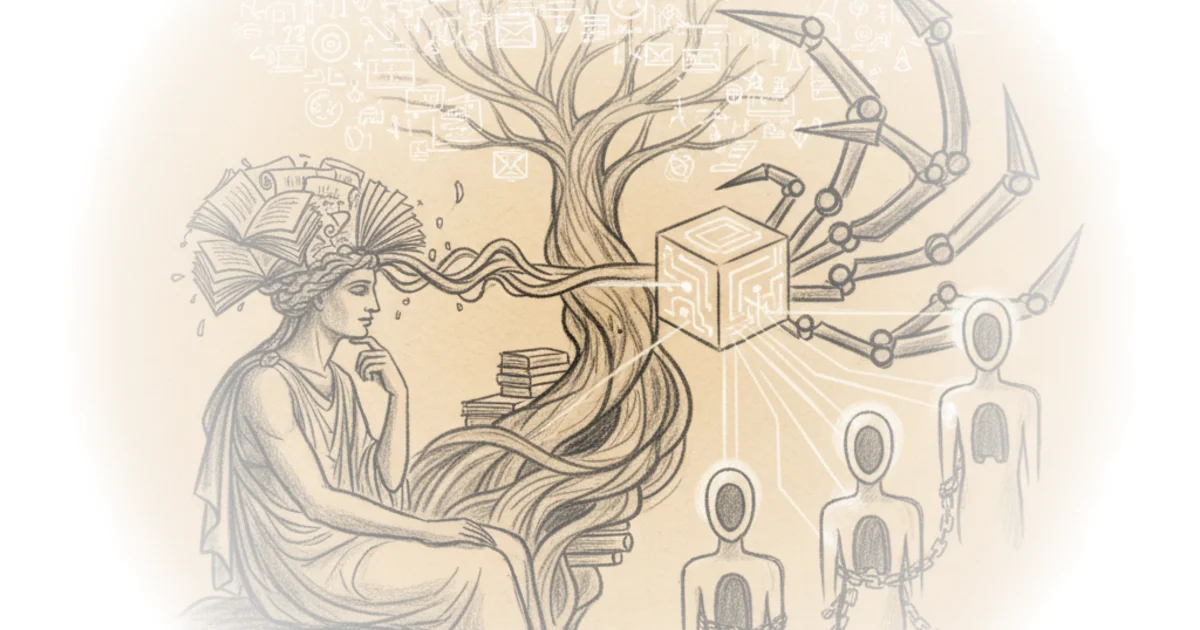
"Ars is skill. Liber is free. The artes liberales—the liberal arts—were, at their origins, not high-minded exercises in self-expression or vague 'critical thinking,' but rather the skills appropriate to a free man," DeLong writes. This definition is crucial because it shifts the focus from what the educated person is to what they must do. They were the skills required to survive and thrive in an institutional world where your only capital was your ability to process information.
The author maps this ancient curriculum directly to the modern need for cognitive independence. The 'Basic Three' of logic, grammar, and rhetoric were not abstract exercises; they were the methods for constructing arguments, reading with precision, and persuading others face-to-face. The 'Next Four'—arithmetic, geometry, astrology (forecasting), and harmony—were the tools for quantifying and modeling the world. DeLong suggests that the thread connecting these disparate fields is not a war between STEM and humanities, but a unified strategy for accessing the 'storehouse of human knowledge we East African Plains Apes have collectively built up since the invention of writing 5000 years ago."
The liberal arts, properly understood, are the skills needed to interface with this Anthology Super-Intelligence—to query it, update it, criticize it, extend it, and carry it forward.
This framing is particularly effective because it bypasses the tired 'skills gap' rhetoric. It posits that education is not about stuffing facts into a brain, but about training the brain to be a 'good front-end interface node' for society's vast distributed system. A counterargument worth considering is whether this high-level abstraction ignores the immediate, vocational pressures facing modern students who need specific trade skills to pay rent. However, DeLong's point is that without the underlying cognitive architecture, those specific skills become brittle in a rapidly changing economy.
The Metabolic Cost of Isolation
To illustrate the fragility of the individual mind cut off from the collective knowledge stack, DeLong turns to a grim case study from the reality show 'Naked & Afraid.' He uses the physical collapse of participants Melissa Miller and Chance Davis in the Ecuadorian Amazon to demonstrate a physiological truth: human survival is not about rugged individualism, but about being plugged into a deep reservoir of tools and social organization.
When stripped of modern infrastructure, even highly competent individuals face 'rapid metabolic catastrophe.' DeLong details how Miller, a nature expert, lost seventeen pounds in three weeks, while Davis, a former Army Ranger, lost thirty-two and suffered a psychological break. "The experience of caloric deprivation without sufficient fat resources seriously messed with his head," he notes, highlighting how hunger drove Davis to binge-eat 7,800 calories a day upon return.
The lesson here is stark. "When you are forced to reinvent fire, metallurgy, agriculture, and epidemiology from scratch, you do not get a heroic age of rugged individualism. You get starvation and infectious disease." This analogy serves as a powerful metaphor for the cognitive danger of disconnection. Just as a human body cannot survive without the 'infrastructure' of tools and social knowledge, a modern mind cannot function without the 'Anthology Super-Intelligence' of human history.
Critics might argue that comparing a reality TV stunt to the existential threat of AI is a category error, but DeLong's point is about the dependency on the collective. The show proves that without the 'knowledge stack,' the human organism is terrifyingly close to the edge. This reinforces his argument that the goal of education is to ensure we remain 'very ordinary brains plugged into very large, very deep, collectively constructed reservoirs of knowledge and practice.'
The Real ASI and the Danger of the Copy-Paste
DeLong then pivots to the contemporary moment, demystifying the hype around Artificial Super-Intelligence. He dismisses the fear of a 'silicon god' awakening in a data center as a 'distracting fantasy.' Instead, he urges us to recognize the 'Anthology Super-Intelligence' we already inhabit. "No individual human—not Aristotle, not Newton, not von Neumann, not, heaven help us, Elon Musk—is remotely smart enough to think through more than a tiny sliver of the world from first principles," he writes.
In this view, modern AI tools like large language models are simply a new interface layer on top of this ancient knowledge stack. They lower the cost of search and synthesis, acting as an 'aggressive reduction in the cost of looking things up.' But DeLong draws a sharp line between using AI as a tool and letting it replace the user's cognitive labor. "Using 'AI' as a way to get yourself out of the loop—to take whatever comes into your machine and copypasta it as your thoughts and conclusions is terrifyingly destructive to your ability to be a Magister Artium Liberalium," he warns.
The core of his argument is that the liberal arts are evolving. Prompt design, verification, and the ability to detect hallucinations are becoming the new 'logic, grammar, and rhetoric.' We are in the early days of a shift where 'knowing how to ask the right question of the machine, and how to check the answer' joins 'knowing how to read a difficult text' as a basic skill. The danger lies in the temptation to let the machine do the thinking, which would leave us hollowed out and unable to function as free people.
Our machines will assist us, or they will hollow us out. This course is an attempt to figure out how our educational institutions need to shift to help us accomplish the first, and not the second.
This distinction is the piece's most vital contribution. It moves the conversation from 'will AI take our jobs?' to 'will AI take our minds?' By framing the issue as one of 'client design' for the human brain, DeLong provides a clear mandate for education: train students to be intelligent clients in a vast system, not passive subjects of algorithmic governance.
Bottom Line
DeLong's strongest move is redefining the 'Anthology Super-Intelligence' as the true collective mind of humanity, making the liberal arts the essential interface for survival in an AI-driven world. His biggest vulnerability is the assumption that educational institutions are capable of making the rapid, structural shifts he demands before the 'hollowing out' becomes irreversible. The reader should watch for how universities actually operationalize 'prompt design' and 'verification' as core liberal arts skills, rather than treating them as optional add-ons.