This piece from Sarah Longwell, Tim Miller, and Bill Kristol delivers a chilling warning wrapped in a hypothetical scenario: a coordinated, drone-fueled blackout on American soil that leaves the nation paralyzed just as a foreign power invades Taiwan. It is not merely a story about a fictional attack; it is a forensic audit of how the FBI's counterintelligence capabilities are being dismantled at the very moment they are most needed. The authors argue that the current administration's reorientation of the bureau away from foreign spies and toward immigration enforcement has created a vulnerability that adversaries are actively exploiting, a claim that demands immediate attention from any reader concerned with national security.
The Cost of Diversion
The authors begin by constructing a terrifying "what if" based on a 2024 RAND Corporation study, illustrating how a foreign adversary could mask state-directed sabotage as domestic extremism. They write, "This scenario—hypothetical, but based on very real fears—is laid out in a 2024 RAND Corporation study modeling how America's enemies could mask state-directed attacks as the work of extremists or criminal groups." This framing is effective because it moves the threat from the abstract realm of cyber-warfare to the concrete reality of power grids and hospitals going dark. The narrative suggests that the chaos of domestic strife is not just a political inconvenience but a strategic opening for enemies to strike.
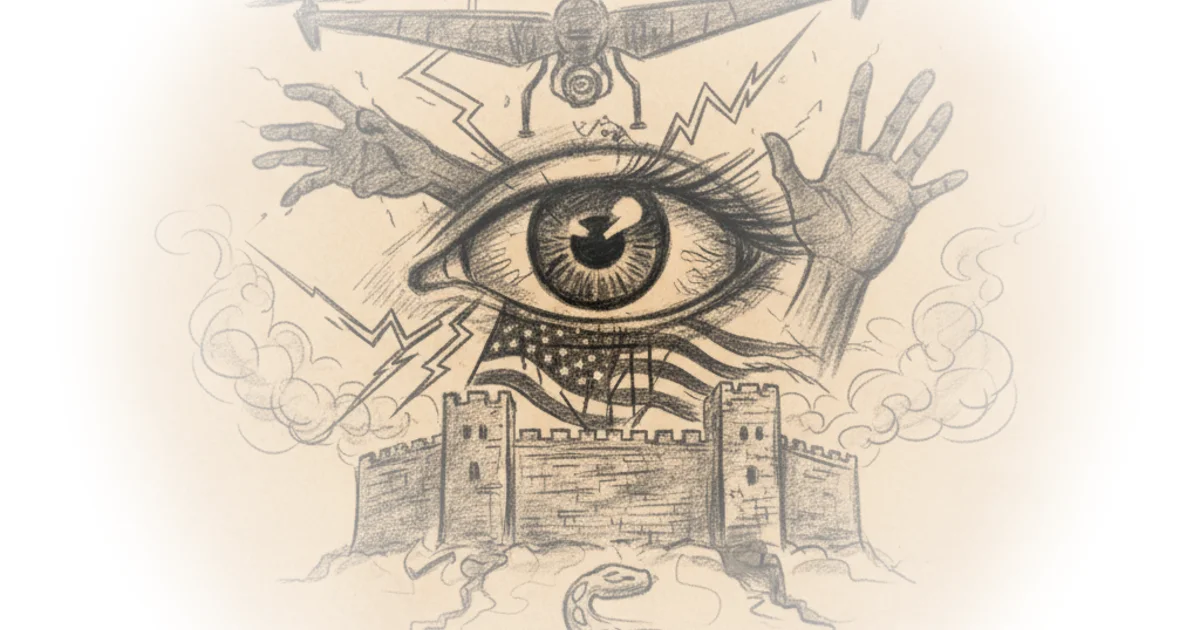
The core of their argument rests on the assertion that the FBI is being systematically weakened. They point out that under Director Kash Patel, the bureau has reassigned nearly a quarter of its agents to immigration enforcement, a task that falls outside its traditional purview. As Sarah Longwell, Tim Miller, and Bill Kristol note, "Counterintelligence specialists with deep expertise in countries like China, Russia, and Iran are now regularly working immigration cases on a rotating basis." This shift is not presented as a minor administrative tweak but as a fundamental misallocation of resources. The authors argue that this leaves the door open for sophisticated networks of spies to operate with impunity.
"It's a disaster," says Robert Anderson, the head of FBI counterintelligence from 2012 to 2014. "I'm rooting for everybody because we're all Americans, [but] Patel needs to wake up."
The inclusion of this quote from a former counterintelligence chief is powerful because it comes from within the establishment, lending weight to the claim that the current direction is dangerous. The authors bolster this by referencing historical precedents, noting that the FBI only learned to effectively hunt spies after the Robert Hanssen scandal and the 9/11 attacks forced a painful evolution. They remind us that in the late 1990s, the bureau was so focused on criminal investigations that it missed the rise of "asymmetric espionage" from China, a threat that has only grown more aggressive since.
Critics might argue that the FBI's traditional counterintelligence focus has been too narrow, and that a broader mandate including immigration could address domestic radicalization that also poses a security risk. However, the authors counter this by highlighting the sheer scale of the foreign threat, describing China's "thousand grains of sand" approach where thousands of individuals contribute small pieces of intelligence to build a devastating mosaic of U.S. capabilities. They write, "Where you find a McDonald's," Szady says, "you'll find a Chinese spy." While hyperbolic, this quote underscores the authors' point that the enemy is ubiquitous and the current FBI strategy is ill-equipped to handle it.
A Dangerous Precedent
The commentary then shifts to the political maneuvering in Congress, where the House Intelligence Committee is considering a bill to strip the FBI of its leading role in counterintelligence. The authors express deep concern that this would place these critical functions under the Director of National Intelligence, Tulsi Gabbard, an office not bound by the same Department of Justice safeguards. They quote Frank Montoya Jr., a retired FBI agent, who warns, "That's really dangerous... You could be creating a domestic spy agency with even less transparency to the American public."
This section is particularly sharp because it connects the budget cuts and personnel shifts to a broader institutional erosion. The authors draw a parallel to the early 1990s under Director Louis Freeh, when a decentralized approach led to a decade of failures, including the bungled investigation of Dr. Wen Ho Lee. They argue that the current administration is repeating these mistakes. "Today, however, Patel and President Donald Trump are moving toward an earlier strategy—one that failed spectacularly in the early 1990s," they write. This historical comparison serves as a stark warning: the path the administration is on has been tried before, and it ended in disaster.
The authors also highlight the human element of this bureaucratic struggle, noting that many former officials, including lifelong Republicans, share the administration's goal of "depoliticizing" the FBI but fear the methods are destroying the agency's core mission. They quote David Szady, who told a then-Director Mueller that if he focused only on criminal prosecutions of spies, "they're going to eat you alive." This anecdote illustrates the tension between political optics and operational reality, suggesting that the current push for high-profile arrests may come at the expense of preventing future attacks.
"All our work is being destroyed," says Montoya. "It's tragic."
The emotional weight of this quote, coming from a veteran of the field, reinforces the urgency of the authors' message. It is not just about policy; it is about the dismantling of a generation of expertise. The authors suggest that the administration's focus on immigration and the potential shift of counterintelligence authority to the DNI are not just strategic errors but existential threats to national security.
Bottom Line
The strongest part of this argument is its synthesis of historical failure with current policy, demonstrating how the FBI's counterintelligence capabilities are being eroded just as the threat landscape becomes more complex and dangerous. The authors effectively use the voices of former insiders to validate their concerns, making the case that the current administration is repeating past mistakes with potentially catastrophic consequences. However, the piece's biggest vulnerability is its reliance on a hypothetical scenario to drive the narrative, which, while compelling, may allow skeptics to dismiss the immediate urgency. Readers should watch closely for the outcome of the House Intelligence Committee's bill and whether the FBI's budget cuts translate into a measurable decline in counterintelligence operations in the coming months.