Jason Slaughter makes a startling claim that cuts against the grain of North American parenting norms: the greatest threat to a child's independence isn't a stranger in a white van, but the very streets their parents drive them on. By contrasting the bustling, child-centric streets of Amsterdam with the desolate, car-dependent sprawl of his hometown in London, Ontario, Slaughter argues that urban design has engineered a culture of fear that is actively harming the next generation.
The Illusion of Safety
Slaughter opens by dismantling the primary justification parents use for keeping children indoors: the fear of abduction. He notes that while abduction stories fuel anxiety, the statistical reality is that "Canada is one of the safest countries in the world and abductions by strangers are exceedingly unlikely." Instead, he attributes this pervasive fear to a feedback loop of media sensationalism and, more critically, city design that isolates residents.
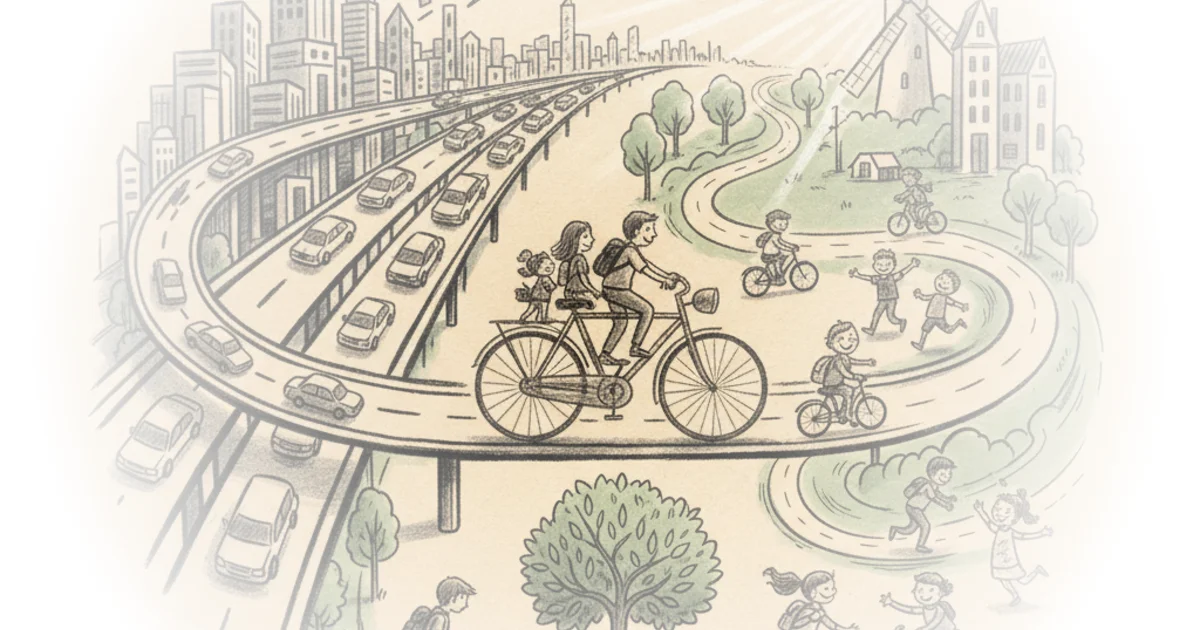
He invokes Jane Jacobs' concept of "eyes on the street," explaining that safety in places like Amsterdam comes from high pedestrian density, whereas "North American style car dependent suburbia is desolate for people outside of a car." The author's observation is sharp and visceral: "I'm almost always the only one out walking and I definitely get the feeling that if something happened to me hundreds of people would drive by without even noticing." This framing is effective because it shifts the blame from individual predators to the structural absence of community.
It shouldn't be too surprising that some parents are uncomfortable having their children walk in an environment like this.
Critics might argue that parental fear is rational regardless of statistics, given that high-speed traffic is a genuine danger. Slaughter anticipates this by distinguishing between the safety of the car occupant and the pedestrian. He points out that while overall traffic fatalities have fallen in developed nations, "pedestrian deaths have increased significantly in the past few decades due to an increase in car traffic, larger trucks and SUVs, distracted driving and higher vehicle speeds." This creates a vicious cycle where parents drive children to avoid danger, thereby adding more cars and making the streets even more lethal.
The Infrastructure of Dependency
The piece moves beyond safety to the sheer impracticality of independent travel in suburban zones. Slaughter highlights that even if parents wanted to let their children walk, "it's either too far or it's not feasible because of a lack of sidewalks." He contrasts the 60 percent of Dutch children who walk or cycle to school with the mere 28 percent in Canada, noting that the Canadian number has plummeted from 58 percent just a few decades ago.
He systematically debunks common excuses used by North Americans, asking, "Did Canada's weather get worse in the past 40 years? Did the hills get higher?" The answer, he asserts, is a resounding no. The real culprit is policy: "we did stop building family-friendly housing anywhere that wasn't car dependent." This is a crucial distinction that many overlook; the problem isn't the climate or the topography, but the zoning laws that make walkable neighborhoods illegal to construct today.
Suburbia may be a good place to shelter toddlers but as soon as a child is more than about six years old being trapped in a McMansion on the edge of town seriously inhibits their growth and independence.
The cultural consequence of this infrastructure is the rise of the "suburban soccer mom," a figure Slaughter describes as a parent who "spends all of her time shuttling her kids around from school to activities to play dates and back." This constant supervision, he argues, is not a natural parenting style but a forced adaptation to an environment where children cannot navigate the world on their own. The result is a generation that is less active and more isolated, with children preferring video games because "outside looks like this."
The Legal Chilling Effect
Perhaps the most damning section of Slaughter's commentary focuses on how urban design has mutated into legal persecution. He recounts the harrowing story of Adrian Crook, a father in Vancouver who allowed his children to take the bus to school alone. Despite the children's competence, Crook was reported to authorities and faced the threat of losing custody.
Slaughter writes, "The ministry decided that children under the age of 10 could not be unsupervised in or outside of the home for any amount of time." He notes that Crook had to spend three years suing the government just to regain the right to let his children have basic independence. This anecdote illustrates a broader trend where "what constitutes adequate supervision is becoming increasingly strict and arbitrarily applied."
You're crazy if you don't think this has a chilling effect that ultimately limits the independence of children in North America.
This legal rigidity creates a paradox: parents are terrified of letting children out because it's dangerous, yet they are also terrified of letting children out because they might be arrested for neglect. Slaughter argues that the solution requires more than just cultural shifts; it demands a fundamental redesign of the built environment. He points out that "walkability is nearly impossible to retrofit on top of car-dependent suburbia," and the few existing walkable areas are "completely unaffordable to most people."
Bottom Line
Slaughter's strongest argument lies in his ability to reframe the "safety" debate, proving that the very infrastructure designed to protect families is actually the primary source of their anxiety and restriction. The piece's biggest vulnerability is its assumption that the Netherlands' model can be easily replicated in North America without addressing the deep-seated political and economic interests that sustain car dependency. However, the verdict is clear: until cities are designed for people rather than cars, the independence of the next generation will remain a casualty of suburban planning.
The solution seemed pretty clear: we moved to the country with the happiest kids in the world.